
S&P 500 Best Week in Over a Year as Black Friday Rally Lifts Dow 592 Points
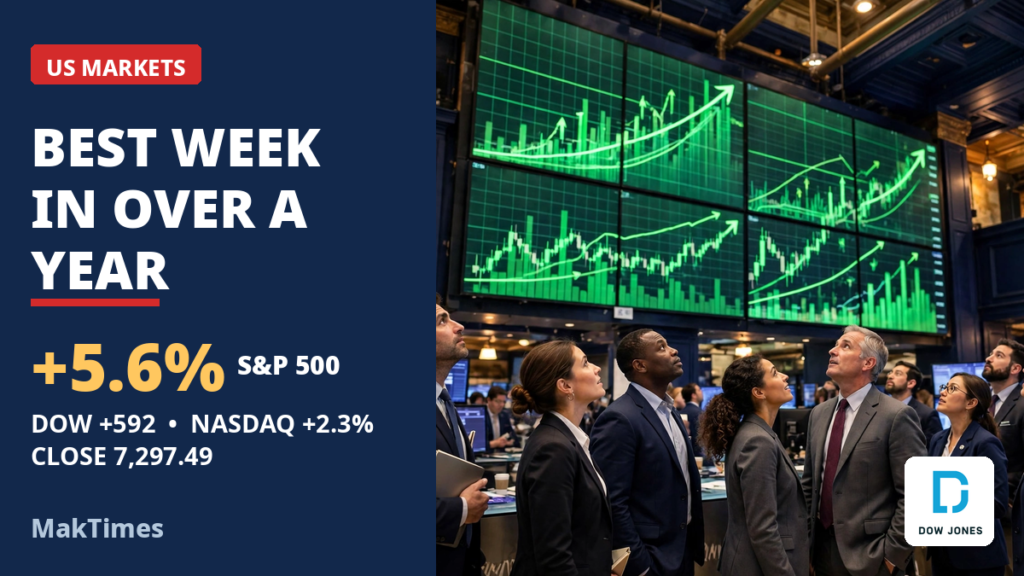
Wall Street closed out its best week in more than a year on Friday, and it did it in half a day. The S&P 500 rose 1.6% in the shortened Black Friday session to finish at 7,297.49, capping a week that turned one of the ugliest Novembers in living memory into a rebound for the record books.
The Dow Jones Industrial Average gained 591.99 points, or 1.18%, to close at 50,774.94. The Nasdaq Composite did better still, climbing 543.70 points, or 2.31%, to 24,129.50. All three indexes finished the week sharply higher — the S&P 500 up 5.6%, the Nasdaq up 6.68% and the Dow up 5.46% — after markets closed early at 1 p.m. Eastern Time following Thursday’s Thanksgiving shutdown.
It was a sharp change of mood. Just a week earlier the market had been counting its losses after seven straight declines, and the question hanging over every trading desk was whether the artificial-intelligence trade that carried stocks for two years had finally broken. Friday gave the buyers their answer, at least for one week.
S&P 500 Best Week: The Numbers Behind the Rally
The buying was broad, but chip stocks led it. Micron jumped 7.6% and Marvell gained 7.3%, while the wider chip gauge rose 4.7%. Nvidia edged 0.8% higher. Amazon, Microsoft, Meta, Oracle and Tesla all rose as investors went back into the big technology names that had been sold hardest in November.
The tape underneath the rally looked healthy, too. The S&P 500 recorded 12 new 52-week highs and no new lows on Friday, and about 10.97 billion shares changed hands across US exchanges. Thin holiday trading usually exaggerates moves in both directions, and Friday was no exception — it was the lowest-volume day for the major indexes since Christmas Eve of 2025 — but the direction was unmistakable.
Friday’s gains more than wiped out Wednesday’s declines for the S&P 500 and the Nasdaq. The week had opened with the index at 6,910.39 after seven consecutive losing sessions, and Monday alone delivered a 4.73% jump to 7,237.17, the first higher close in eight sessions. By Friday’s early close, the damage of the month’s sell-off had been cut by more than half.
A Thanksgiving Week for the Record Books
Measured against history, the week stands out. The S&P 500’s 5.6% gain was its best week in over a year — the biggest weekly advance since April 2025 — and the second-best Thanksgiving week since 1950. Only 2008, when the index rose 12.03% in the same week, did better. The next best were 1963 at 5.20% and 2025 at 3.73%.
Black Friday itself was strong by the same yardstick. The S&P 500’s 1.60% gain on the half day was the third-best Black Friday since 1950, behind only 1971 at 1.78% and 2007 at 1.69%. The Nasdaq’s 2.31% jump made it the index’s best Black Friday since 2000, and all three major indexes recorded their best Black Friday in over a decade.
The context matters. The index went into the week down 8.83% for November, the deepest November slide into Thanksgiving since 2008. That is what made the rebound so striking: it arrived not after a gentle pullback but after the market’s worst week since the Covid crash, a stretch that had already featured the Nasdaq’s 3.8% plunge and a Dow that needed Wednesday’s session, erasing a 1,100-point plunge, to steady itself.
Shoppers Showed Up Too
The market had a second tailwind, and it came from the tills. Thanksgiving Day online sales in the US reached $7.1 billion, up 10.4% on a year earlier and ahead of Adobe Analytics’ $6.9 billion forecast. Adobe projected Black Friday online spending of $12.9 billion, up 9.2% on last year.
Salesforce’s early read told a similar story. Thanksgiving online sales reached $37.2 billion globally, up 4.6%, and $8.8 billion in the US, up 5.1%. Black Friday was expected to notch about $83 billion in online sales worldwide, keeping its place as the most important shopping day of the year.
The spending figures matter because they answer the question the market has been asking all autumn: whether the American consumer, squeezed by higher prices, is still spending. On the first big test of the holiday season, the answer was yes — and retail stocks moved with it. Dow futures had jumped 303 points before the open on the same shopping optimism, and the cash session carried the move through to the close.
Why the Rally Still Needs a Second Look
None of this settles the argument that has driven November’s wild swings. The same week that produced the best gains in over a year also saw investors pull a net $30.57 billion from US equity funds in the week to November 25, the biggest weekly outflow in 11 weeks, according to LSEG Lipper data. Technology funds alone lost $9.27 billion. Money was still leaving even as prices bounced.
The thin volume is the other caveat. Holiday-shortened sessions are notorious for overstating moves, and Friday’s was the quietest in almost a year. Monday’s full-volume session is the first real test of whether buyers follow through once the whole market is back at its desks.
There is also unfinished business on the calendar. Marvell reports results in the week ahead, Nvidia chief Jensen Huang is due to testify before the Senate Banking Committee on December 3, and the Fed’s next rate decision on December 8–9 still looms over everything, with traders watching whether the December hike odds hold near 96%.
For now, though, the week belongs to the buyers. After the worst November slide since 2008, five sessions of buying gave the S&P 500 its strongest week in nineteen months — and gave a market that had forgotten how to rally a reminder of what one looks like.
Sources: Reuters, Barron’s, Adobe Analytics, Salesforce, LSEG Lipper, November 27, 2026.
Educational Content Only — Not Financial Advice: MakTimes is a news and education website. This article is published for general information and awareness only and is not financial, investment, trading, or legal advice. We are not financial advisors. Cryptocurrency, gold, and other markets are volatile and can result in loss. Always do your own research (DYOR) and consult a licensed financial advisor before making any financial decision. Past performance is not a guarantee of future results.