
Dow Jones Today: Dow Erases 1,100-Point Plunge to Close Higher in Biggest Comeback Since 2022
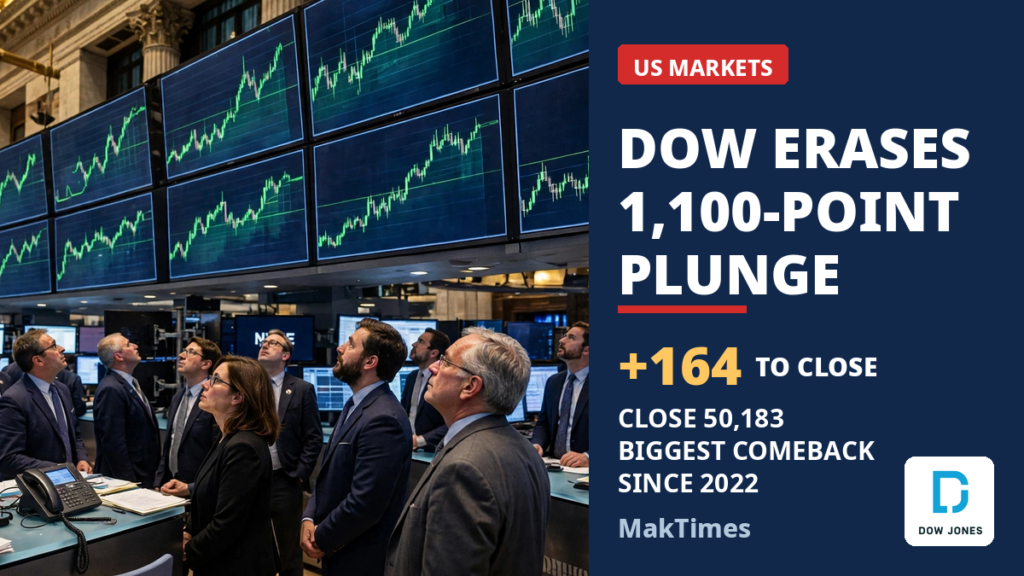
The Dow Jones Industrial Average erased a 1,105-point intraday plunge on Wednesday to close 164 points higher, pulling off its biggest comeback in nearly five years as buyers stepped in after a brutal morning sell-off in artificial intelligence stocks.
The Dow finished up 164.25 points, or 0.33%, at 50,182.95, after falling as much as 1,104.96 points in the morning session. The S&P 500 slipped just 0.25% to 7,182.78 after dropping 3.2% at its low, and the Nasdaq Composite closed down 0.62% at 23,585.80 after plunging 4.6% at its worst point of the day. The Russell 2000, which tracks smaller companies, rose 0.71% to 2,704.06.
A rout at the open, a rally by the close
Wednesday morning looked like another day of capitulation. Nvidia, the chipmaker at the centre of the AI trade, was down more than 9% at one stage, and the Philadelphia Semiconductor Index was heading for a seven-month low. The S&P 500 briefly dipped below 7,000, touching 6,969.93, while the Nasdaq-100 at one point sat about 20% below its record close — bear-market territory by the usual definition.
Then, around midday in New York, the selling ran out of force. Dip buyers moved in, and the recovery spread fast. By the close, eight of the eleven S&P 500 sectors were higher, led by materials and energy. Advancing stocks outnumbered decliners 1,941 to 762 on the New York Stock Exchange, and 371 of the 500 stocks in the S&P 500 finished in positive territory. Even the technology sector, the day’s worst performer, pared a 5.5% intraday loss to close down just 0.8%.
Barron’s called it the largest Dow reversal since 2022, and market watchers described it as the biggest comeback since January 24, 2022. The Dow climbed roughly 1,269 points from its intraday low to its close.
Nvidia and the AI trade stay under pressure
The recovery did not rescue the AI trade. Nvidia fell 3.91% to $149.30, slipping back below $150 for a second straight loss after it surged more than 30% on Monday. That Monday rally, the stock’s third-best day on record, now looks like a brief interruption in a slide that has cut the shares by more than a third from their October peak.
The weakness ran through the whole chip complex. Oracle, Micron, SanDisk and AMD all traded lower, and the PHLX Semiconductor Index, which had fallen almost 8% at its low, still closed down 0.65%. Apple was the exception among the mega-cap technology names, holding near record highs while its peers fell.
What changed on Wednesday was not the AI story but where the money went. Investors rotated out of expensive technology and into value: materials, energy, financials, consumer staples and utilities all finished higher. It was a rotation, not a panic — the kind of session that leaves the headline indexes mixed while most stocks underneath them actually rise.
Hot inflation and new tariffs set the morning mood
The morning’s selling had real triggers behind it. Core PCE inflation rose 3.3% in October, the Fed’s preferred measure, running well above the central bank’s 2% target, while headline inflation reached 3.8%. Third-quarter GDP was revised up to an annualised 4.3%, stronger than expected. Strong growth plus sticky inflation is an awkward mix for a central bank that had been expected to start cutting rates, and traders are now pricing in a near-certain rate rise when the Federal Reserve meets on December 8–9.
Fresh tariff proposals covering 16 economies added another layer of pressure, reviving worries about a trade war with China and higher costs for American companies. The 10-year Treasury yield sat around 4.85% as investors moved into the safety of bonds, and the VIX volatility index spiked to 35 during the morning before settling near 28.29.
Gold rose about 0.5% to $3,609 an ounce, while oil climbed as Middle East tensions flared, with WTI crude above $84 a barrel and Brent near $94.61.
A short holiday week ahead
Trading now runs into the Thanksgiving break. US stock markets are closed on Thursday, November 26, for Thanksgiving, and the New York Stock Exchange closes early at 1:00 p.m. ET on Friday, November 27. Holiday-thin trading can make sharp moves sharper, and there is little time this week for buyers to prove Wednesday’s turnaround was more than a one-day bounce.
The debate on Wall Street is now whether the afternoon recovery marked a genuine bottom or just a breather before the next leg down. Wednesday’s session did not settle the argument over AI valuations, but it did show one thing clearly: when the drop gets deep enough, buyers are still willing to step in.
Sources: CNBC, November 25, 2026; MarketWatch, November 25, 2026; Investopedia, November 25, 2026; InvestingLive, November 25, 2026; Reuters, November 25, 2026.
Educational Content Only — Not Financial Advice: MakTimes is a news and education website. This article is published for general information and awareness only and is not financial, investment, trading, or legal advice. We are not financial advisors. Cryptocurrency, gold, and other markets are volatile and can result in loss. Always do your own research (DYOR) and consult a licensed financial advisor before making any financial decision. Past performance is not a guarantee of future results.