
IMF Pakistan $1.2 Billion: Board Meets December 11 to Decide Next Tranche
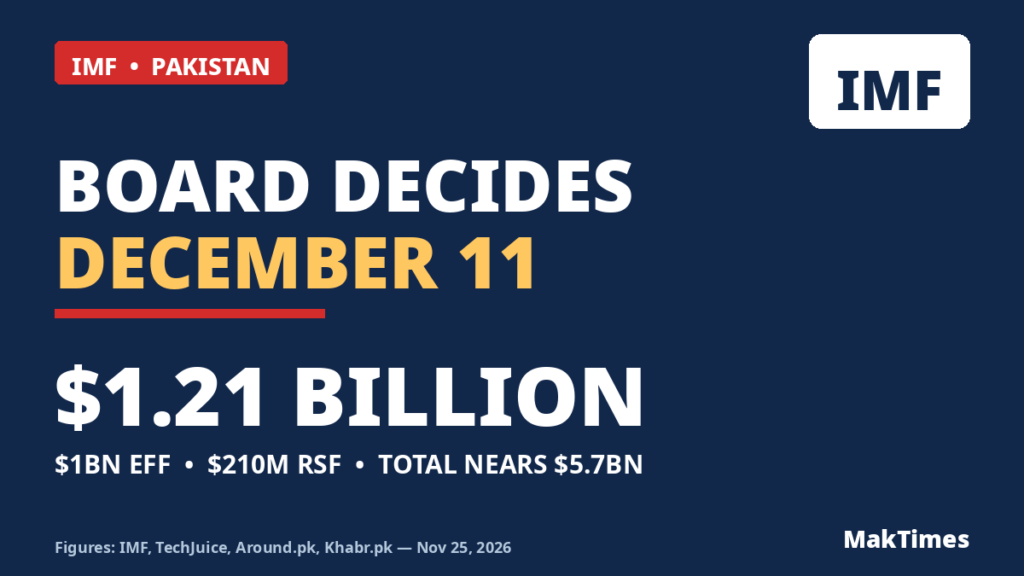
The International Monetary Fund has put a date on the decision Pakistan’s economy has been waiting for. Its Executive Board will meet on December 11 to vote on the next release of money under the country’s loan programmes — about $1.21 billion in all.
That is not a small sum, and it is not a formality either. The board still has to say yes. But the groundwork is done: Pakistan and the Fund’s mission team reached a staff-level agreement on October 7, and Finance Minister Muhammad Aurangzeb has confirmed the December meeting. Sixteen days from now, the board decides whether the money moves.
For ordinary Pakistanis the question is simpler than the acronyms make it sound. The money shores up the country’s foreign exchange reserves — the dollars the State Bank holds to pay for imports, service debt and steady the rupee. When reserves thin out, the pressure shows up everywhere: in import bills, in the exchange rate, in the cost of the fuel and machinery the country buys from abroad. A $1.21 billion inflow does not fix Pakistan’s economy on its own. It buys breathing room. And in a programme that has already run for two years, breathing room is exactly what the board is being asked to approve.
The $1.2 billion question: what the board decides
December 11 is not one decision but two, wrapped into a single meeting. The board will complete the fourth review of the Extended Fund Facility — the $7 billion, 37-month programme approved in September 2024 — and the third review of the Resilience and Sustainability Facility, the $1.4 billion climate-focused arrangement that runs alongside it. It will also conclude the 2026 Article IV consultation, the Fund’s regular health check of a member country’s economy.
If the reviews pass, the release breaks down like this: about $1 billion under the EFF, equal to 760 million Special Drawing Rights, and about $210 million under the RSF, equal to 154 million SDRs. Together, roughly $1.21 billion. Total disbursements under the two programmes would then reach about $5.7 billion.
The numbers have been settled since October. What was missing was the date. That changed this week, when the Fund’s schedule put the Pakistan item on the board’s December 11 agenda.
How Pakistan got here
This is Pakistan’s 23rd IMF programme, and the current one has followed the familiar rhythm of missions, agreements and board votes. An IMF team led by Iva Petrova held talks in Karachi and Islamabad from September 23 to October 7, covering the fourth EFF review, the third RSF review and the Article IV consultation. The staff-level agreement that came out of those talks is the document the board will now judge.
The programme’s own record so far is a sequence of cleared reviews. The first was completed in May 2025, the second in December 2025 and the third in May 2026. That last review released about $1.1 billion under the EFF and about $220 million under the RSF, taking total disbursements to about $4.8 billion.
Both arrangements are scheduled to run until September 2027 — less than ten months away. That deadline matters, because it frames the question the Fund’s own people keep raising in public: what comes after.
Why the money matters for reserves and the rupee
Pakistan’s total liquid foreign reserves stood at $26,864.5 million as of October 30, according to the State Bank’s figures. That is a far healthier cushion than the country held when the programme began, when reserves had fallen to levels that barely covered a few weeks of imports. But the Fund’s resident representative in Islamabad, Mahir Binici, warned this week that the buffers remain thin.
His reasoning was blunt. Imports are rising. Remittance growth — the money overseas Pakistanis send home, which has been one of the economy’s steadiest supports — is slowing. Exports sit at around 10% of gross domestic product, a level Binici described as a structural weakness. Put together, that is an external position that can come under pressure in the medium term, even with IMF money flowing.
The rupee has been steady rather than strong, trading around Rs276.47 to the dollar in the interbank market this week. The stock market has been watching too — the KSE-100 index hovered near 178,400 in Wednesday’s session, a fraction below Tuesday’s close, after gaining more than 1,000 points the day before.
None of this makes December 11 a day that decides Pakistan’s fate. It makes it a day that decides whether the programme stays on schedule, and whether the reserves cushion grows by another $1.21 billion before the year ends.
The conditions attached — and the warnings
IMF money has never come without conditions, and this review is no exception. Earlier this month the Fund told Pakistan to phase out its Rs75 billion fuel subsidy promptly, arguing that it is costly and too broadly targeted. Any future fuel relief, the Fund said, must be limited, time-bound, channelled through established social assistance programmes and paid for inside the 2026-27 budget.
The Fund has also pressed Pakistan to raise its tax-to-GDP ratio to about 15% — the level its representative says emerging economies need to fund public services — with faster structural reforms including digital invoicing, risk-based audits and rationalised tariffs. The fiscal side of the programme is already tight: the country’s fiscal surplus shrank 40% to Rs1.27 trillion in the first quarter of the fiscal year as interest payments jumped 23% — and December electricity bills may carry Rs4.22 per unit in adjustments — as the regulator weighs two hikes.
Then there is the question Binici sidestepped when it was put to him: can Pakistan avoid another IMF programme once this one ends in September 2027? No clear answer came back. The silence is telling. A country that has needed 23 programmes has not yet proved it can stand without one, and the Fund’s own staff know it.
What happens next
The calendar from here is short. The board meets on December 11. If it approves the reviews, the disbursement follows quickly — the Fund’s releases are normally made within days of a board decision, and the money lands in the State Bank’s reserves. If it does not approve, or if it asks for more prior actions, the wait stretches into the new year and the reserves cushion stays where it is.
Either way, the December meeting is only a checkpoint. The programme ends in September 2027, and the harder conversation — about exports, taxes and whether Pakistan can finance itself without another bailout — is still ahead. December 11 answers the immediate question. The bigger one will take longer.
Sources: TechJuice, Around.pk, Khabr.pk, TecSpectrum, RakaLogics, Token Times, IMF.org, Profit via WealthPK — 25 November 2026.
Educational Content Only — Not Financial Advice: MakTimes is a news and education website. This article is published for general information and awareness only and is not financial, investment, trading, or legal advice. We are not financial advisors. Cryptocurrency, gold, and other markets are volatile and can result in loss. Always do your own research (DYOR) and consult a licensed financial advisor before making any financial decision. Past performance is not a guarantee of future results.