
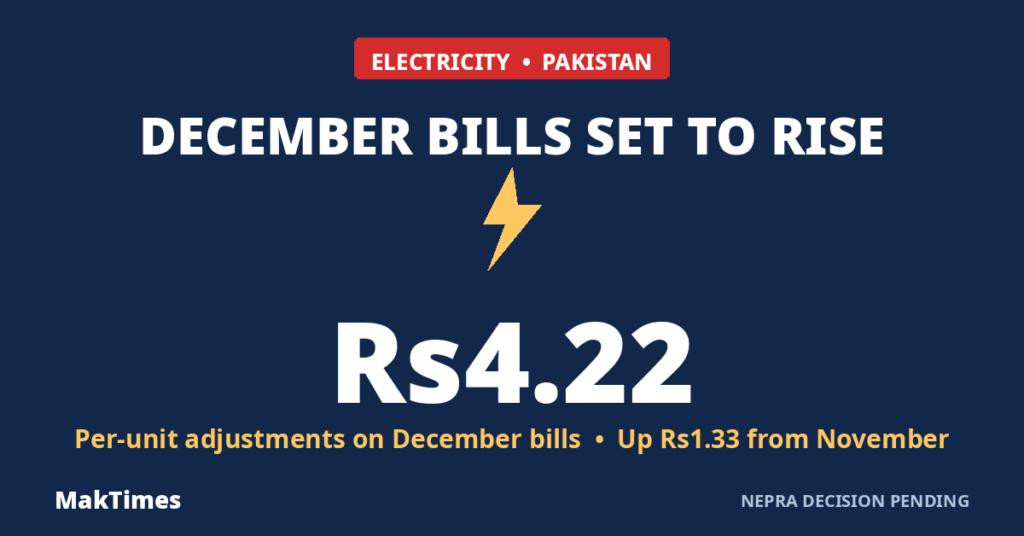
Electricity Price in Pakistan: December Bills May Carry Rs4.22 Per Unit in Adjustments as NEPRA Weighs Two Hikes
Electricity bills landing in December could carry the heaviest adjustments of the year. Consumers across Pakistan — Karachi included — may pay Rs4.22 per unit in quarterly and monthly adjustments next month, up from Rs2.89 in November. That is a net rise of about Rs1.33 per unit, and it would add roughly Rs29.8 billion to what households and businesses pay for power.
Nothing is final yet. Both charges behind the figure are requests sitting with the regulator, not approved tariffs. But the numbers are now on the table, the hearings are under way, and the prime minister has been briefed.
Two separate charges, one bill
The Rs4.22 figure is not a single hike. It is two different mechanisms landing in the same month.
The first is the quarterly tariff adjustment for July to September 2026. Power distribution companies have asked the National Electric Power Regulatory Authority (NEPRA) to let them recover Rs23.33 billion from consumers over three months — December 2026 to February 2027 — at a rate of Rs1.34 per unit. NEPRA held a public hearing on November 17, chaired by Chairman Waseem Mukhtar Chaudhry, and reserved its decision.
The second is the monthly fuel charges adjustment for October 2026. The Central Power Purchasing Agency (CPPA-G), which buys electricity on behalf of the distribution companies, has asked NEPRA to approve Rs2.8819 per unit. That figure is the gap between the fuel cost already built into the tariff — Rs7.8696 per unit — and what fuel actually cost in October. NEPRA will hear that request on November 26.
Add the two together and you get Rs4.22. That is the total adjustments line December bills would carry if NEPRA approves both requests in full.
Why December is not simply Rs4.22 more
Read the headline figure carefully, because it is easy to misread. December bills would not rise by Rs4.22 per unit on top of November’s bills. November’s bills already carry Rs2.89 per unit in adjustments — Rs2.37 from September’s fuel charge and Re0.52 from the outgoing quarterly adjustment. Those November charges end when the new ones begin.
So the real comparison is Rs4.22 against Rs2.89. The difference is Rs1.33 per unit. A household using 300 units in a month would pay roughly Rs400 more in adjustments than it did in November, if both requests are approved exactly as filed. The total adjustments on that same bill would come to about Rs1,266.
There is a second wrinkle worth knowing. The fuel charge is worked out on the units used in the reference month — October — rather than the units on the December bill itself. That was the practice for November’s fuel charge, which was calculated on September’s consumption, and the same rule is expected to apply this time, though it has not been confirmed for the December round.
And NEPRA does not have to say yes. The regulator can approve a request, cut it, or change it after the hearing — it often trims these requests — so Rs4.22 is the ceiling of what consumers face, not a done deal.
What the distribution companies are claiming
The quarterly adjustment request is the bigger of the two in scope, even if the fuel charge is the bigger number. Distribution companies want to recover costs from the July-to-September quarter, and the largest single item is capacity payments — Rs38.917 billion claimed for power plants that must be paid whether or not they run. On top of that come Rs7.79 billion for the impact of transmission and distribution losses on fuel cost adjustments, and Rs5.597 billion in variable operation and maintenance costs.
Those are the costs of a system patched rather than fixed for years: capacity payments to idle plants, power lost in old wires and theft, fuel bought at prices the tariff did not anticipate. All of it eventually lands on the bill.
Karachi is not exempt
Both charges would apply nationwide, including to K-Electric consumers in Karachi. The fuel charge reaches Karachi under the federal government’s uniform fuel charges adjustment policy, in place since 2023, and NEPRA has confirmed the quarterly adjustment would also apply to K-Electric.
That matters because Karachi’s consumers have historically been treated separately from the ex-WAPDA distribution companies — LESCO, IESCO, MEPCO and the rest. On these two adjustments, there is no separation. A household in Karachi faces the same per-unit increase as one in Lahore or Islamabad.
What the government is saying
Prime Minister Shehbaz Sharif chaired a meeting on electricity prices this week at which the adjustments and possible relief for consumers were discussed. According to Geo News, which first reported the combined Rs4.22 figure, the prime minister has been briefed on all the details, and the government is seeking to pass on the smallest possible burden to consumers.
One thing the government has already ruled out is any change to the base tariff this year. The uniform base tariff for domestic consumers stays where it is for calendar year 2026, with the national average at Rs33.38 per unit and the top domestic slab at Rs47.69 per unit for consumption above 700 units a month. The December pain comes entirely from the adjustments layered on top of that base.
Why bills keep climbing
Zoom out and the pattern is hard to miss. The base tariff has been held steady, yet the bill keeps growing because the adjustments never stop. Fuel charges swing with global oil and gas prices. Quarterly adjustments sweep up capacity payments and losses every three months. Each mechanism is defensible on its own — fuel really did cost more in October, capacity payments really are owed — but together they mean the price of electricity is effectively revised upward several times a year, in increments too small to trigger a headline on their own.
That is also why rooftop solar has become one of Pakistan’s fastest-growing consumer stories. Households and businesses that can afford the upfront cost are buying their way out of the adjustment cycle altogether — a trend MakTimes reported earlier this month as the country’s rooftop capacity passed 22GW in two years. For everyone who cannot, December’s bill is another reminder of how little control they have over the number at the bottom.
Sources: Geo News via Pakistan Point, 21 November 2026; The News, 18 November 2026; NEPRA hearing notices, 17–18 November 2026; ebillpakistan.pk explainer, 19 November 2026.
Educational Content Only — Not Financial Advice: MakTimes is a news and education website. This article is published for general information and awareness only and is not financial, investment, trading, or legal advice. We are not financial advisors. Cryptocurrency, gold, and other markets are volatile and can result in loss. Always do your own research (DYOR) and consult a licensed financial advisor before making any financial decision. Past performance is not a guarantee of future results.