
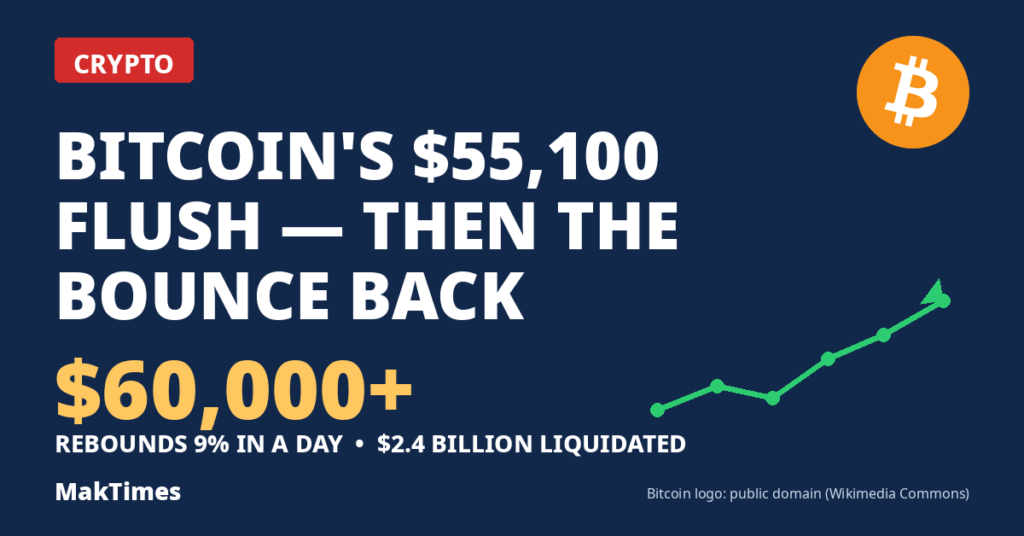
Bitcoin Price Today: Bitcoin Rebounds Above $60,000 After Crashing to $55,100 in Weekend Flush
Bitcoin price today is back above $60,000 — but only after a weekend that shook even the traders who thought they had seen everything this market can do. On Saturday, Bitcoin fell to about $55,100, its lowest level since September 2024. Then, in the space of a few hours, it climbed back above $60,000, leaving behind roughly $2.4 billion in liquidated positions and a market asking whether the worst is over — or whether the bounce is only a pause.
The numbers tell the story of two very different days. Bitcoin dropped under $60,000 on Friday, November 20 — something it had not done since early July. Saturday opened near $58,800 on the Kraken exchange and kept falling, touching about $55,100 in the early hours — below Friday’s low of roughly $57,660 and the weakest print in more than two years. Then the selling stopped. Bitcoin climbed to an intraday high near $60,880 and closed Saturday near $60,090, up 2.18% on the day. On Sunday it was trading around $59,300 to $60,200, up roughly 2% over 24 hours — a recovery of about 9% from the low, according to CoinDesk figures cited by CoinStats.
For anyone keeping score across the month, the damage is still severe. Bitcoin is down about 26% over the past 30 days and sits roughly 52% below its all-time high of $126,080. The Fear & Greed Index, which tracks market sentiment, read 11 on Saturday — deep in “extreme fear” territory. And the coin now trades about 13% below its 200-week moving average of roughly $68,357, a long-term trend line it slipped under earlier in the week.
How the flush happened
The trigger was not a single event. It was a pile-up.
Leveraged traders were the first casualty. As the price fell through $60,000, then $58,000, then $57,000, automated liquidations cascaded. Data from Coinglass, cited by several crypto outlets, put total crypto liquidations at roughly $2.4 billion to $2.67 billion over 24 hours — and more than 93% of those were long positions, traders betting the price would rise. Every forced sale dragged the price down a little further, setting off the next wave of liquidations. It is the same mechanism that has defined every sharp crypto move for years, and it works just as fast in both directions: once the selling exhausted itself, liquidated short positions added buying pressure on the way back up, according to CoinMarketCap’s market analysis.
Behind the leverage sat a slower, heavier force — the exchange-traded funds. Thursday, November 19, brought $582.3 million of net outflows from US spot Bitcoin ETFs. BlackRock’s IBIT alone accounted for $541.1 million of that, its largest single-day outflow since the fund launched in January 2024. November’s total outflows have now reached about $3.47 billion, and the funds lost money in every complete trading session from Tuesday to Thursday last week.
Why stocks dragged Bitcoin down with them
Bitcoin did not fall in isolation. Friday was a brutal day for equities, and the pain was concentrated exactly where crypto investors look first: artificial intelligence stocks.
The Nasdaq Composite dropped 5.28% on Friday. The Philadelphia Semiconductor Index — the home of the chipmakers that power the AI boom — fell 10.73% in a single session. Reuters linked the sell-off to growing concern that AI valuations had run too far, too fast. That matters for Bitcoin because, for all the talk of it being “digital gold”, it has traded like a high-risk technology asset for most of this year. When the Nasdaq sneezes, Bitcoin tends to catch a cold.
The Federal Reserve added to the pressure. Minutes from the Fed’s October 27–28 meeting, released on Wednesday, showed that almost all officials judged further interest rate increases would likely be appropriate. Markets now price a December rate rise as near-certain, with the next decision due on December 9. Higher rates for longer is the opposite of what risk assets want to hear, and it has weighed on everything from growth stocks to gold to Bitcoin in the same week.
Gold, the asset Bitcoin is so often compared with, offered no shelter either. Spot gold closed the week near $3,518 an ounce, its worst week since March, as the same rate-hike expectations and the equity sell-off forced selling across markets. When traders need cash in a hurry, they sell what they can, not what they want to.
What traders are watching next
The first test comes on Monday, November 23, when the next round of ETF flow figures arrives. CoinMarketCap’s analysis flags roughly $58,700 as the level to watch: holding above it keeps the door open to a retest of the $60,900 area, while losing it raises the risk of another move toward the recent low near $55,150. Those are technical levels reported by market analysts, not predictions.
Two other dates sit on the calendar. On November 30, index provider MSCI removes Strategy — the company formerly known as MicroStrategy — and Japan’s Metaplanet from its global indexes at the close of trading. Strategy holds 850,849 Bitcoin bought for about $64.20 billion, an average of roughly $75,452 per coin, according to its November 16 filing. And on December 9, the Fed announces its rate decision, the event the whole market has been pricing since the minutes landed.
There was also a reminder this weekend that crypto’s risks are not only about prices. Chainflip, a cross-chain exchange, confirmed on November 21 that an attacker drained about $12 million from its vault, including 122.86 Bitcoin and 520.22 Ether. The platform has moved into full safe mode, with deposits, withdrawals and swaps disabled, and has offered the attacker a deal: keep 10% of the funds if 90% is returned by 18:38 UTC on Monday, November 23. It is Chainflip’s second exploit in about ten weeks, and its token, FLIP, fell 42.9% in 24 hours.
Away from Bitcoin, the broader crypto market rose about 1.57% over the same 24 hours, close to Bitcoin’s own gain — a sign the bounce was market-wide rather than driven by anything specific to Bitcoin itself. Funding rates on Binance’s main Bitcoin contract settled near zero, suggesting traders are neither aggressively long nor short as the new week begins.
None of that changes the central fact of the weekend: Bitcoin lost more than a quarter of its value in a month, fell to a two-year low, and then bounced 9% in a day. Traders who survived the flush are watching Monday’s ETF numbers and the Fed’s December meeting to judge whether the recovery has legs.
Sources: CoinStats, November 22, 2026; Blockchain Reporter, November 22, 2026; CoinMarketCap, November 22, 2026; CoinDesk via CoinStats, November 22, 2026; Reuters via CoinStats, November 22, 2026.
Educational Content Only — Not Financial Advice: MakTimes is a news and education website. This article is published for general information and awareness only and is not financial, investment, trading, or legal advice. We are not financial advisors. Cryptocurrency, gold, and other markets are volatile and can result in loss. Always do your own research (DYOR) and consult a licensed financial advisor before making any financial decision. Past performance is not a guarantee of future results.