
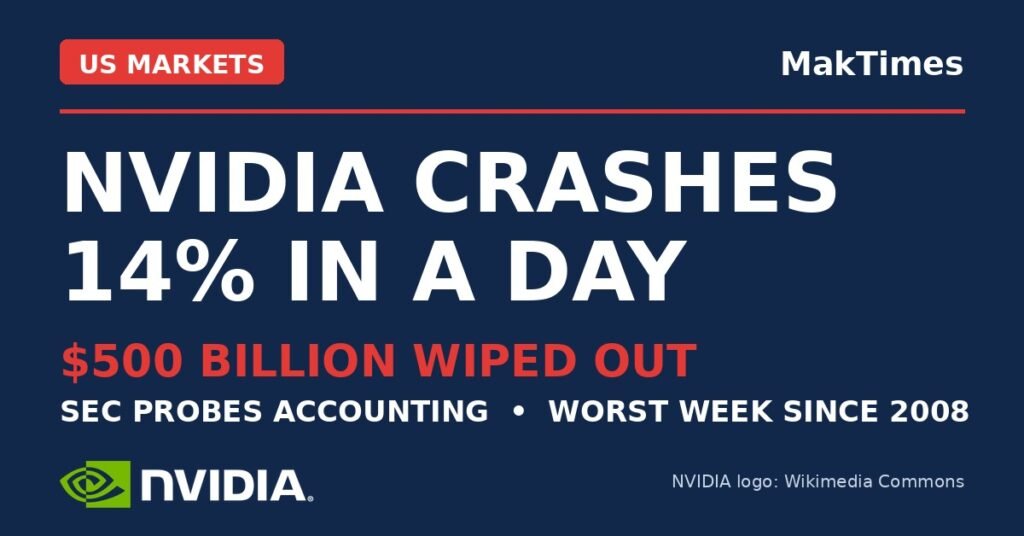
Nvidia Stock Plunges 14% as SEC Probes Its Accounting — $500 Billion Wiped in a Day
Nvidia stock fell 14% on Friday after Reuters reported that the US Securities and Exchange Commission is examining the chipmaker’s accounting practices. The drop erased roughly $500 billion in market value in a single session — one of the largest one-day wipeouts any company has ever suffered.
Shares closed at $125.53, down $20.45 on the day. At that price Nvidia is worth about $3.03 trillion. Six weeks ago it was the most valuable company on earth. Now it ranks fourth, behind Apple, Microsoft and Alphabet.
The Reuters report landed in the afternoon, and the selling accelerated within minutes. Nvidia had already been down more than 6% before the story broke, caught in a brutal day for the whole market. By the close it was down 14.01% — its worst single day in nearly two years.
What the SEC is reportedly looking at
Reuters, citing two people briefed on the matter, said the SEC’s enforcement staff are scrutinising potential accounting issues at Nvidia. The report did not say when the inquiry began, or which practices are under review. Both the SEC and Nvidia declined to comment.
The Wall Street Journal had first reported on Tuesday that the SEC was investigating Nvidia, but could not establish what the probe was about. Friday’s report supplied the missing piece: the focus is the company’s accounting.
That distinction matters. An investigation on its own proves nothing — Reuters itself noted that investigations are not evidence of wrongdoing, and many close without any enforcement action. But an accounting probe at a company whose numbers sit at the centre of the artificial intelligence boom is a different kind of headline, and traders reacted accordingly.
What exactly might be in scope is still unclear. Reporting in recent weeks has pointed to a few open questions. The Financial Times reported that roughly $104 billion of Nvidia’s 2025 revenue was booked through its Singapore unit. The company has also changed how it reports revenue by geography, breaking it out by where customers are headquartered rather than where they are billed — a distinction that can blur where its chips actually end up. Receivables, meanwhile, have stretched to around 64 days of sales. None of these is an accusation. They are the lines of inquiry analysts and reporters are now watching.
The worst week since 2008
Friday capped a week Nvidia will want to forget. The stock fell 23% across the week — its worst weekly slide since the financial crisis of 2008 — wiping roughly $1 trillion from its market value in five sessions. It has now fallen for seven straight trading days, its longest losing run since 2008.
Step back further and the scale of the reversal is staggering. October 6 marked the peak: a record close of $239.24. At Friday’s price the stock is down about 48% from that high. The company has lost roughly $2.7 trillion in market value in just six weeks.
And yet the business, on paper, is still booming. Nvidia reported quarterly results on November 17 — revenue of $115.8 billion, roughly double a year earlier — and the shares still fell. The numbers were strong. The market simply stopped believing they were enough.
A pile of problems, all at once
The SEC report is only the latest trouble to land on a company that, a month ago, looked untouchable. Co-founder Jensen Huang resigned as chief executive on November 11, after revelations about his personal relationships, including with a woman US authorities suspect of spying for China — something China denies. The resignation alone knocked the shares lower, and the selling has barely paused since.
Thursday brought a subpoena from California Attorney General Rob Bonta. His office is examining whether the company or Huang allowed advanced chips to reach China, and whether investors were misled about that risk. Huang is also set to appear before Congress on December 1 for questioning about potential national-security breaches.
The Justice Department, meanwhile, is reviewing Nvidia’s planned $12.9 billion purchase of Hugging Face, according to Reuters. And Washington has just tightened chip export rules covering data centres in Southeast Asia — rules that directly affect where Nvidia’s most advanced processors can be sold.
Each of these, on its own, would be a serious headache. Together they have turned the market’s favourite stock into its most punished one.
The AI trade is unwinding around it
Nvidia did not fall alone on Friday. The whole artificial intelligence trade came under pressure as investors questioned whether the enormous sums being poured into AI infrastructure will ever earn their keep. AMD fell 13%, Micron dropped almost 14% and Broadcom slid 12%. Anthropic, the AI lab whose record-breaking listing had lit up markets just days earlier, fell about 9% to close near its $83 issue price.
The Nasdaq composite sank 5.3% on the day, its second-worst session of the year, and the S&P 500 fell 3.7% — its seventh straight daily loss, the longest since 2020. Both the Dow and the S&P 500 are now in correction territory, down more than 10% from their recent peaks. The CBOE Volatility Index — Wall Street’s fear gauge — jumped 30% and hit its highest level in a year, closing near 40.
Trading in Nvidia was frantic. Volume surged to about 608 million shares, roughly 262% above the stock’s three-month daily average.
What happens next
Investigations like this do not resolve quickly. The Motley Fool’s analysis noted that the probe is likely to hang over the company for months, and possibly longer. Nvidia’s next quarterly filing will be read with unusual care — analysts will be looking for any change in how the company reports its revenue, and any hint of what the SEC is asking about.
For the wider market, the question is whether Nvidia’s fall is a company-specific story or the moment the AI boom’s valuations finally broke. The chipmaker was the engine of the rally that carried US stocks to records through the first half of 2026. Its collapse — nearly half its value in six weeks — is now dragging the whole market down with it.
Sources: Reuters, The Wall Street Journal, Barron’s, The Motley Fool, Investor’s Business Daily, November 20–21, 2026.
Educational Content Only — Not Financial Advice: MakTimes is a news and education website. This article is published for general information and awareness only and is not financial, investment, trading, or legal advice. We are not financial advisors. Cryptocurrency, gold, and other markets are volatile and can result in loss. Always do your own research (DYOR) and consult a licensed financial advisor before making any financial decision. Past performance is not a guarantee of future results.