
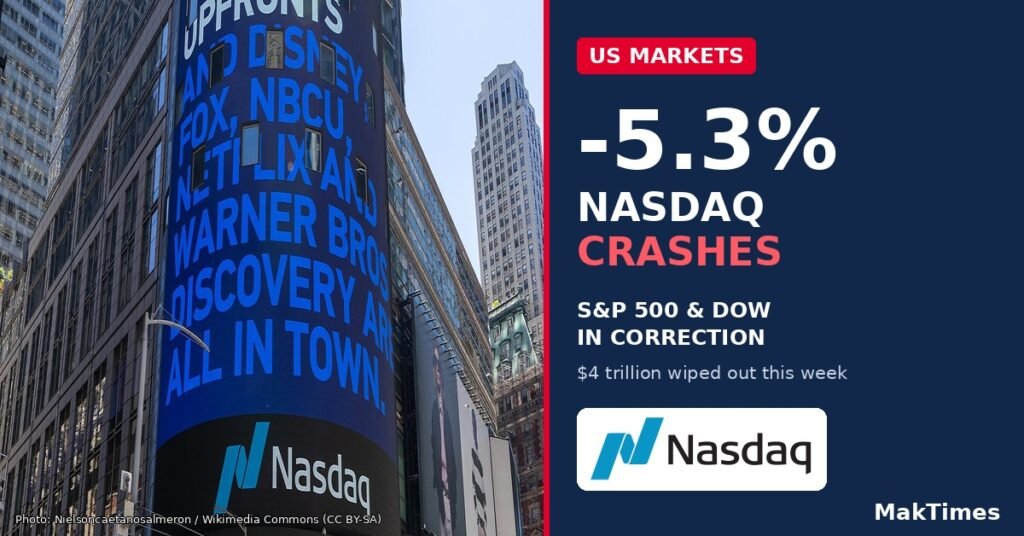
Stock Market Crash Today: Nasdaq Plunges 5.3% as S&P 500 and Dow Enter Correction
Friday, November 20, 2026, was the day Wall Street stopped calling it a dip. The Nasdaq Composite plunged 5.3%, the S&P 500 fell 3.7% for a seventh straight session, and the Dow Jones Industrial Average dropped 1.9% — and by the closing bell, two of the three major indexes had officially entered correction territory.
The numbers tell the story in one glance. The Nasdaq finished at 22,617.73, down 1,261.47 points. The S&P 500 closed at 6,910.39, down 265.44 points. The Dow ended at 48,147.33, down 949.73 points. The Nasdaq 100 fell 5.6% to 25,028.98, and the Russell 2000 lost 2.8%.
A correction means a fall of 10% or more from a recent peak. The S&P 500 now sits 11.6% below its October 6 record. The Dow is 11.4% below its August 5 record. The Nasdaq crossed that line weeks ago and is 18.1% below its October peak — and Friday’s drop wiped out every gain the index had made in 2026. It now stands about 2.7% lower for the year.
It was the Nasdaq’s worst week since 2020, down around 10%. The index’s 1,261-point fall was its second-largest one-day points drop in history, according to Investopedia. The Wall Street Journal reported that members of the tech-heavy benchmark lost more than $4 trillion in market value this week alone. Wall Street’s fear gauge told the same story: the CBOE Volatility Index, known as the VIX, spiked to 33.63, up nearly 80% in five days.
The AI trade came undone
For three years, artificial intelligence was the engine pulling the whole market higher. On Friday, it was the engine pulling it down.
Nvidia led the rout. Shares of the chipmaker — the company whose processors power most of the world’s AI data centres — fell 14% to $125.53. It was Nvidia’s worst day in almost two years and its seventh straight losing session. For the week, the stock fell about 23%, its worst week since the financial crisis of 2008.
Two things hit Nvidia on the same day. Reuters reported that the US Securities and Exchange Commission is probing the company’s accounting practices. And investors are still digesting the sudden resignation of founder and chief executive Jensen Huang, who stepped down on November 12. Even a spectacular earnings report — revenue of $115.8 billion in the third quarter, more than double a year earlier — has not steadied the stock. It has now lost roughly a third of its value in two weeks.
Anthropic, the AI lab behind the Claude chatbot, was supposed to rescue the mood. Its record-breaking stock market debut on Thursday — the largest initial public offering in history — briefly lifted the whole sector. The shares opened at $111.50, well above the $83 listing price, before fading to close the day at $97.17.
Friday took the shine off completely. Anthropic fell about 9% to around $89, at one point trading within five cents of its $83 offer price. The Wall Street Journal’s verdict was blunt: not even the biggest IPO in history could stop the bleeding.
Every member of the so-called Magnificent Seven — the giant tech stocks that dominate the indexes — finished lower on Friday. Chip stocks were hit hardest of all. The Philadelphia semiconductor index fell 11% in a single session, with Micron down 14% and SK Hynix down 13% in US trading.
Bitcoin and gold fell too
The selling did not stop at stocks. Bitcoin fell below $60,000 on Friday for the first time since July, touching $57,778 on the Binance exchange — its lowest level since September 2024. Reuters reported the price at $56,814 late on Friday night in New York. Around $2 billion in leveraged crypto positions were wiped out in 24 hours, according to data firm Coinglass, and BlackRock’s spot Bitcoin fund recorded a record $541.1 million outflow on Thursday. The Crypto Fear & Greed Index sat at 12, deep in “extreme fear” territory, for a ninth straight day.
Gold, usually the place investors run to when markets panic, offered no shelter either. Spot gold fell more than 2% on Friday. In Pakistan, 24-karat gold dropped to Rs379,836 per tola, according to the All Pakistan Gems and Jewellers Association.
The pattern was the same almost everywhere. In Asia, Japan’s Nikkei fell 5.1%, South Korea’s Kospi lost 5.2% and Taiwan’s Taiex plunged 6.2%. Europe’s Stoxx 600 dropped 2% and Canada’s main index fell 2.5%.
Why it happened now
No single headline caused Friday’s sell-off. It was a pile-up.
Investors have spent weeks questioning whether the hundreds of billions of dollars pouring into AI data centres will ever pay off. The Anthropic debut was meant to answer that question with a vote of confidence. Instead, its second-day slide read as the opposite — a market that no longer believes the story at any price.
Interest rates added to the pressure. Federal Reserve Governor Lisa Cook said this week that rates were too low to address inflation, according to Reuters, reviving bets that the Fed could raise rates in December rather than cut them. Higher rates hit expensive growth stocks hardest, and the AI trade is full of them.
Then there is the politics. Investors are watching how newly elected Democratic governors might slow the pace of the data-centre buildout, and whether Washington’s chip export rules will keep tightening. Both questions hang over the same handful of companies that carry the market.
Pakistan went the other way
While Wall Street was falling, Pakistan’s stock market rose. The KSE-100 index gained 610 points on Friday to close at 177,382.57, its second straight day of recovery. The Pakistan Stock Exchange’s own wrap showed ENGRO, HUBCO and UBL among the day’s strongest stocks.
The contrast will not last forever — global sell-offs have a habit of reaching Karachi eventually — but on Friday, at least, the local market moved in the opposite direction.
What to watch next
US markets are closed over the weekend and reopen on Monday, when the Chicago Fed’s National Activity Index is due at 8:30 a.m. Eastern time. It is also Thanksgiving week in the United States, which usually means thinner trading — and thinner trading can make sharp moves sharper.
The honest answer to the question everyone is asking — is this the bottom, or the start of something worse — is that nobody knows yet. What is certain is that the market that spent three years climbing on the AI story has now spent seven sessions falling on it. The S&P 500’s losing streak is its longest since the Covid-19 pandemic. Whether the correction ends quickly or drags on will depend on the same things that caused it: the AI spending question, the Fed’s next move, and whether the next big earnings reports give investors a reason to believe again.
Sources: Associated Press closing market data, November 20, 2026; Reuters, November 20, 2026; Investopedia, November 20, 2026; The Wall Street Journal, November 21, 2026; CNN, November 20, 2026; Pakistan Stock Exchange, November 20, 2026; All Pakistan Gems and Jewellers Association, November 20, 2026.
Educational Content Only — Not Financial Advice: MakTimes is a news and education website. This article is published for general information and awareness only and is not financial, investment, trading, or legal advice. We are not financial advisors. Cryptocurrency, gold, and other markets are volatile and can result in loss. Always do your own research (DYOR) and consult a licensed financial advisor before making any financial decision. Past performance is not a guarantee of future results.
Pingback: Bitcoin Crashes Below $56,000
Pingback: Trump Threatens Tremendous Tax on AI Data Centers