
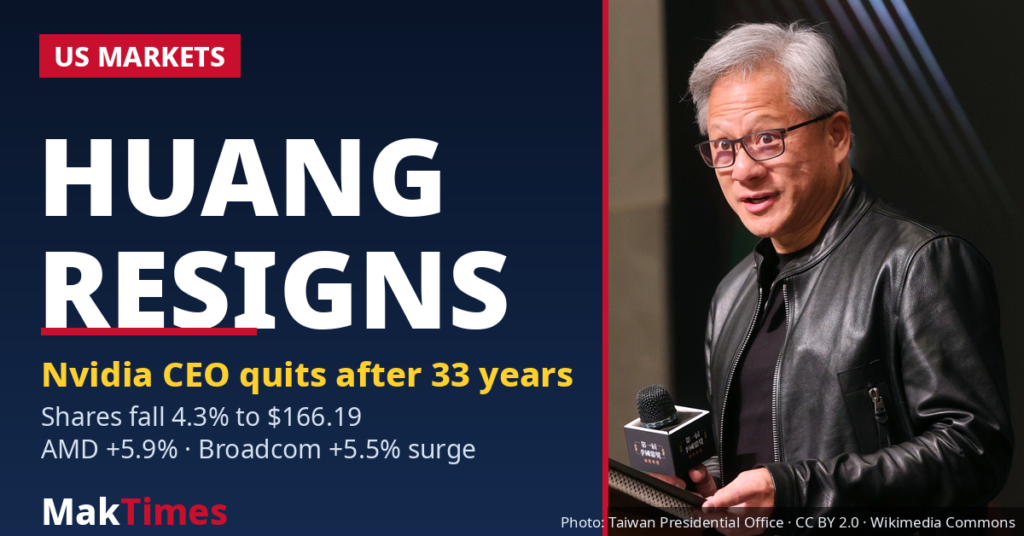
Jensen Huang Resigns as Nvidia CEO: Shares Fall 4.3% as AMD and Broadcom Surge
Jensen Huang has resigned as Nvidia’s chief executive, ending a 33-year run at the company he co-founded and built into the engine room of the global artificial intelligence boom. The board announced the decision on Thursday, November 12, and it took effect immediately.
Huang stepped down as chief executive, president and board member all at once. Chief financial officer Colette Kress will run the company as interim chief executive while the board looks for a permanent successor.
The board had opened its own inquiry four days earlier, bringing in outside lawyers to examine whether Huang had been caught up in a foreign intelligence operation. The admission came in a staff memo dated Sunday, November 8, in which Huang said he had been unfaithful to his wife and asked for forgiveness. Nvidia linked the matter to reports in The New York Times and The Wall Street Journal about his relationship with Alice Huang, a Singapore-based businesswoman US officials suspect of working for Chinese intelligence.
How the scandal unfolded
The New York Times first reported in October 2025 that US authorities had concluded Alice Huang — no relation to the Nvidia chief — acted as a Chinese intelligence asset. She is an executive at Megaspeed, a Singapore company that buys Nvidia chips and builds AI data centres across South-East Asia. The Information later reported that she had facilitated $7.5 billion in chip sales to China. The US Commerce Department has been investigating Megaspeed since late 2024, and the Justice Department is now leading several investigations involving her. Chinese officials have denied any involvement.
Then came the second disclosure. On Wednesday, November 11, The New York Times reported that Huang had also had an extramarital relationship with Kimberly Powell, Nvidia’s vice president of healthcare, according to five people who worked at the company. Hours later, The Wall Street Journal reported that Nvidia’s board was preparing to remove him. Late on Wednesday the board met to decide his future. By Thursday morning, he was gone.
Huang, 63, co-founded Nvidia in 1993 and led it through three decades of reinvention — from graphics cards for gamers to the chips that now power nearly every major AI system on the planet. He owned about 3.6% of the company’s stock. There is no obvious single successor.
Wall Street’s verdict: Nvidia down, rivals up
The market’s first reaction was brutal. Nvidia shares opened more than 13% lower on Thursday, touching $148.80 — a level not seen since July 2025 — before buyers stepped in. The stock clawed back most of the loss and closed at $166.19, down $7.54, or 4.3%, on the day. It edged about 1% higher in after-hours trading.
What happened next said as much as the fall itself. Investors did not abandon AI shares. They rotated between them.
Advanced Micro Devices jumped 5.9% to $585.30. Broadcom climbed 5.5% to $364.36. Alphabet, whose internally built TPU chips offer an alternative to Nvidia hardware, rose 1.6%.
The broader market held up far better than the headlines suggested. The S&P 500 slipped 0.4% to 7,592.40. The Dow Jones Industrial Average fell 189 points, or 0.4%, to 52,297.09. The Nasdaq dropped about 0.4%. Small caps had the worst of it — the Russell 2000 fell 1.7% — and the CBOE Volatility Index rose nearly 7% to 18.70. Investors were rattled, not routed. Bond yields told a separate story: the 10-year Treasury yield closed above 5.1%, its largest two-day rise since April 2025, as the bond market reopened after Veterans Day and digested Tuesday’s hotter-than-expected US inflation data.
Put the sell-off in context and the scale becomes clear. Nvidia has now fallen more than 30% from its October 6 peak of $243.37, wiping out roughly $1.8 trillion of market value in five weeks, according to Reuters calculations. The stock is down about 27% over the past month. It remains one of the world’s most valuable companies, with a market capitalisation above $4 trillion, but the aura of invincibility is gone.
What happens next
Three things will decide how this plays out.
First, the earnings report. Tuesday, November 17 brings the first results since the resignation, with the numbers due after the closing bell. Analysts expect earnings per share of about $2.53 on revenue of roughly $111 billion. The numbers matter, but the call matters more: investors will want to hear from Kress and the rest of the leadership team about whether the company’s AI roadmap and chip supply plans are unchanged.
Second, the succession. The board has not named a search firm or a timeline, and Huang’s shadow is long. He was not just the chief executive; he was the public face of the company, its chief salesman and its strategist, famous for the black leather jacket and the keynote speeches that drew stadium crowds. Whoever takes over inherits a company at the centre of a geopolitical fight over AI chips — and a board that has just shown it will act fast when a chief executive becomes a liability.
Third, Washington. House Foreign Affairs Committee chair Brian Mast said on November 12 that Huang had agreed to testify before Congress ahead of Thanksgiving. Senate Democratic leader Chuck Schumer demanded answers from the Trump administration about what it knew, and when.
For Pakistan’s readers, the story lands closer than it might seem. Nvidia’s chips sit inside the data centres, cloud services and AI tools used daily in Pakistan, and the company’s fortunes move the global tech stocks that shape sentiment on markets from Karachi to New York. A leadership crisis at the world’s most important AI company is a reminder that the technology the whole world now depends on rests, in the end, on people — and people can fall.
The AI boom did not end on Thursday. The chips are still shipping, the data centres are still being built, and the demand that made Nvidia the world’s most valuable company has not gone away. What ended was an era: 33 years, one founder, one leather jacket, one company that became shorthand for the future. The question now is what Nvidia becomes without him.
Sources: Nvidia news release, November 12, 2026; USA Today, November 12, 2026; The Wall Street Journal, November 12, 2026; The New York Times, November 11, 2026; Reuters; Associated Press; Nasdaq closing data, November 12, 2026.
Educational Content Only — Not Financial Advice: MakTimes is a news and education website. This article is published for general information and awareness only and is not financial, investment, trading, or legal advice. We are not financial advisors. Cryptocurrency, gold, and other markets are volatile and can result in loss. Always do your own research (DYOR) and consult a licensed financial advisor before making any financial decision. Past performance is not a guarantee of future results.
Pingback: Bitcoin Price Today: Bitcoin Crashes Below $70,000 for the First Time Since August as $1.3 Billion in Bets Are Wiped Out - MakTimes