
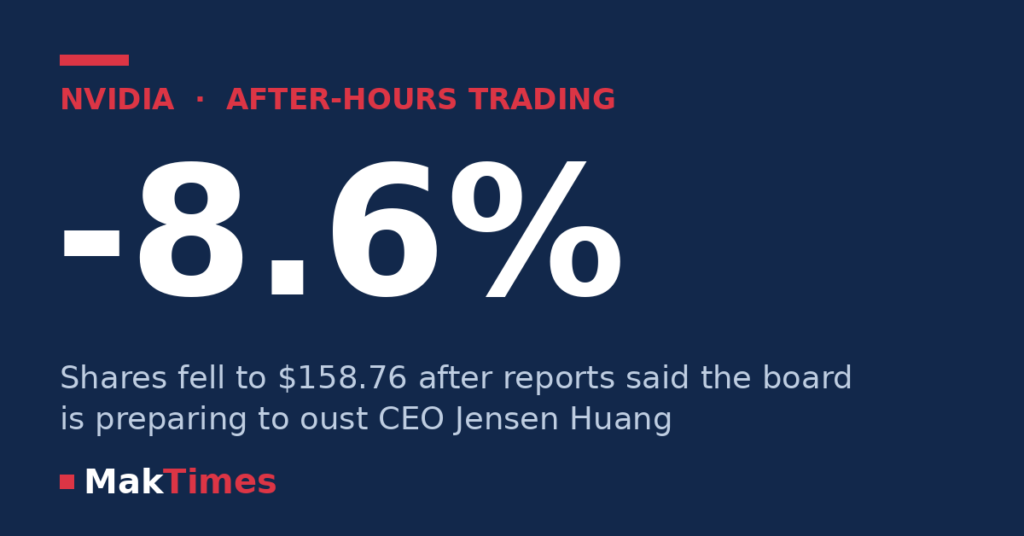
Nvidia Stock News: Shares Sink 8.6% After Hours as Board Reportedly Prepares to Oust CEO Jensen Huang
Wednesday was supposed to be a good day for Nvidia.
The chipmaker’s shares climbed 2.9% in regular trading and closed at $173.73, carried up by a roaring session for artificial intelligence stocks after cloud firm CoreWeave reported results that beat expectations. Then the closing bell rang, and the story flipped. Two newspaper reports landed within minutes of each other, and Nvidia stock was suddenly down 8.6% in after-hours trading at $158.76 a share — a drop of nearly $15 that, if it holds when trading resumes, would pull the company’s market value below $4 trillion.
Two reports, minutes apart
The first blow came from The New York Times, which reported that chief executive Jensen Huang had a relationship with Kimberly Powell, Nvidia’s vice president of healthcare and one of the executives who report directly to him. The paper cited people who worked at the company. Minutes later, The Wall Street Journal raised the stakes considerably. Its reporting described a board actively lining up Huang’s removal, with directors possibly gathering that same Wednesday night to settle whether he stays or goes.
The reporting did not stop there. A person familiar with the matter told Reuters the directors were meeting late on Wednesday to weigh Huang’s position. Bloomberg reported that Nvidia has been working with an outside firm to identify possible replacements. Nvidia itself said nothing. The company did not respond to requests for comment from Reuters or Barron’s, no announcement had been made by Thursday morning in Asia, and Huang remains chief executive. It is important to be clear about that much: these are reports about a decision being prepared, not a decision announced.
A scandal reaches the boardroom in days
None of this arrived from nowhere. Over the weekend, Huang acknowledged a separate relationship, with a woman named Alice Huang — no relation — whom US officials suspect of passing information to China’s government. The board responded on Sunday, November 8, by opening an independent investigation into whether its chief executive had been the target of a foreign intelligence operation. The inquiry is being run by a committee of independent directors, helped by outside lawyers from Wachtell, Lipton, Rosen and Katz. At the time, the board publicly expressed confidence in Huang and said it had no reason to believe national security or company secrets had been compromised.
That confidence has been tested every day since. The stock had already fallen about 7% this week before Wednesday’s after-hours tumble, and Reuters puts the value wiped off the company since the investigation began at roughly $600 billion. The board has 11 directors, including Huang himself. Wednesday’s second report changed the question hanging over the company: no longer only what the chief executive did, but whether the board still wants him doing the job.
Why investors are so rattled
Few companies anywhere are as tied to one person as Nvidia is to Jensen Huang. He co-founded the business in 1993 and has run it ever since, turning a maker of graphics cards for gamers into the company that supplies the chips the entire AI boom is built on. He holds about 70 million shares directly, according to regulatory filings. He has also said, more than once, that he does not believe in succession planning. Nvidia has never named a number two, and there is no obvious candidate waiting in the wings.
That is why Wednesday night hit so hard. One analyst quoted in coverage of the sell-off reduced the fear to a single line: Nvidia’s shares are worth $300 with Jensen as chief executive, and $225 without him. Wall Street has started pricing that risk in: at least one major firm cut its rating on the stock this week and slashed its price target to $200, naming the uncertainty over Huang’s future as one of the reasons. The pressure is political, too. Senator Kevin Cramer of North Dakota, a senior member of the Senate Banking Committee, has said Huang should step down. John Moolenaar, who chairs the House Select Committee on China, has warned that Huang could face subpoenas if he does not agree to appear before three House committees. The White House, for its part, already knows what the board is weighing, according to CBS News.
The strange split on Wall Street’s day
The irony of Wednesday is that the wider market had one of its better days in weeks — and Nvidia was part of it, until it was not. It has been a jumpy week for US investors: on Tuesday, hot inflation figures knocked gold down nearly 3% and revived talk of another Federal Reserve rate rise in December. Wednesday’s session itself, though, was calm and broadly positive. The Nasdaq Composite rose 1.6% to 25,466.19, the S&P 500 gained 1.3% to 7,619.38, and the Dow Jones Industrial Average added 0.5% to 52,486.49.
The catalyst was CoreWeave, the AI data-centre company whose shares leapt 25% to $60.77. Its third-quarter revenue came in at $3.66 billion, up 168% from a year earlier, and it raised its full-year outlook to as much as $13.3 billion. Just as important was how it plans to pay for its expansion: delayed-draw loans rather than riskier public debt. That reassured a market that had spent weeks worrying the AI build-out was financed on sand. With roughly a quarter of CoreWeave’s shares held by short sellers, the good news squeezed them hard and lit a fire under AI stocks across the board — Nvidia included, for a few hours at least.
What happens next
For now, everything waits on the board. Two dates matter. The first is whenever the directors speak: a statement standing behind Huang would probably calm the stock, while a departure would open the succession question Nvidia has avoided for three decades. The second is November 17, when Nvidia reports its quarterly results — an event that would normally be entirely about demand for AI chips, and will now be dominated by the question of who is running the company.
What Wednesday night already showed is how much of Nvidia’s value sits in one man’s position. Around $600 billion has gone since Sunday. For the company that sells the picks and shovels of the AI age, the market spent the night pricing something else entirely: the man holding them.
Sources: The Wall Street Journal, The New York Times, Reuters, Bloomberg and Barron’s — November 11–12, 2026.
Educational Content Only — Not Financial Advice: MakTimes is a news and education website. This article is published for general information and awareness only and is not financial, investment, trading, or legal advice. We are not financial advisors. Cryptocurrency, gold, and other markets are volatile and can result in loss. Always do your own research (DYOR) and consult a licensed financial advisor before making any financial decision. Past performance is not a guarantee of future results.