
Petrol Price in Pakistan Today: Petrol Falls to Rs335 Per Litre in Second Straight Cut, Diesel Drops to Rs364
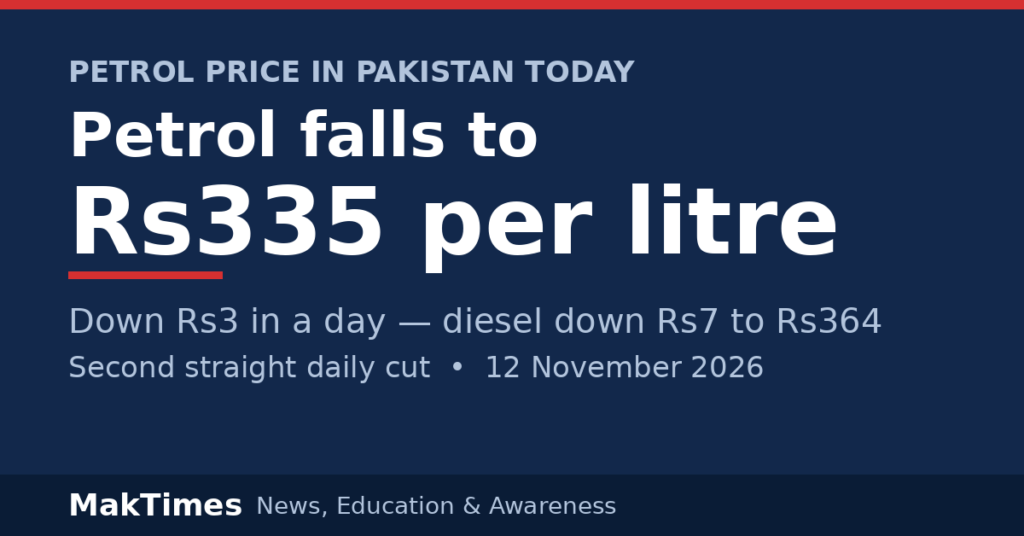
Petrol price in Pakistan today is Rs335 per litre. The government cut it by another Rs3 overnight, and high-speed diesel is down Rs7 to Rs364, in the second reduction in two days.
The Oil and Gas Regulatory Authority (OGRA) issued the notification late on Wednesday evening, and the new rates took effect from Thursday, 12 November. A day earlier, petrol had been cut by Rs8 to Rs338 and diesel by Rs7 to Rs371. Put the two days together and a litre of petrol is Rs11 cheaper than it was on Monday.
Petrol price in Pakistan today: the new rates
| Fuel | Old price | New price | Change |
|---|---|---|---|
| Petrol | Rs338 | Rs335 | −Rs3 |
| High-speed diesel | Rs371 | Rs364 | −Rs7 |
The rates apply for today only. Under the new system, OGRA revises fuel prices every day, Monday to Friday, so a fresh notification can follow tomorrow.
A fortnight of falling fuel
Zoom out a little and the drop looks bigger than a single Rs3 cut. Petrol stood at Rs346 a litre on Monday. Two weeks ago it was roughly Rs43 higher than today’s level. Diesel has come down faster still — from Rs378 on Monday to Rs364 today, a Rs14 fall in three days.
That slide follows crude oil, not the other way round. Brent crude, the global benchmark Pakistan’s imports track, settled at $92.76 a barrel on Wednesday, up 1.39 per cent on the day. But that single-day rise hides the bigger picture: Brent is still roughly 22 per cent below its peak of about $118 at the end of October. It is that longer fall, working its way through import cargoes, that has been showing up at Pakistani pumps through November.
Why the cuts are coming daily now
Until recently, Pakistan revised fuel prices every fortnight, then weekly. The federal cabinet changed that on 30 October, approving a daily review mechanism after renewed hostilities in the Middle East rattled oil markets. The weekly system itself had only been introduced after the Israel-Iran conflict flared in February, and the Strait of Hormuz — the narrow waterway carrying a large share of the world’s oil — has stayed at the centre of the story since.
OGRA has also started publishing daily petroleum prices on its own website, so drivers can check the day’s rate before filling up instead of waiting for the news. Under the revised formula, the import price of petrol is worked out from the actual cost of the relevant PSO cargo, with refineries’ premium and duty temporarily fixed at pre-war levels for 30 days and the difference passed back to consumers through the petroleum levy account.
None of that guarantees the direction holds. Thirty-seven ships were reported attacked in the Strait of Hormuz during October, and the US Energy Information Administration expects Brent to stay near $100 a barrel through the end of the year. A fresh spike in crude would feed into the same daily mechanism just as quickly as the current fall has.
The tax bite is still there
Here is the part of the pump price that has not moved at all. Taxes and duties of Rs114 a litre on petrol and Rs100 a litre on diesel remain in place — roughly a third of what a motorist pays for petrol is tax, not fuel. The cuts are real money back in a driver’s pocket, but the levy floor means prices can only fall as far as the tax structure allows.
That is also why the relief feels uneven across the household budget. Petrol and diesel are falling. Cooking gas is not. OGRA raised the official LPG price for November by Rs14.73 per kg to Rs294.07, taking an 11.8-kg domestic cylinder to Rs3,470.09 — and in the open market, LPG has been reported selling for as much as Rs600 to Rs630 per kg in some areas, more than double the official rate.
What it means for your pocket
For a motorist, the arithmetic is simple. A 10-litre fill costs Rs30 less than it did yesterday and Rs110 less than on Monday. For a bike rider filling five litres, the saving is smaller — Rs15 against yesterday — but it lands every single day the price keeps stepping down.
Diesel matters differently. It runs the trucks that carry food to market, the buses between cities, and the tractors in the fields. A Rs7 cut in one day, Rs14 in three, trims freight and farming costs at the margin — though fares and freight charges have a habit of falling more slowly than fuel prices rise.
The wider backdrop is still tight. Weekly inflation was last recorded at 12.31 per cent, so cheaper fuel is arriving while household budgets are already stretched. It helps. It does not, on its own, fix a month of rising prices elsewhere.
What happens next
The next OGRA notification is due tomorrow, and the daily system means nobody has to wait a fortnight to find out which way the price moves. Drivers should check the rate before filling up — and keep the receipt, because under daily pricing, today’s Rs335 is only today’s price.
Sources: The News, 12 November 2026; Pakistan Today (Profit), 11 November 2026; Business Recorder via danioPSX, 12 November 2026; Bloom Pakistan, 11 November 2026; The Pakistan Daily, 10 November 2026; Stockbiz market wrap, 12 November 2026.
Educational Content Only — Not Financial Advice: MakTimes is a news and education website. This article is published for general information and awareness only and is not financial, investment, trading, or legal advice. We are not financial advisors. Cryptocurrency, gold, and other markets are volatile and can result in loss. Always do your own research (DYOR) and consult a licensed financial advisor before making any financial decision. Past performance is not a guarantee of future results.