
California Minimum Wage Rises to $17.40 in 2027: What Changes on January 1
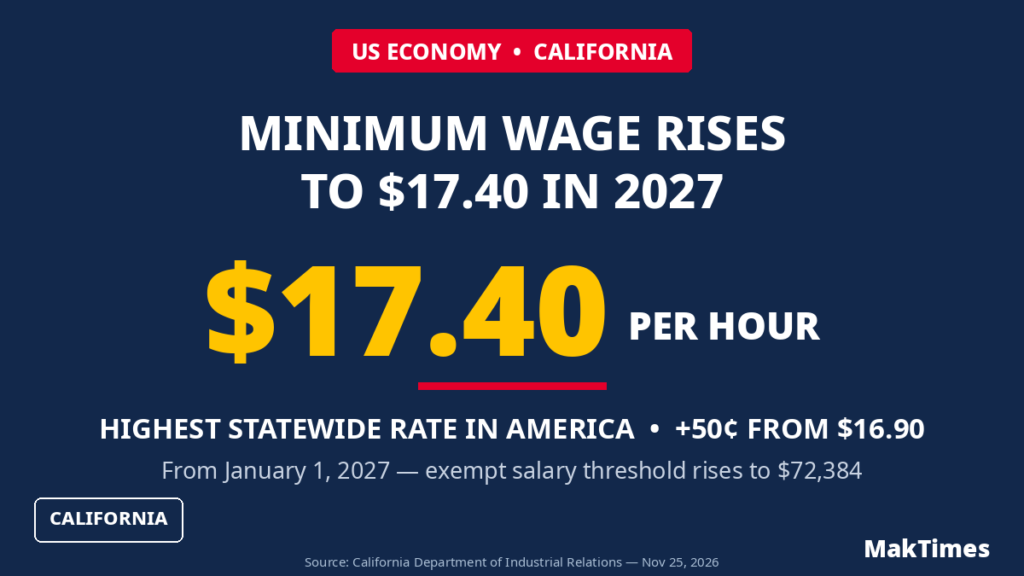
California is about to pay its lowest-paid workers more — again. From January 1, 2027, the state’s minimum wage rises from $16.90 to $17.40 an hour, a 50-cent increase that Governor Gavin Newsom announced on July 31, 2026, after the state’s Department of Finance certified the new rate.
The number is not a political gesture. It is the output of a formula California wrote into law years ago: every January, the minimum wage moves with inflation, measured by the national Consumer Price Index for Urban Wage Earners and Clerical Workers, known as CPI-W. For the 12 months to June 30, 2026, that index rose 2.99 percent. So the wage rises 2.99 percent. Nobody in Sacramento voted on $17.40. The arithmetic did.
That matters for two reasons. First, the increase is locked in — it takes effect on January 1 whether or not anyone in the state capital is still talking about it. Second, it makes California’s floor the highest statewide minimum wage in the country, and nearly two and a half times the federal minimum wage, which has sat frozen at $7.25 an hour since 2009.
The numbers that matter
The headline figure is $17.40. The figures around it are what decide who actually feels the change.
A full-time worker on the state minimum — 40 hours a week, 52 weeks a year — will earn $36,192 in 2027 at the new rate, up from $35,152 at $16.90. That is $1,040 more over the year. It is not a fortune. In a state where a one-bedroom flat in San Diego or San Jose can swallow half a pay cheque, it is not even close. But for a worker on the floor, it is the difference between a month of groceries and a month without them, and it arrives without anyone having to ask for a raise.
The increase also lifts a threshold most workers never hear about until it affects them. Salaried staff in California can only be classed as exempt from overtime — executive, administrative and professional roles — if they earn at least twice the minimum wage for a full-time week. At $17.40, that floor becomes $72,384 a year, or $6,032 a month, up from $70,304 in 2026. Employers with salaried staff sitting between those two numbers have a choice to make before January: raise the salary, or start paying overtime.
And the $17.40 figure is only the floor. It is not what most Californians on low pay will actually earn.
The floor is not the rate in most of California
California does not allow a tip credit. A waiter in Los Angeles must be paid the full $17.40 in cash wages before a single dollar of tips — unlike in most American states, where employers can count tips toward the minimum. That rule stays.
Then there are the carve-outs. Fast-food workers at most large chains in California already earn at least $20 an hour under the FAST Recovery Act, and that rate is untouched by the January change. Healthcare workers are on their own separate ladder under Senate Bill 525, with rates that depend on the type of facility — some of those rose on July 1, 2026, and more are scheduled. For those two groups, $17.40 is a number on a poster, not a pay rise.
The bigger story is local. Dozens of California cities and counties set their own minimums above the state rate, and they are moving too. West Hollywood’s rate for non-hotel workers rises to $20.94 on January 1, 2027, from $20.25 — the highest in the state. Palo Alto goes to $19.25 from $18.70. San Diego rises to $18.35 from $17.75. San Mateo reaches $19.25. In every case, the worker is paid the highest rate that applies to them — city, county or state, whichever is most generous.
That patchwork is the point the official announcements tend to bury. A worker in Fresno and a worker in West Hollywood do the same job under the same state law and take home different pay, because California’s wage floor is really a stack of floors, and the state one is only the bottom layer.
How California got to $17.40
The road here is short to tell and long to live through. When Newsom took office, the statewide minimum was $12 an hour. It has risen every January 1 since 2017, from $10.50, through $15 in 2022, $15.50 in 2023, $16 in 2024, $16.50 in 2025, $16.90 in 2026, and now $17.40. The mechanism has two guardrails: the annual increase is capped at 3.5 percent, and the rate can never fall, even if prices do.
That cap is why the 2027 rise is 2.99 percent rather than something larger. Inflation, as measured by CPI-W, ran at 2.99 percent for the relevant 12 months. Had it run hotter — say 4.5 percent — the increase would have stopped at 3.5 percent anyway. The formula protects workers from inflation and employers from a sudden jump, and it does both by being boring. Nobody negotiates it. Nobody campaigns on it. It just runs.
Who actually gains, and who pays
California has roughly 39 million residents and one of the largest economies on earth — bigger, on its own, than most countries. A 50-cent rise across the lowest-paid slice of that workforce moves a lot of money: into rent, groceries, transport and childcare, mostly spent locally, mostly immediately. That is the argument the governor’s office made when it announced the increase, and it is the standard economic case for minimum-wage rises: low-paid workers spend what they earn, and they spend it near home.
The counter-argument is just as familiar, and it is heard every January in California. Small businesses, restaurants and retailers say the automatic rises compound — a few percent a year, every year, with no pause — and that the cost lands hardest on the firms with the thinnest margins. Some warn of fewer hours, slower hiring, or higher prices. What is not in doubt is that the January 1 date is fixed, and payroll systems, postings and exempt salaries have to be updated before it arrives. January 1, 2027, falls on a Friday, so pay periods that straddle the new year need to be split: hours worked on or after January 1 are paid at $17.40, hours before it at $16.90.
The same cost pressures show up at the pump, where California drivers pay America’s highest gas prices.
What workers should check
If you work in California, two things are worth checking before January.
First, your hourly rate. If you are on the state minimum, it should read $17.40 from your first shift on or after January 1, 2027. If your employer pays monthly or has a pay period that crosses the date, the hours from January 1 onward are at the new rate.
Second, whether a higher rate applies to you. Check your city or county — San Diego, Palo Alto, West Hollywood, San Mateo and many others pay above the state floor. Check whether you are a fast-food worker ($20) or a healthcare worker (facility-dependent rates under SB 525). The highest applicable rate is the one you are owed.
Why this keeps happening every year
There is a temptation to treat each January’s announcement as a fresh political event. It is not. California removed the politics from the number a decade ago and handed it to an index. The result is a wage floor that climbs a little every year, in step with prices, without a vote, a campaign or a strike. Supporters call that stability. Critics call it autopilot. Either way, the next number is already being calculated: the Department of Finance will certify the 2028 rate by August 1, 2027, using the same CPI-W measure, under the same 3.5 percent cap.
For now, the fact that matters is simple. On January 1, 2027, the lowest legal hourly wage in California becomes $17.40. It is the highest statewide rate in America. And for the workers at the bottom of the pay scale in the country’s richest state, it is 50 cents an hour more than they earned the day before.
Frequently asked questions
What is California’s minimum wage in 2027?
$17.40 per hour, effective January 1, 2027, for all employers statewide, regardless of size. It rises from $16.90, a 50-cent (2.99 percent) increase.
How was the $17.40 rate decided?
California law adjusts the minimum wage annually for inflation using the CPI-W index. The Department of Finance certified the 2027 rate on July 31, 2026, after CPI-W rose 2.99 percent in the 12 months to June 30, 2026. Annual increases are capped at 3.5 percent and the rate can never fall.
Does the $17.40 rate apply to fast-food workers?
No — most fast-food workers in California already earn at least $20 an hour under the FAST Recovery Act, which is higher than the statewide rate and still applies. Healthcare workers also have separate, higher rates under Senate Bill 525.
What is the exempt salary threshold for 2027?
$72,384 a year ($6,032 a month), up from $70,304 in 2026. Salaried executive, administrative and professional staff must earn at least that much, and meet the duties test, to be exempt from overtime.
Do California cities pay more than $17.40?
Yes. Many cities and counties set higher local minimums — for example West Hollywood $20.94, Palo Alto $19.25, San Diego $18.35 and San Mateo $19.25 from January 1, 2027. Workers are paid the highest rate that applies to them.
Can employers count tips toward the $17.40?
No. California does not allow a tip credit, so tipped employees must receive the full $17.40 per hour in cash wages before tips.
Sources
- Office of Governor Gavin Newsom, “Governor Newsom announces California will raise statewide minimum wage“, July 31, 2026
- California Department of Industrial Relations, “California’s minimum wage set to increase to $17.40 per hour on January 1, 2027“
- California Chamber of Commerce, “2027 California Minimum Wage Increasing to $17.40/Hour“
- Nixon Peabody, “California localities to raise the minimum wage in 2027“, October 12, 2026
- Ogletree Deakins, “California’s Minimum Wage Rate Set to Rise to $17.40 in 2027“
- Proskauer, “Here We Go Again: California’s Minimum Wage Is Headed Up to $17.40“, September 2026
Educational Content Only — Not Financial Advice: MakTimes is a news and education website. This article is published for general information and awareness only and is not financial, investment, trading, or legal advice. We are not financial advisors. Always do your own research and consult a licensed professional before making any financial decision.