
Pakistan’s First Astronaut Launches Into Orbit: Zeeshan Ali Blasts Off Aboard Shenzhou-24 to Tiangong
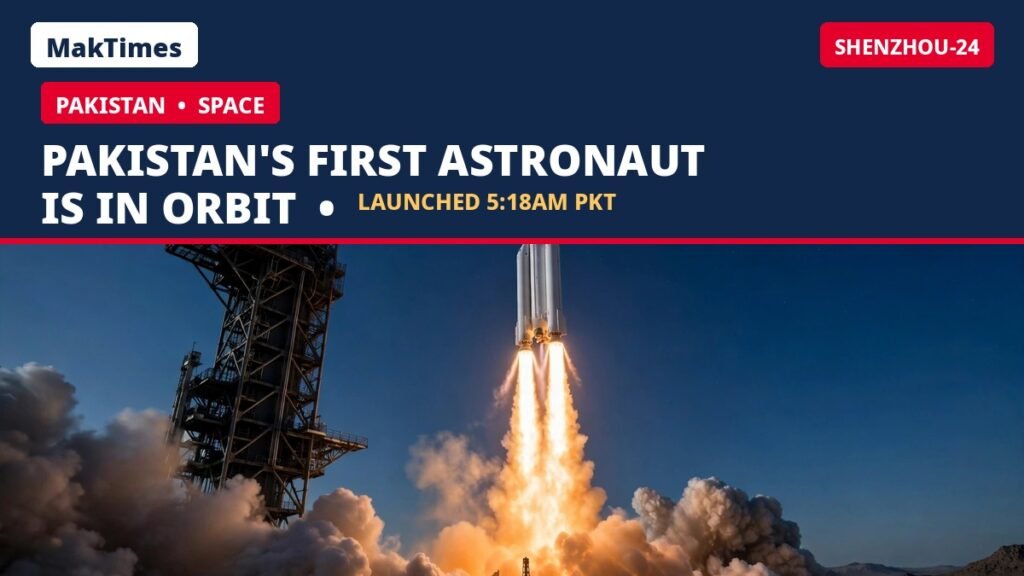
Pakistan has a man in orbit. At 5:18 in the morning, Pakistan time, a Long March-2F rocket rose out of the Gobi Desert carrying Muhammad Zeeshan Ali — a 40-year-old Pakistan Air Force pilot — and at that moment he became the first Pakistani ever to travel into space. The crew was named on Monday, a day before liftoff, when MakTimes previewed the mission.
The launch went cleanly. China’s Manned Space Agency called it “a complete success” within the hour. Ten minutes in, the capsule parted from its booster and was on its own in orbit. CCTV’s live pictures showed the three men thumbing through a flight manual shortly afterwards, and the agency said all three were doing well.
Ali has a job to do up there. His formal role is payload specialist. No astronaut from outside China has ever set foot on Tiangong before him, which makes the flight a milestone for Beijing too, not only for Islamabad. China has never before flown a crewed mission with a foreign astronaut on board. Shenzhou-24 breaks that pattern: two Chinese crew members, one Pakistani, one spacecraft.
Beside him sit commander Tang Hongbo, 51, on his third trip to Tiangong, and flight engineer Wu Yi, 39, on his first flight. Tang is now the first astronaut to board the station three times, having flown there on Shenzhou-12 in 2021 and Shenzhou-17 in 2024.
Pakistan’s First Astronaut: What Zeeshan Ali Will Do in Orbit
The work starts once the spacecraft docks. Shenzhou-24 was due to meet Tiangong roughly three and a half hours after liftoff, and Ali is expected to spend about a week aboard the station — somewhere between five and ten days — before returning to Earth aboard the Shenzhou-23 spacecraft with the departing crew.
Ninety experiments and technology tests are on the mission’s list, according to Xinhua. Ali’s own headline task is an in-orbit experiment on photosynthetic cyanobacteria, a form of research with direct relevance to food production. Around it sit four Pakistani biotechnology and materials projects, chosen by Chinese institutions from more than 300 proposals that universities across Pakistan sent to the Space and Upper Atmosphere Research Commission (SUPARCO). The research focuses on food security and climate change — two problems Pakistan knows at first hand.
The crew swap works differently this time. Zhu Yangzhu, who commands Shenzhou-23, will remain on Tiangong for a full year. His crewmates head home with Ali — among them Lai Ka-ying, the first astronaut from Hong Kong. Ali’s stay is far shorter than the usual six-month rotation for a Chinese astronaut, but for Blaine Curcio, a space analyst at Hong Kong-based Orbital Gateway Consulting, the value lies in three things: standing, technical knowledge, and a deeper working relationship with Beijing.
Getting here took most of a year. The groundwork was laid in February 2025, when Islamabad and Beijing agreed to pick and prepare Pakistani astronauts for flights to the Chinese station. Three rounds of screening followed. Two names came out of that process: Ali and Khurram Dawood. Both trained in China. In the end Ali got the seat, and Dawood stayed on as his reserve.
The training was not only technical. Ali spent seven months in Beijing, and in that time he took intensive Chinese-language classes, learned Chinese songs, read Chinese poetry, practised calligraphy and played table tennis. It was the kind of preparation that says something about how seriously both sides took the partnership — this was never meant to be a ceremonial seat.
His Words Before the Launch
Ali spoke to reporters on Tuesday, the day before launch, and the line he left behind is the one Pakistan will remember. “I’m not flying for myself. I carry the name of Pakistan on my shoulder,” he said, adding that he carried the hopes of 250 million Pakistanis. Then he looked further ahead: “This mission is not a finish line; it is a launch pad. And I hope the next chapter of China-Pakistan space cooperation will grow from one astronaut, one flight to multiple joint flights, to the Moon, Mars and beyond.”
Back home, the reaction was immediate. President Asif Ali Zardari called the flight a “landmark achievement” and a moment of immense national pride, and quoted the national poet Allama Iqbal: “Sitaron se aagay jahan aur bhi hain” — there are worlds beyond the stars. Prime Minister Shehbaz Sharif described it as a “historic first” in a post on X, thanked Chinese President Xi Jinping, and wrote that “Pakistan-China friendship is surpassing the heights of the Himalayas, in its journey to outer space.” Federal Minister for Planning Ahsan Iqbal, who attended the farewell ceremony at Jiuquan, told reporters: “This is just the beginning, not the end.”
SUPARCO has opened a Mission Hub portal — astronaut.suparco.gov.pk — where Pakistanis can follow the flight, with a dashboard of the station’s modules, a mission timeline and a countdown clock. It is a small detail, but a telling one: for the first time, a Pakistani space mission has a live audience at home.
Why This Flight Matters Beyond the Headline
Pakistan owns no launch vehicle and no crewed spacecraft. Without this partnership, there was no road to orbit at all. That is what makes the flight more than a prestige moment: it is Pakistan’s first entry into human spaceflight, bought with science rather than symbolism.
The partnership itself is old. Pakistan-China space cooperation dates back to the early 1990s, with Beijing launching several Pakistani satellites over the decades. The next step is already on the calendar: a Pakistani-built rover is scheduled to travel aboard a Chinese lunar mission around 2028.
China, meanwhile, is using Tiangong to make a point of its own. The station has been running at full capacity since late 2022. Beijing pitches it as a station open to the world — and the timing is no accident, with the NASA-led International Space Station possibly winding down by 2030. Putting a foreign astronaut aboard first — and a Pakistani one — is a deliberate signal about whose station is open for business.
For Pakistan, the test now is what follows the homecoming. One flight makes a hero. A programme makes a spacefaring country. The experiments Ali runs this week, the data that comes back to Pakistani universities, and whether a second astronaut follows — those are the measures that will decide whether November 25, 2026 is remembered as a beginning or as a one-off.
This morning, though, the country can simply watch the sky. A Pakistani is up there. That sentence has never been true before.
Sources: Reuters, November 25, 2026; The News, November 25, 2026; Xinhua via China Daily Asia, November 25, 2026; China Manned Space Agency, November 25, 2026.