
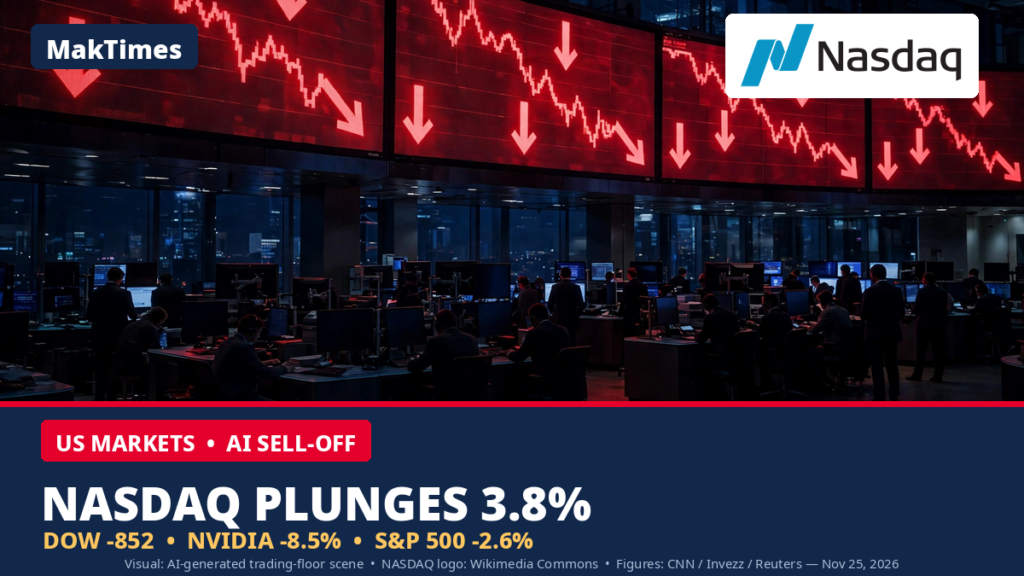
Nasdaq Plunges 3.8% as Dow Drops 852 Points in Deepening AI Sell-Off
The Nasdaq plunged 3.8% on Wednesday as the sell-off in artificial intelligence stocks deepened, dragging the Dow Jones Industrial Average down 852 points and the S&P 500 down 2.6% in a session that erased most of Monday’s sharp rebound.
By late morning in New York, the damage was already severe. The Dow had fallen more than 1,000 points at its worst point of the session, touching 49,015.99, while the Nasdaq was down as much as 4.35% at its intraday low of 22,701.38. The S&P 500 sank nearly 3% at its lowest, to 6,987.38. More than 90% of the stocks in the S&P 500 were in the red.
Nvidia leads the slide
Nvidia sat at the centre of the selling once again. The chipmaker slid 8.5% shortly after markets opened, wiping out a large part of the more than 30% surge it posted on Monday, when the company reinstated Jensen Huang as chief executive. That Monday rally had been the stock’s third-best day on record. Two days later, the mood had flipped entirely.
Anthropic, the AI company behind the Claude chatbot, fell more than 7% in the session. It had already closed Tuesday at $81.91, just below its $83 IPO price, only five trading sessions after its record Nasdaq debut. The stock that Wall Street cheered last week now trades underwater.
The selling spread well beyond the two headline names. Oracle dropped around 7.8%, Alphabet fell 5.6%, and memory chipmaker SanDisk lost nearly 10%. Corning slid 7.9% and Bloom Energy, which supplies power systems for data centres, fell 11%. The State Street Technology Select Sector ETF, a broad basket of tech stocks, traded more than 4.8% lower.
Chip stocks took some of the heaviest hits of the day. Nvidia, Micron, Broadcom, AMD and Intel fell as much as 10% during the session, and the Magnificent Seven group of big tech names dropped as much as 5%. CoreWeave, the AI cloud infrastructure company, lost 10.6%.
Even good earnings offered no shelter. Dell fell more than 7% despite reporting better-than-expected third-quarter results and giving fourth-quarter guidance. Ambarella plunged more than 24% after its current-quarter forecast came in weaker than expected and its third-quarter earnings and revenue both missed estimates. Urban Outfitters dropped 11% after comparable sales grew 4.4%, below the 5.3% analysts had expected. Workday slipped 3% even though it beat on earnings and revenue, after its free cash flow of $691 million fell short of the $712 million consensus.
Hot inflation data raises the stakes
Traders were also digesting fresh economic data that strengthened the case for the Federal Reserve to raise interest rates next month. Core PCE inflation, the Fed’s preferred measure excluding food and energy, rose 3.3% year on year in October, slightly above the Dow Jones estimate and well above the central bank’s 2% target. Headline PCE inflation reached 3.8%, up from 3.7% in September.
The economy, meanwhile, looked stronger than expected. The second estimate of third-quarter GDP showed growth at an annualised 4.3%, against expectations of 3.5%. First-time claims for unemployment benefits totalled 189,000 in the week ended November 21, coming in under the 200,000 economists had expected. Strong growth plus sticky inflation is an awkward combination for a central bank that had been expected to start cutting rates.
Traders are now pricing in a 98% chance that the Fed raises interest rates by a quarter point at its December meeting, according to CME FedWatch. “A December hike was already widely expected, but the bigger question now is whether the Fed sees it as enough, or signals that more tightening may be needed,” Bret Kenwell, US investment strategist at eToro, wrote in a note.
For the December hike debate, see the Fed minutes: Waller makes the case for 50 basis points.
Bond markets told a different part of the story. The 10-year Treasury yield fell to around 4.84% as investors nervous about the AI trade rushed into the safety of bonds. Yields fall when bond prices rise.
Tariffs pile on
A fresh tariff announcement added another layer of pressure. The US Trade Representative’s office published proposed tariff rates targeting 16 economies, including Japan, South Korea, China, the European Union and Taiwan, citing overproduction concerns. President Donald Trump unveiled the new set of duties on Wednesday, reigniting nerves about a trade war with China.
The proposal landed on a market already rattled by the inflation print and the AI sell-off. Tariffs raise costs for American companies and their customers, and the prospect of retaliation from trading partners has a habit of turning a bad day into a worse one.
The AI mood has turned
What makes this week’s slide different from the wobbles earlier in the month is the breadth of the doubt. Investors are no longer just trimming the hottest names. They are questioning whether the AI spending boom can keep paying for itself.
Elon Musk added to that doubt earlier in the week, saying AI companies could face a cash crunch in the next year as computing prices moderate with new capacity being built. The warning landed in a market already asking how long data-centre spending can grow at its current pace, and who pays if it slows.
The worry has travelled well beyond American shores. South Korea’s Kospi, dominated by memory chip giants SK Hynix and Samsung, closed down 6.2% on Wednesday. It has now plunged 48% since a peak in June. Europe’s benchmark Stoxx 600 index lost around 0.3%, a smaller fall, but still in the red as the AI worry rippled across markets.
Monday’s euphoria already feels like a long time ago. The Dow had reclaimed 50,000 on Tuesday, closing at 50,018.70, and the Nasdaq had jumped more than 6% on Monday in its best day in months. Wednesday’s session gave a large part of that back in a few hours, and the Nasdaq is now on course for one of its worst days of the year.
A short week ahead
Trading now runs into the Thanksgiving break. US stock markets are closed on Thursday, November 26, for Thanksgiving, and the New York Stock Exchange closes early at 1:00 p.m. ET on Friday, November 27. That leaves little time this week for buyers to steady the market, and holiday-thin trading can make sharp moves sharper.
Attention then turns to the Federal Reserve, which meets on December 8–9. The inflation data released on Wednesday has made a rate rise at that meeting close to a certainty in traders’ eyes. What matters next is what the Fed signals about 2027: whether one rise is enough, or whether more tightening is coming. For a market built on cheap money and expensive AI promises, that answer matters more than any single day’s fall.
Sources: CNN, November 25, 2026; Invezz, November 25, 2026; Reuters, November 25, 2026; Zacks, November 25, 2026; Morningstar, November 25, 2026.
Educational Content Only — Not Financial Advice: MakTimes is a news and education website. This article is published for general information and awareness only and is not financial, investment, trading, or legal advice. We are not financial advisors. Cryptocurrency, gold, and other markets are volatile and can result in loss. Always do your own research (DYOR) and consult a licensed financial advisor before making any financial decision. Past performance is not a guarantee of future results.