
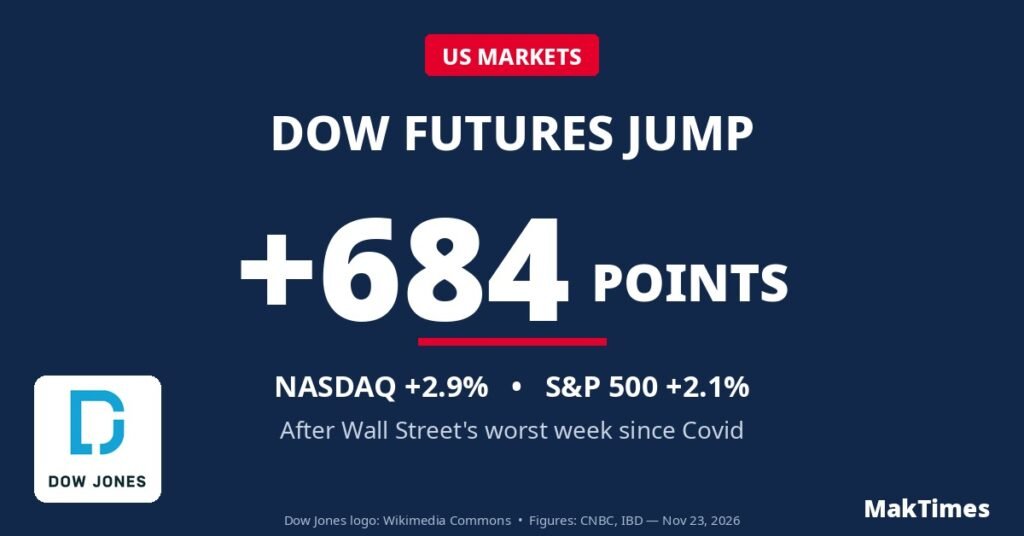
US Stock Market Today: Dow Futures Jump 684 Points as Nasdaq Soars 3% After Worst Week Since Covid
Wall Street is trying to get back on its feet. Futures tied to the Dow Jones Industrial Average jumped 684 points, or 1.41%, on Sunday night. S&P 500 futures rose 2.1%. Nasdaq futures climbed 2.89%. The bounce arrived after the worst week American stocks have suffered since the Covid crash — a week that wiped trillions of dollars off share values and left all three major indexes in correction territory.
The numbers from Friday still sting. The Dow closed at 48,147.33, down 949.73 points on the day and 8% on the week — its worst weekly fall since March 2020. The S&P 500 finished at 6,910.39, down 3.7% on Friday and 8.6% for the week. The Nasdaq Composite ended at 22,617.73, down 5.3% on Friday and 10% across the five sessions, erasing every gain it had made in 2026.
Nobody on Wall Street is calling this a bottom yet. Futures move fast in the thin Sunday-night session and have faded before the opening bell more than once this autumn. But the size of the move gave traders something they had lacked all last week: a reason to buy.
The funding question Oracle had to answer
The spark came from Oracle. After Friday’s close, the software giant posted on X that it “has secured all the funding we need to fulfill our contract with OpenAI” and described itself as the first hyperscaler fully funded for this investment cycle. The message was aimed at the doubt haunting the stock for weeks: how does a company of Oracle’s size pay for a $300 billion computing deal?
Oracle’s answer, in short, is that the money is already lined up. The company completed a roughly $20 billion capital raise at the start of November — about $10 billion from selling shares at $116 each and about $10 billion in bonds carrying coupons of between 7% and 8.65%. The financing outlined at its investor day, including vendor financing, is in place, the company said. Construction at the Stargate site in Abilene, Texas, where OpenAI’s GPT-6 Astra model was trained, is nearly complete, and the two companies plan another 4.5 gigawatts of data-centre capacity across the United States.
The market’s first reaction was brutal. Oracle shares fell 8.48% on Friday to $101.19, a new 52-week low close, with an intraday low of $100.25. The stock is down 19.3% over five sessions and 48% so far this year. After hours, it clawed back about 2% to roughly $103.29 — a small vote of confidence, not a verdict.
The doubt is not hard to see. Oracle recently reported capital spending of $28.5 billion against negative free cash flow of $5.4 billion, and it does not expect positive free cash flow until the second half of fiscal 2028, with a target of more than $30 billion in fiscal 2029. Bernstein analyst Mark Moerdler is holding an Outperform rating with a $325 price target, arguing the market is now pricing Oracle below even his stress case, in which AI data-centre revenue evaporates and the hardware becomes worthless.
Whether Oracle’s statement holds is the question hanging over the whole AI trade. Sunday night’s futures suggest the market, for now, is willing to give the company the benefit of the doubt.
Asia tries to stop the slide — but Seoul keeps falling
Asian authorities moved over the weekend too. South Korea is preparing a 10 trillion won market-stabilisation fund, temporarily easing daily share-buyback restrictions and stepping up surveillance of illegal short selling, margin loans and possible forced liquidations. China and Taiwan announced stabilisation measures of their own, according to reports carried by Investor’s Business Daily.
It has not been enough — yet. South Korea’s KOSPI fell as much as 5.41% intraday on Monday as investors kept retreating from technology and semiconductor shares, and the index is now down 17% in November. The KOSPI closed last week at 4,869.96, down 7.9% on the week, with Samsung Electronics down 11.1% and SK Hynix down 8.5%. Foreign investors have sold Korean stocks for a seventh straight month, with cumulative net outflows of $115.2 billion — the biggest retreat on record, according to LSEG data cited by Reuters.
The Korean rout matters because it shows what is really being tested. Samsung and SK Hynix make nearly half the KOSPI’s value between them, and together they dominate the world’s supply of the AI memory chips that data centres need. Their earnings have soared — ninefold and sevenfold respectively — yet the shares keep falling. The disconnect, analysts say, is now about buyers, not profits: with foreign money leaving and buyback programmes winding down, few buyers are left to step in.
What last week actually cost
The scale of the damage is worth stating plainly, because it explains why a single Sunday-night bounce cannot settle anything. The S&P 500 fell for seven straight sessions, its longest losing streak since the pandemic began in 2020, and now sits 11.6% below its October 6 record high. The Nasdaq is roughly 18% below its own peak. All 11 sectors of the S&P 500 fell more than 1% on the week, the first time that has happened since the week of April 4, 2025. Smaller companies fared no better: the Russell 2000 lost 7.5% on the week.
The fear gauge told the same story. The Cboe Volatility Index, or VIX, closed Friday at 35.89 — up 86% on the week, its highest level since April 2025. Money rushed into government bonds, pushing the 10-year Treasury yield down to 4.91%. Gold slid to around $3,546 an ounce, on course for its worst week in eight months. Bitcoin, which crashed to $55,100 over the weekend, steadied near $61,000 on Monday morning.
Nvidia sat at the centre of the wreckage. Its shares plunged 14% on Friday and finished the week down 23% — its worst week since the financial crisis of 2008 — after Reuters reported that the Securities and Exchange Commission is examining the company’s accounting. Anthropic, whose record Nasdaq debut had been one of the few bright spots of the week, slid 9.1% on Friday to $88.30.
What comes next: Dell, inflation data and Thanksgiving
Hewlett Packard Enterprise reports quarterly results after Monday’s close, and its AI-server orders will be an early read on data-centre spending. Dell reports on Tuesday evening — the first big report on AI-server demand since the rout — alongside Workday and Autodesk.
Wednesday is the big day. At 8:30 a.m. Eastern come the second estimate of third-quarter growth, durable-goods orders, weekly jobless claims a day early because of the holiday, and the October personal consumption expenditures price index — the Federal Reserve’s preferred inflation gauge. Futures markets still put the odds of a quarter-point Fed rate rise on December 9 at roughly 90%, according to CME FedWatch data cited by TheStreet.
Thanksgiving then shortens the week: US markets close on Thursday, November 26, and trading ends early at 1 p.m. Eastern on Friday, November 27.
Edward Yardeni of Yardeni Research cut his year-end S&P 500 target to 7,500 from 7,900 after the sell-off. Morgan Stanley and Goldman Sachs still expect the S&P 500 to finish 2027 at 8,700, according to Fortune. Those are forecasts, not outcomes.
A bounce is not a bottom. But after five sessions of relentless selling, Monday’s futures gave the market its first quiet morning in a week. Whether buyers hold through Dell’s results and Wednesday’s inflation data will say more about the AI trade than any single Sunday-night rally can.
Sources: CNBC, “Stock market today: Dow futures jump 700 points and Nasdaq soars 3% after entering correction” (23 November 2026); Investor’s Business Daily, “Dow Jones Futures Jump As Oracle, Korea Try To Ease Market Fears” (23 November 2026); Reuters, “Record profits but record outflows: ‘Sell Korea’ trade stalks Seoul market” (19 November 2026); Seeking Alpha, “South Korea’s KOSPI drops 5% as AI fears trigger broader stock sell-off” (23 November 2026); The Associated Press via MarketWatch, Friday market closes (20 November 2026); MarketSunrise, “US Stock Market Week Ahead: AI Rout, Dell & PCE” (22 November 2026).
Educational Content Only — Not Financial Advice: MakTimes is a news and education website. This article is published for general information and awareness only and is not financial, investment, trading, or legal advice. We are not financial advisors. Cryptocurrency, gold, and other markets are volatile and can result in loss. Always do your own research (DYOR) and consult a licensed financial advisor before making any financial decision. Past performance is not a guarantee of future results.
Pingback: KSE-100 Today: PSX Jumps 1,000 Points to 178,400 on Monday