
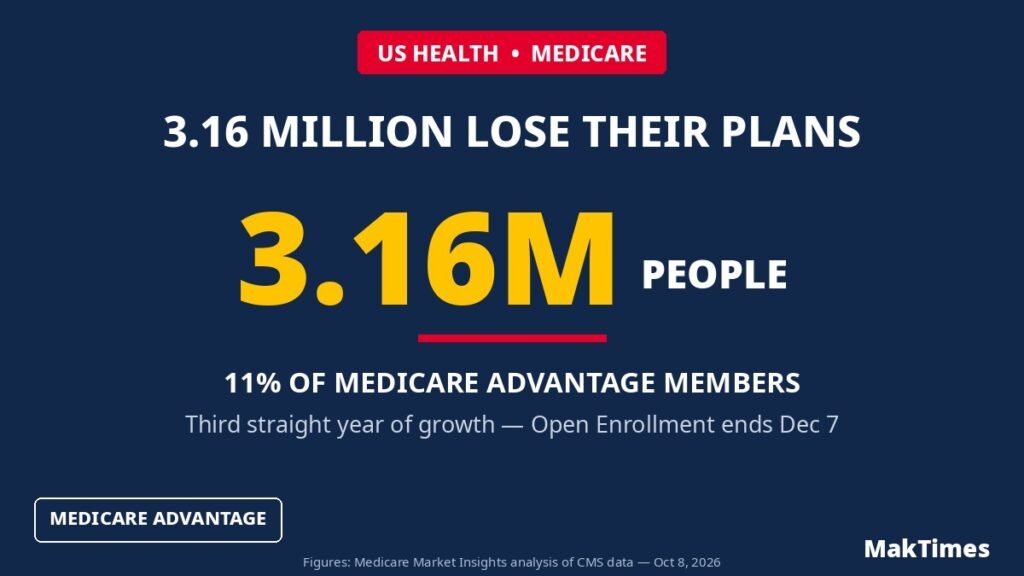
Medicare Advantage Disruptions 2026–2027: 3.16 Million People Are Losing Their Plans
For 2027, some 3.16 million people will find their Medicare Advantage plan has gone — 11% of all individual Medicare Advantage enrollment, or more than one member in ten — in the third consecutive year that the total has risen. Open Enrollment closes on December 7, 2026, which leaves ten days for the people affected to find new coverage.
Medicare Market Insights reached the total in an October 8 study of federal figures: about 2 million people lost a plan for 2025, about 2.87 million for 2026, and 3,156,598 for 2027. A separate estimate from health technology firm Duos puts the number of people forced to switch even higher, at roughly 5 million, because it counts members whose plans changed so much that staying put is no longer a real option.
Losing a Medicare Advantage plan used to be unusual. Figures cited by Medicare Market Insights show that, from 2021 to 2024, terminations and service-area cuts together removed only 0.4% to 1.5% of members each year. Johns Hopkins researchers found a similar pattern: forced disenrollment averaged around 1% a year between 2018 and 2024, then jumped to 6.9% in 2025 and was expected to reach about 10% in 2026. The 2027 figure — 11% — is the third year in a row above 7%.
What “losing a plan” actually means
That 3.16 million total divides in two, and which half a person falls into changes what they should do next.
Roughly three in four of those affected — about 2.36 million people — are in plans that are ending outright, ceasing to exist on December 31, 2026. The remaining quarter, about 800,000 people, are in plans that will still be around in 2027 but are pulling out of their county — what the industry calls a service-area reduction. The plan survives; the member’s address no longer qualifies for it.
One plan type bears most of the disruption: local PPOs, the broad-network products that allow out-of-network doctors at a higher cost, account for 59% of it. Almost a fifth of local PPO members — 1,849,692 people — are in a plan that is terminating, against 7% for HMO plans. The pattern is not a retreat from Medicare Advantage itself, but from its widest-network products, which are the most expensive to run.
Who is cutting, and where
Humana, the biggest single cutter, moved first. On its second-quarter earnings call the insurer said its 2027 plan exits would affect about 600,000 members — 8% of its 7.2 million Medicare Advantage members — to “prioritize higher-performing plans.” It is Humana’s second year of market exits in a row; in 2026 it dropped 194 counties from its service area.
The rest of the industry followed the same logic. UnitedHealthcare is ending plans that cover roughly 390,000 members and is withdrawing from 228 counties. Health Care Service Corporation — operator of nonprofit Blue Cross plans in five states — is withdrawing from 498 counties while entering none, followed by Centene with 359 counties, Elevance Health with 66 and Humana with 62.
Smaller carriers are leaving outright. Clear Spring Health said it is leaving the Medicare Advantage market altogether, closing its Colorado, Georgia and Illinois businesses. Presbyterian Health Plan is pulling out of further Medicare Advantage markets in 2027, affecting around 30,000 subscribers. Molina Healthcare is to stop selling Medicare Advantage plans that include prescription-drug coverage in 2027.
The geography is where the disruption turns into a real problem. About 638,000 people with Medicare live in 193 counties where, for 2027, no Medicare Advantage plan that includes Part D drug coverage is accepting general enrollment — up from 123 counties this year. There, people do not get to pick between insurers; the options are Original Medicare with a separate drug plan, or no Advantage plan at all.
Rural counties are hit hardest. KFF found that in 2026 the average beneficiary could choose from 32 Medicare Advantage plans with drug coverage, down from 42 options the year before. But averages hide the thin spots: in Alaska there was no plan at all, one in Vermont, four in South Dakota and three in Wyoming. Disruption in 2026 was already severe: a February analysis in the medical journal JAMA found that up to a tenth of the market had to look for a new plan, with more than a fifth of enrollees losing theirs in 12 states — and 92% in Vermont.
Why insurers are pulling back
A shortfall in funding lies behind the cuts. Insurers say the cost of patient care has risen faster than the money Medicare pays them, leaving the 2027 payment rise short of closing the gap. The Centers for Medicare & Medicaid Services first proposed an average payment increase of almost nothing for 2027 — 0.09%. The final figure, announced in April, was 2.48%. Better, but insurers said it still would not cover rising patient-care expenses.
A second squeeze came from federal policy: after years of criticism that Medicare Advantage plans were overbilling the program, officials moved to cut overpayments to insurers, lowering reimbursement rates, while medical costs kept rising. The result, in the words of Shannon Benton of the Senior Citizens League, is that insurers are now “prioritizing profit growth over enrollment growth.”
Falling star ratings also reduced quality bonus payments, pushing insurers to end lower-rated plans and shift members into higher-rated contracts.
Medicare Advantage now covers more than half of eligible beneficiaries — 55% in 2026, according to KFF, or about 35 million older Americans. UnitedHealthcare accounts for more than a quarter of that enrollment and Humana for about a fifth, so when carriers that large redraw their maps, millions of people move with them.
The money members will pay
Finding a new plan is only part of the disruption. Inside the plans that survive, costs are climbing on several fronts at once — doctor and prescription copayments, deductibles and out-of-pocket limits.
January brings the squeeze into focus in two numbers. Social Security benefits rise 3.6% in 2027, the biggest cost-of-living adjustment since 2023, taking the average retired worker’s check from $2,095 to $2,170 a month — about $75 more. But the standard Medicare Part B premium, deducted from that check for most beneficiaries, rises to $209.40 a month, up $6.50 from $202.90, and the Part B deductible rises to $292 from $283. The raise is real, yet the premium takes a share of it before the money reaches a bank account.
One contrast has drawn attention: the administration announced payments of at least $90 for 20 million traditional Medicare beneficiaries, but not for those in private Medicare Advantage plans, according to InsuranceNewsNet — leaving the people facing the largest disruption outside that payment.
What to do before December 7
For 2027 coverage, enrollment opens on October 15 and closes on December 7, 2026. Anyone whose plan is ending must choose 2027 coverage by December 7.
First, find out whether your plan will continue. Insurers had to warn members in advance, with non-renewal letters due by September 30 before the 2027 changes, so watch for yours in the mail along with the Annual Notice of Change, which lays out your plan’s changes for 2027. A plan ending does not end your Medicare coverage. From there you can pick a different Medicare Advantage plan, go back to Original Medicare with a separate drug plan, or, if you qualify, use a Guaranteed Issue Right to buy certain Medicare Supplement plans.
Three checks cover most of the risk: the new out-of-pocket limit compared with 2026, the Part D deductible compared with 2026, and whether a Part B giveback the plan used to offer is still there. In rural counties, first establish whether any plan is open to general enrollment in your county at all — in 193 counties, for a drug plan, the answer is no.
This is not a one-year disruption. Three straight years of growth in the share of members losing plans — 7%, then 10%, then 11% — make a pattern, and the insurers’ own words describe a retrenchment driven by margins rather than one bad year. For the 3.16 million people with a non-renewal letter, December 7 is the practical deadline; after it, the choices narrow to whatever remains.
FAQ
How many Medicare Advantage members are losing their plans for 2027?
Medicare Market Insights’ October 8 analysis of CMS data puts it at about 3.16 million people, 11% of individual Medicare Advantage enrollment; Duos, in a separate estimate, puts the number forced to switch at roughly 5 million.
Has this scale of Medicare Advantage disruption happened before?
No, it is the third year in a row the number has grown: roughly 2 million people lost plans for 2025 (7% of members), about 2.87 million for 2026 (10%) and 3.16 million for 2027 (11%), versus 0.4% to 1.5% a year before 2025.
Which insurers are cutting Medicare Advantage plans for 2027?
Humana is the largest, with about 600,000 members affected. UnitedHealthcare is ending plans that cover about 390,000 members, while Health Care Service Corp., Centene and Elevance are each leaving hundreds of counties. Clear Spring Health is leaving the market entirely, and Presbyterian Health Plan and Molina Healthcare are scaling back.
What is the difference between a plan termination and a service-area reduction?
A termination means the plan ceases to exist; a service-area reduction means the plan continues but withdraws from your county. Roughly 75% of the 3.16 million affected members are in terminated plans and about 25% (roughly 800,000) in service-area reductions.
When is the last day to pick 2027 Medicare coverage?
December 7, 2026. The window runs October 15 to December 7, and anyone whose plan is ending must have chosen 2027 coverage by then.
If my plan ends, do I lose Medicare?
No — a plan ending does not end your Medicare coverage. From there you can pick a different Medicare Advantage plan, go back to Original Medicare with a separate drug plan, or, if you qualify, use a Guaranteed Issue Right to buy certain Medicare Supplement plans.
Why are insurers cutting Medicare Advantage plans?
Insurers say the cost of patient care has risen faster than Medicare payments — CMS set a 2.48% average rate increase for 2027 — and federal moves to reduce overpayments cut reimbursements further. Falling star ratings also reduced quality bonus payments. Insurers describe the shift as prioritizing profit growth over enrollment growth.
Educational Content Only — Not Financial Advice: MakTimes is a news and education website. This article is published for general information and awareness only and is not financial, investment, trading, or legal advice. We are not financial advisors. Always do your own research and consult a licensed professional before making any financial decision.
Sources: Medicare Market Insights, October 8, 2026; Duos; Johns Hopkins; KFF; JAMA, February 2026; Centers for Medicare & Medicaid Services, April 2026; InsuranceNewsNet.