
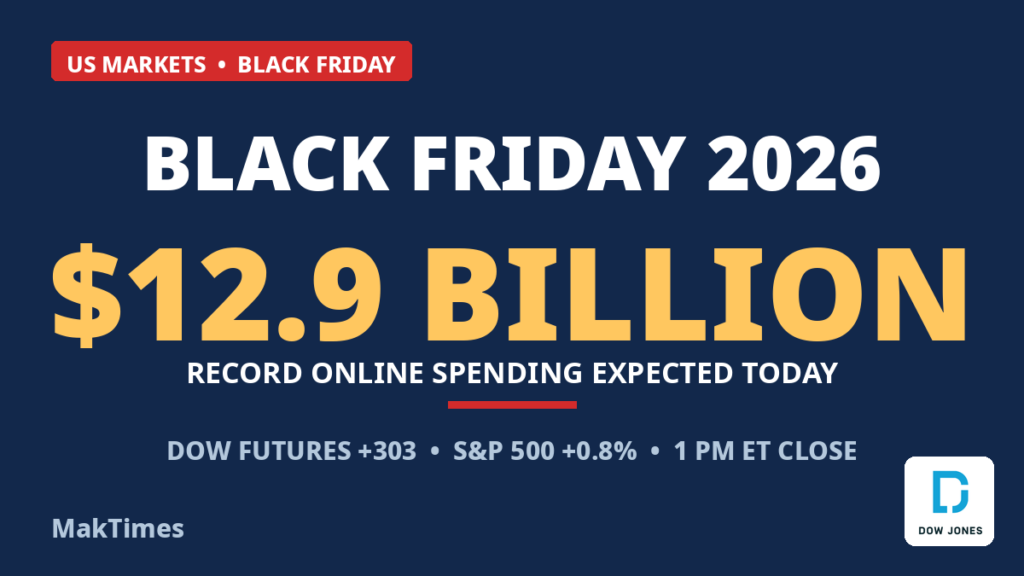
Black Friday 2026: Dow Futures Jump 303 Points as $12.9 Billion Shopping Day Begins
Black Friday 2026 arrived with Wall Street pointing higher. Contracts tied to the Dow Jones Industrial Average climbed 303 points, or 0.6%, in overnight trading, while S&P 500 futures rose 0.8% and Nasdaq 100 futures gained about 0.7%, setting up a positive reopen after the Thanksgiving break. The buying came after one of the wildest sessions of the year — and on the very day American shoppers are expected to spend a record $12.9 billion online.
Stocks are trying to steady themselves after a bruising sell-off. Shoppers are about to tell everyone whether the American consumer is still holding up. Both answers start landing today.
Black Friday 2026: futures point higher after Wednesday’s wild swing
Wednesday was the kind of day traders remember. The Dow sank more than 1,100 points at its worst, then turned around and finished 167 points higher at 50,182.95. It was the biggest comeback for the blue-chip average since 2022, and MakTimes reported it as it happened. The Nasdaq had its own whipsaw: down as much as 4.6% during the session, it clawed back most of the damage to close 0.6% lower at 23,585.80. The S&P 500 slipped 0.3% to 7,182.78.
Futures suggest the recovery has legs. S&P 500 futures traded near 7,243 overnight, up about 0.65%, and Nasdaq 100 futures rose to roughly 26,244. Investor’s Business Daily had the Dow up 0.7% and the Nasdaq 100 up 1%; the direction never changed.
For the week so far, the S&P 500 is up almost 4% through Wednesday’s close, according to CNBC. Wednesday was only the third day of what technicians call a rally attempt. A follow-through day — a strong gain on rising volume that confirms a new uptrend — could arrive as soon as Friday, even on the Nasdaq, though thin holiday trading makes the signal harder to read.
A $12.9 billion day for online shopping
The shopping numbers are the other half of today’s story, and they are striking on their own. Adobe Analytics expects Americans to spend $12.9 billion online on Black Friday, up 9.2% from the $11.8 billion record set last year. Cyber Monday, on November 30, is forecast even bigger at $15.1 billion. Across the whole holiday season, Adobe puts online spending at $275.1 billion, up 6.7%.
The National Retail Federation, which counts all retail rather than just online, expects November and December sales to pass $1 trillion for the first time — $1.013 trillion, up 4.2% on last year. It expects 126 million Americans to shop on Black Friday itself and 182.7 million across the Thanksgiving weekend. Last year a record 202.9 million people shopped over the same stretch.
Mastercard’s own forecast is a touch more optimistic: holiday retail sales up 5.5%, with online spending rising 11% and physical stores growing 3.6%.
The discounts are doing the work. Adobe expects peak markdowns of 30% on electronics and 29% on toys, roughly in line with last year. Pay-later checkout is set for another record too, with Adobe forecasting $21.3 billion of it across the season. And the way people find deals is changing fast: traffic referred to US retailers by AI tools is expected to jump 95% on Black Friday alone.
A short session, and thin trading
Anyone watching the tape today needs to know the clock. The New York Stock Exchange and the Nasdaq open at the usual 9:30 AM Eastern time but shut early at 1:00 PM. Bond markets close an hour later. It is the shortest regular session of the year, and volumes are usually light, with many traders still out of office.
That thinness cuts both ways. Small orders can move prices more than usual, and a gain that looks convincing at midday can fade fast. Veteran traders treat holiday sessions as a preview, not a verdict. The real test comes next week, when full desks return and the market has to hold whatever ground it takes today.
The consumer test behind the rally
Strip away the futures and the forecasts, and Black Friday is really a test of one thing: whether American households keep spending while the economy sends mixed signals. Inflation, measured by the core PCE index, came in at 3.3% in the latest reading, and the Federal Reserve meets on December 8–9 with markets pricing in another rate rise. Growth, meanwhile, was revised up to 4.3% in the third quarter.
Retailers have been planning for a split consumer all year. Higher-income shoppers are still spending freely; lower-income households are leaning harder on discounts, credit and pay-later plans. That is why the discount depth matters as much as the headline sales figure.
Adobe will publish the actual Black Friday total over the weekend, and the Census Bureau’s November retail sales report follows on December 16.
What traders watch next
For the market, today is about whether the rebound can survive contact with a full week. The Dow’s comeback on Wednesday was dramatic, but the index is still nursing the losses of the worst week since Covid. The Nasdaq remains the worry: it has fallen hard on AI valuation doubts, and the chip names that led the sell-off — Nvidia, Micron, AMD — were among the strongest in overnight trading.
If Friday delivers a follow-through day, the rally attempt gets its confirmation. If the early gains fade into the 1:00 PM close, sceptics will call the comeback a holiday bounce. Either way, the answer will be clearer by Monday, when volume returns and the market has to defend its levels with real money.
Black Friday has always been about more than shopping. This year it doubles as a confidence vote — in the consumer, in the rally, and in a market that has spent the last two weeks reminding everyone how quickly it can fall.
Sources: Barron’s, Investor’s Business Daily, Finwire, Adobe Analytics holiday forecast, National Retail Federation, Mastercard Economics Institute, Salesforce — 27 November 2026.
Educational Content Only — Not Financial Advice: MakTimes is a news and education website. This article is published for general information and awareness only and is not financial, investment, trading, or legal advice. We are not financial advisors. Cryptocurrency, gold, and other markets are volatile and can result in loss. Always do your own research (DYOR) and consult a licensed financial advisor before making any financial decision. Past performance is not a guarantee of future results.