
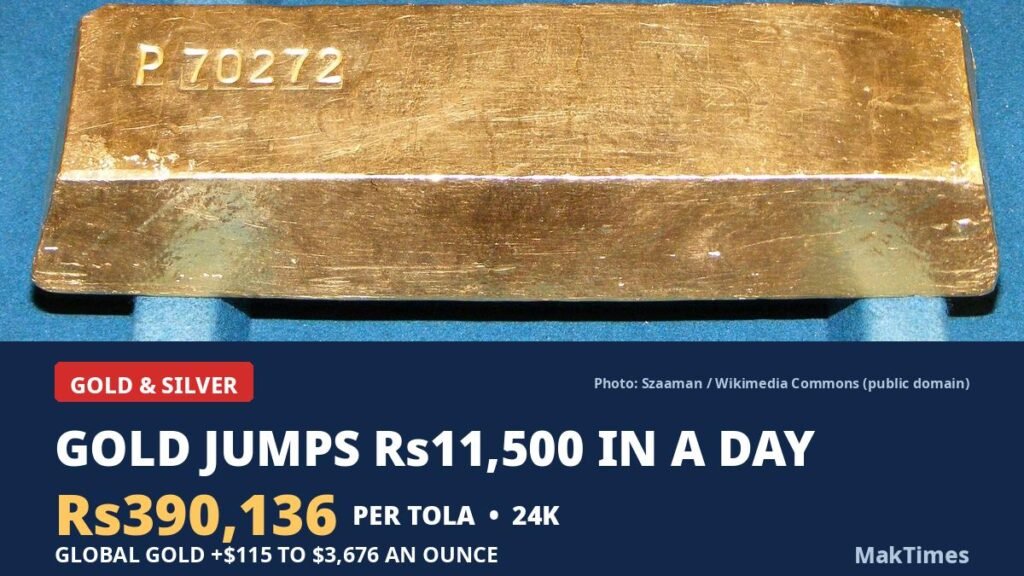
Gold Price in Pakistan Today: Gold Jumps Rs11,500 Per Tola as Global Gold Rebounds From 14-Month Low
Gold buyers in Pakistan woke up to a jolt on Friday. The price of 24-karat gold shot up Rs11,500 in a single day — one of the sharpest one-day jumps of the year — as the metal staged a powerful recovery in world markets after sliding to its lowest level in fourteen months.
Friday’s official tola rate, fixed by the country’s sarafa association, was Rs390,136 — higher than the figure quoted the day before. Ten grams rose Rs9,859 to Rs334,478. Silver moved with it, gaining Rs277 to Rs4,906 per tola. The jump tracked a surge in international bullion, where gold climbed $115 in a day to $3,676 an ounce.
It was a sudden reversal. Only two days earlier, on Wednesday, gold had touched $3,426 an ounce — its weakest since late August last year. By Friday afternoon in New York, spot gold was trading above $3,640, up more than 2% on the day and over 3% at one point during the session. December futures on the US COMEX exchange settled 2.9% higher at $3,637.60 an ounce.
What moved in Pakistan
The local market follows the world price, with a premium of roughly $20 an ounce built in, according to the association. When international gold jumps $115, the tola rate in Karachi and Lahore follows within hours.
Friday’s move came after a bruising stretch. Gold in Pakistan had already fallen hard through November. On November 19, the tola rate stood at Rs399,400. By November 23 it had slid to Rs384,200. Friday’s Rs11,500 jump recovered roughly three-quarters of that slide in a single session.
Saturday morning, independent sarafa trackers showed the rate holding around Rs393,700 per tola, up a further few hundred rupees from Friday’s official close — a sign the rebound had not faded overnight.
Silver moved the same way, only more sharply. The white metal surged roughly 5% globally on Friday to around $44 an ounce, its strongest showing in the rally. In Pakistan, that translated into the Rs277 per-tola rise to Rs4,906.
Global gold’s sharp turnaround
The recovery had three drivers, and none of them was a mystery.
First, bargain hunting. After weeks of heavy selling, gold had fallen far enough — and fast enough — that buyers stepped back in. The metal had lost more than 9% the previous week, its worst weekly fall in eight months, and was down by more than a third from January’s record high above $5,400 an ounce. At $3,426, traders who had been waiting on the sidelines started buying.
Second, physical demand from Asia stayed firm. Jewellers and retail buyers in China and India kept purchasing through the slide. World Gold Council data shows Chinese demand for gold bars and coins hit a record 393 tonnes in the first nine months of this year, even as jewellery buying fell by more than a quarter. When prices dropped, that underlying demand did not disappear — it waited for a cheaper entry point, and Friday was it.
Third, the mood in wider markets improved. Concerns about artificial-intelligence spending eased after a brutal week for technology shares, and the US dollar softened. A weaker dollar makes gold cheaper for buyers paying in other currencies, and it often lifts the metal on the same day.
Why gold fell so far first
The rally needs context, because the fall that came before it was extraordinary. Gold began 2026 on a tear, reaching an all-time high near $5,405 an ounce in January. Then the metal turned. Hot American inflation data hardened expectations that the Federal Reserve will keep raising interest rates next month — and possibly again early next year — instead of cutting them.
Higher rates are gold’s oldest enemy. The metal pays no interest, so when rates rise, holding gold costs more in lost income. That logic drove the metal below $4,000 an ounce on November 11, and it has stayed there since. By Wednesday, gold had given up almost $2,000 from its January peak.
Analysts quoted by Reuters were careful about Friday’s bounce. Several said it was too early to call a bottom, with the Fed’s next decision due on December 9 and rate-hike expectations still capping the advance. The metal is still heading for a third straight monthly decline of more than 6%.
What it means for buyers in Pakistan
For households, the timing is awkward. Wedding season is under way, and gold is the purchase most families cannot postpone. A tola that cost Rs384,200 on Monday now costs Rs390,136 — and jewellers add making charges on top of the sarafa rate, so the bill at the counter is higher still.
Savers face the same question from the other side. Gold has been the refuge of choice for Pakistanis protecting cash from inflation for generations, and the metal’s wild November — down sharply in a matter of days, then up Rs11,500 in one — is a reminder of how quickly that refuge moves in both directions.
The rupee has been steady, trading near Rs276 to the dollar, so this week’s moves have come almost entirely from the world gold price rather than the currency. That cuts both ways: if global gold slips again, the local rate follows it down just as fast.
For now, the market is watching two dates. The Federal Reserve announces its next rate decision on December 9, and the decision will set the tone for gold into the new year. Until then, Friday’s jump is best read as a sharp bounce inside a much bigger slide — welcome for sellers, costly for buyers, and far from a settled trend.
Silver jumps too
Silver deserves its own note. The metal rose about 5% on Friday to roughly $44 an ounce, outpacing gold, and at one point during the session its December contract was up more than 8%. Silver is more volatile than gold — it swings harder in both directions — and Friday showed the upside of that volatility. In Pakistan, the per-tola rate rose Rs277 to Rs4,906.
Sources: The News (All Pakistan Sarafa Gems and Jewellers Association rates), 28 November 2026; Reuters, 27–28 November 2026; The Wall Street Journal market talk, 28 November 2026; World Gold Council data via Reuters, 28 November 2026; MakTimes reporting, 19 and 23 November 2026.
Educational Content Only — Not Financial Advice: MakTimes is a news and education website. This article is published for general information and awareness only and is not financial, investment, trading, or legal advice. We are not financial advisors. Cryptocurrency, gold, and other markets are volatile and can result in loss. Always do your own research (DYOR) and consult a licensed financial advisor before making any financial decision. Past performance is not a guarantee of future results.
Pingback: FOMC Meeting Schedule 2027: Seven Rate Decisions Listed