
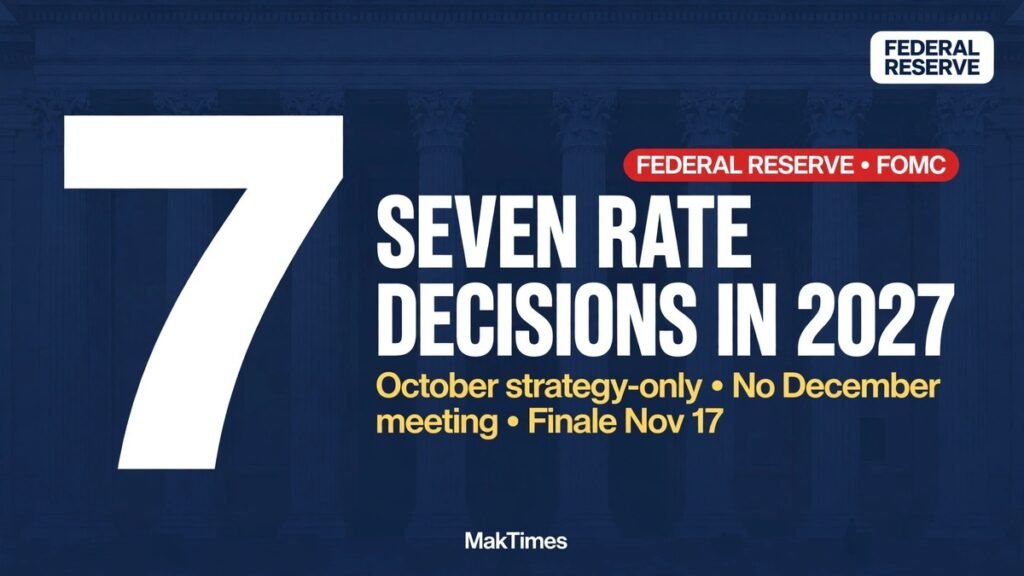
Fed Cuts Its 2027 Calendar to Seven Rate Decisions: Full FOMC Meeting Schedule for 2027
The Federal Reserve has redrawn its own calendar for 2027, and the change is bigger than a shuffled date. When the Fed published its revised tentative schedule on November 12, 2026, it did two things markets had not seen before: it turned one of the year’s eight meetings into a strategy session with no interest-rate vote at all, and it moved the year’s final rate decision forward by three weeks, from December to November.
The result: seven rate decisions instead of eight, a mid-autumn gap in the decision cycle, and a November finale carrying the year’s last word on borrowing costs — the dates that will move stocks, mortgage rates, gold and the dollar next year.
This article sets out the full schedule, what changed from the Fed’s original 2027 calendar, and how each decision day works.
The full 2027 FOMC calendar
For 2027, the Federal Open Market Committee has eight meetings scheduled. Each meeting runs for two days, Tuesday to Wednesday, and the policy decision is announced at 2:00 p.m. Eastern Time on the second day. The schedule, as published by the Federal Reserve on November 12, 2026:
| Meeting | Decision day | Rate vote? | Summary of Economic Projections |
|---|---|---|---|
| January 26–27 | Wednesday, January 27 | Yes | No |
| March 16–17 | Wednesday, March 17 | Yes | Yes |
| April 27–28 | Wednesday, April 28 | Yes | No |
| June 8–9 | Wednesday, June 9 | Yes | Yes |
| July 27–28 | Wednesday, July 28 | Yes | No |
| September 14–15 | Wednesday, September 15 | Yes | Yes |
| October 26–27 | Tuesday, October 27 | No — strategy meeting | No |
| November 16–17 | Wednesday, November 17 | Yes | Not yet published |
The first meeting of 2028 is already pencilled in for January 25–26, 2028.
Every date is tentative until the committee confirms it at the meeting before, and the Fed can still call an unscheduled meeting if conditions demand one. But barring that, these are the dates that will set the cost of money in 2027.
What changed from the original 2027 calendar
The Fed had already published a tentative 2027 calendar once before. That version ran January 26–27, March 16–17, April 27–28, June 8–9, July 27–28, September 14–15, October 26–27 and December 7–8 — eight meetings, eight rate votes, with the year ending in December as usual.
The November 12 revision changes two things.
First, the October 26–27 meeting is no longer a rate-setting meeting. The Fed’s own announcement says it “will be dedicated to the discussion of broad monetary policy strategy issues.” There will be no rate vote and, on the Fed’s wording, no policy decision announced that week. Federal Reserve Chair Kevin Warsh had signalled the plan at the October 28, 2026 press conference, telling reporters that one meeting in the fall of 2027 would be set aside for a strategy discussion.
Second, the December meeting is gone. In its place, the committee will meet on November 16–17, and that becomes the final rate decision of 2027. The year will close without a December decision for the first time in the modern calendar — no rate call in the final six weeks of the year, and no December press conference to close out 2027.
Taken together, the revision means seven chances for the Fed to move rates in 2027, not eight, and a seven-week stretch from the September 15 decision to the November 17 finale in which the committee meets once and does not vote.
Why the October meeting has no rate vote
A meeting with no rate decision is unusual, but it is not unprecedented in spirit. The Fed reviews its monetary policy framework every few years, and the October session is set aside for that kind of broad discussion — the strategy questions that do not fit inside a two-day rate debate: how the committee thinks about its inflation goal, how it weighs employment against prices, and how it communicates its intentions.
That matters for markets even though no rate changes hands in October. A framework discussion can move expectations about every meeting that follows it. If the committee signals a different way of thinking about inflation or about how quickly it should react to the data, traders reprice the November decision and the whole 2027 path within hours. The October meeting will produce no statement and no vote, but the minutes — released three weeks later, on November 17 — will be read line by line for exactly that reason.
It is also worth noting what the October meeting does not mean. It is not a pause, and it is not a signal that the Fed has finished its work for the year. The November meeting still carries a full vote, and the committee can still act between meetings if events force its hand. The October session is a deliberate gap, not an accident.
The meetings that matter most
Not all seven decisions carry equal weight. Three of them — March, June and September — come with the Summary of Economic Projections, the Fed’s quarterly release of its own forecasts for growth, unemployment, inflation and the path of rates. Those are the meetings where the committee shows its hand: the “dot plot” of individual rate forecasts is published alongside the decision, and the chair holds a press conference to explain it.
The March 17 meeting is the first projections release of the year and the first chance to see how the committee’s view of 2027 has changed since December. June 9 brings the mid-year update. September 15 is the last scheduled projections release of the year — and, under the revised calendar, the last one before the November finale.
The November 17 meeting is the year’s final rate decision, and it now carries a weight the December meeting used to hold. Whatever the committee decides that Wednesday will stand as its position on rates until the January 2028 meeting, more than two months later. The Fed has not yet published whether the November meeting will include a fresh round of projections; if it does not, the September forecasts will be the last formal word on the committee’s outlook until January.
The January 27 meeting, the year’s first, sets the tone. It comes seven weeks after the December 9, 2026 decision, and it will be the first read on how the committee views the economy after the turn of the year.
How each decision day works
The rhythm of a Fed decision day is fixed, and it is worth knowing because the market moves in stages through the afternoon.
At 2:00 p.m. Eastern Time on the second day of the meeting, the committee releases its policy statement. That short document announces the rate decision and, in a few carefully chosen sentences, explains the committee’s view of the economy. A single changed word in that statement can move stocks, bonds, gold and the dollar within seconds.
At the same time, on projections meetings, the Summary of Economic Projections is released — the dot plot and the forecasts — and at 2:30 p.m. the chair holds a press conference and takes questions. The answers there often matter more than the statement itself, because the chair can signal what would change the committee’s mind at the next meeting.
Three weeks after each meeting, the Fed publishes the minutes — a detailed record of the discussion, including the arguments of officials who disagreed. For the October strategy meeting, the minutes are the only record the public will get, which makes the November 17 release date one to watch.
The decision itself takes effect the following morning, when the new target range for the federal funds rate applies to overnight lending between banks. That rate is the anchor for everything else: credit-card rates, mortgage rates, car loans and the yield on savings accounts all move, directly or indirectly, from where the Fed sets it.
What to watch before the first 2027 meeting
The 2027 calendar does not start in a vacuum. The committee’s last meeting of 2026 is December 8–9, with the decision due on Wednesday, December 9. The target range for the federal funds rate stands at 3.75–4.00% heading into that meeting, and the December decision — along with its projections release — will set the starting point for everything that follows in January.
Between now and January 27, the data that matters most is the same data the committee watches: inflation readings, the monthly jobs report, and any sign that the economy is running hotter or cooler than the Fed expects. A strong run of data before January could put a rate move on the table at the first meeting of the year; a weak run could do the opposite.
The other thing to remember is that the calendar is a plan, not a promise. Every date is tentative until confirmed at the preceding meeting, and the Fed has held unscheduled meetings before when events moved fast. The schedule tells you when the committee intends to decide. The economy decides whether those intentions hold.
Frequently asked questions
How many FOMC meetings are there in 2027?
Eight meetings, on January 26–27, March 16–17, April 27–28, June 8–9, July 27–28, September 14–15, October 26–27 and November 16–17. Only seven of them include an interest-rate vote.
Why is there no FOMC meeting in December 2027?
The Federal Reserve revised its tentative 2027 schedule on November 12, 2026. The revision replaced the December 7–8 meeting with a November 16–17 meeting, making November the year’s final rate decision, and turned the October 26–27 meeting into a strategy discussion with no rate vote.
What time are FOMC decisions announced?
At 2:00 p.m. Eastern Time on the second day of each meeting. The chair’s press conference follows at 2:30 p.m. on the same day.
Which 2027 meetings include the Summary of Economic Projections?
March 16–17, June 8–9 and September 14–15. Those are the meetings where the Fed publishes its forecasts and the dot plot of rate expectations.
When are the FOMC minutes released?
About three weeks after each meeting. For the October strategy meeting, the minutes — due November 17 — are the only public record of the discussion.
Is the 2027 schedule final?
No. The Federal Reserve calls each date tentative until the committee confirms it at the meeting immediately before it, and it can call an unscheduled meeting if circumstances require one.
Educational Content Only — Not Financial Advice: MakTimes is a news and education website. This article is published for general information and awareness only and is not financial, investment, trading, or legal advice. We are not financial advisors. Markets are volatile and can result in loss. Always do your own research and consult a licensed financial advisor before making any financial decision. Past performance is not a guarantee of future results.
Sources: Federal Reserve, “Federal Reserve announces revised tentative schedule of Federal Open Market Committee meetings in 2027,” November 12, 2026; Federal Reserve FOMC meeting calendars 2026 and 2027; Dodd-Frank Update, November 2026; Scotsman Guide, November 2026; Stock Near, November 2026; MakTimes, “FOMC Meeting Schedule 2026,” https://maktimes.com/fomc-meeting-schedule-2026/