
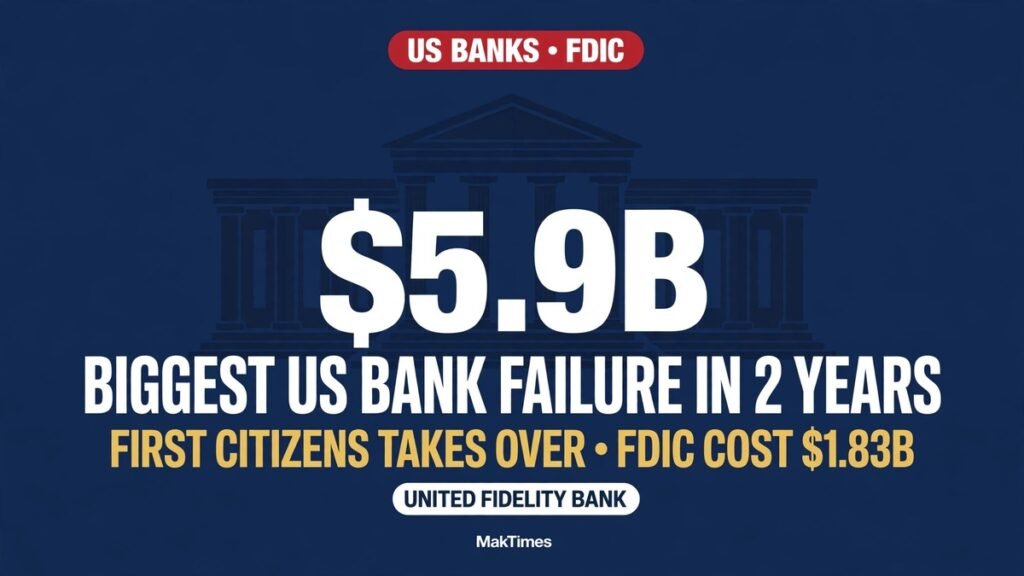
United Fidelity Bank Shut Down: $5.9 Billion Lender Seized in Biggest US Bank Failure Since 2024
United Fidelity Bank is closed. Federal regulators seized the Indiana lender on Friday evening, November 27, in the biggest US bank failure in more than two years — a $5.9 billion collapse that will cost the federal deposit insurance fund an estimated $1.83 billion.
The Office of the Comptroller of the Currency said the bank was in an “unsafe or unsound condition” and was likely unable to pay its obligations or meet its depositors’ demands in the normal course of business. The Federal Deposit Insurance Corp. was named receiver the same evening, and by the time the announcement landed, a buyer was already in place.
First Citizens Bank & Trust of Raleigh, North Carolina — the same bank that bought Silicon Valley Bank out of its 2023 failure — has agreed to take over United Fidelity’s deposits and most of its assets. The failed bank’s 22 branches reopened on Saturday under the First Citizens name.
It is a sharp, uncomfortable contrast with the mood on Wall Street. the S&P 500 just posted its best week in over a year, and the Dow jumped 592 points on Black Friday. Yet underneath that rally, a 112-year-old bank was quietly falling apart — and the bill for cleaning it up is unusually large.
United Fidelity Bank: the key figures at a glance
| Figure | Reading |
|---|---|
| Total assets (Sept 30, 2026) | About $5.9 billion |
| Total deposits (Sept 30, 2026) | About $5.4 billion |
| Deposits taken over by First Citizens | About $4.5 billion |
| Loans taken over by First Citizens | About $3.1 billion |
| Estimated cost to the FDIC insurance fund | About $1.83 billion |
| Loss ratio on the bank’s assets | About 31% |
| Branches | 22, across Indiana, Illinois, Florida, Colorado and the US Virgin Islands |
| US bank failures in 2026 so far | 7 — the most in a year since 2017 |
What went wrong inside the bank
United Fidelity was not a surprise name on the regulators’ watch list. The OCC had placed the bank under a consent order back in October 2023, citing deficiencies in board oversight, capital planning, credit review and internal controls. Three years later, the problems had not been fixed. They had grown.
The damage was concentrated in one place: apartment-block lending. United Fidelity had built a loan book heavily weighted toward multifamily real estate, and by the end of September that bet had turned against it. According to the bank’s own regulatory filings, $2.16 billion of its roughly $3.05 billion loan book was noncurrent — about 70% of everything it had lent. Of that troubled pile, $2.14 billion was multifamily property, nearly four-fifths of the $2.72 billion it had lent on apartment buildings.
The losses followed fast. The bank wrote off $362.6 million in loans in the first nine months of 2026, almost all of it on multifamily lending, and lost $249.6 million over the same period — nearly all of it in the third quarter alone. At the end of June, the bank had reported just $16.7 million in noncurrent loans. Three months later, that figure had multiplied more than a hundredfold.
That speed is what makes the failure stand out. A bank does not usually go from a small bad-loan number to a $1.83 billion insurance-fund bill in a single quarter. The FDIC’s estimated loss works out to roughly 31 cents on every dollar of the bank’s assets — an unusually high ratio for a resolution of this size, and a sign of how far the loan book had deteriorated before regulators stepped in.
First Citizens, for its part, did not buy blind. Its deal includes an asset discount of about $2.6 billion, and it took on only $3.1 billion of the loans. The FDIC said some brokered deposits would not transfer to First Citizens, though it did not say how many or why.
What happens to depositors now
For the bank’s customers, the official message is reassuring. The FDIC said depositors will retain all of their funds and keep their deposit insurance coverage, now as customers of First Citizens. Accounts transfer automatically. Over the weekend, customers could still write cheques, use ATMs and pay with debit cards.
The branches — including three in Evansville, where the bank was headquartered, and two in the US Virgin Islands, where it traded as Bank of St. Croix — reopened on Saturday as First Citizens branches. The bank had been founded in 1914, and it was the first Evansville bank to fail since Integra collapsed in 2011.
First Citizens BancShares, the parent company, trades on the Nasdaq under the ticker FCNCA. It is no stranger to this kind of deal. When Silicon Valley Bank failed in March 2023, First Citizens bought its deposits and loans in a similar FDIC-arranged rescue, and it has now done the same job twice in three years.
Why this failure stands out
Size is the first reason. United Fidelity is the largest US bank failure since Philadelphia-based Republic First Bank closed in April 2024 with about $6 billion in assets. It is the second-largest since the 2023 regional banking crisis that brought down Silicon Valley Bank and First Republic.
The second reason is the count. This is the seventh US bank failure of 2026 — the highest yearly total since 2017. The six failures before it, combined, held only about $1.43 billion in assets. United Fidelity alone held more than four times that total.
The third reason is the cost. The $1.83 billion hit to the Deposit Insurance Fund is more than 1.1% of the entire fund, which stood at $163.5 billion with a 1.50% reserve ratio at the end of the third quarter, according to FDIC data published on November 24. One bank, in one weekend, wiped out a meaningful slice of the buffer that protects every insured deposit in the country.
None of that means a wider crisis is under way. The fund exists precisely for failures like this one, and the FDIC’s process worked the way it is supposed to: the bank was closed on a Friday evening, a buyer was found before the weekend, and depositors kept access to their money. Regulators closed the bank before it could miss a payment, rather than after.
But the pattern is worth watching. Seven failures in a year, the biggest in two and a half years, and a loan book that went bad with startling speed — all of it landing in the same week that US stocks were celebrating their best run in over a year. The market’s mood and the banking system’s health are not always the same story. This weekend, they were not.
The failure also lands just ahead of the Federal Reserve’s next rate decision on December 9, when policymakers will weigh the state of the economy and the banking system together.
Educational Content Only — Not Financial Advice: MakTimes is a news and education website. This article is published for general information and awareness only and is not financial, investment, trading, or legal advice. We are not financial advisors. Cryptocurrency, gold, and other markets are volatile and can result in loss. Always do your own research (DYOR) and consult a licensed financial advisor before making any financial decision. Past performance is not a guarantee of future results.
Sources: CNN, November 28, 2026; Reuters, November 27–28, 2026; Associated Press, November 28, 2026; FDIC / Office of the Comptroller of the Currency statements, November 27, 2026; Indianapolis Star, November 28, 2026.