
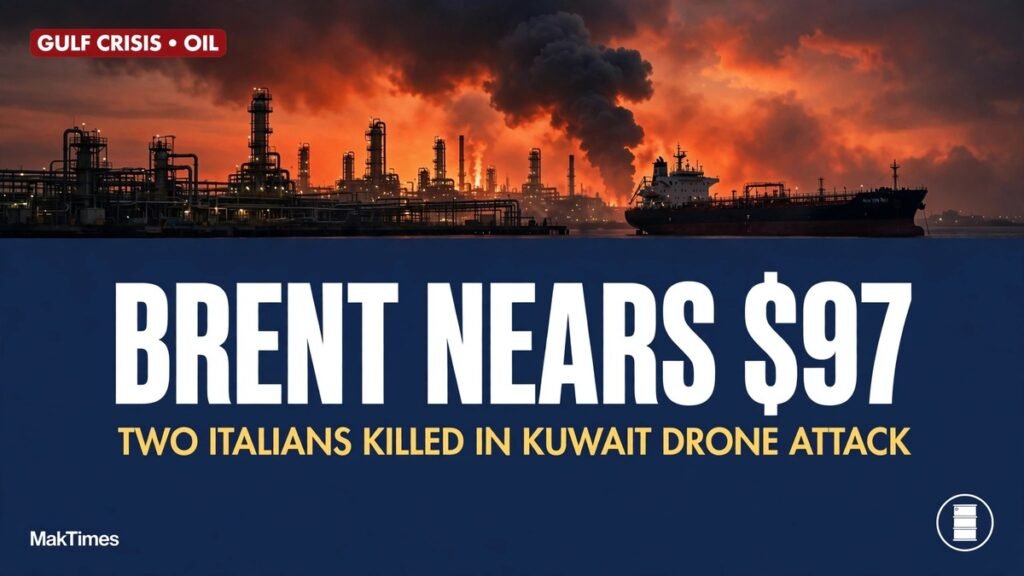
Brent Crude Nears $97 as Iranian Drones Kill Two Italians in Kuwait
Brent crude pushed to within a dollar of $97 on Friday after drones struck an air-defence site in Kuwait, killing two Italian technicians and dragging Europe directly into a Gulf war that has now hit three countries in a week.
The benchmark settled Thursday at $96.57 a barrel, up $1.96 in a single session. That was its highest close since November 6, and it put Brent on course for its first weekly gain in four weeks. Early Friday trading saw it ease a touch to $96.19, but the direction of travel was not in doubt. American WTI crude, meanwhile, traded near $85.66, up more than 2%.
The Kuwait attack is the reason. And it is the reason the oil market, which had spent most of November sliding, suddenly looks nervous again.
What happened in Kuwait
The drones came just before dawn on Thursday, November 26. Kuwait’s military said it detected several of them inside the country’s airspace and dealt with them. Falling debris from the intercepted drones struck an air-defence detection station, killing two men and injuring two more.
The dead were Italian. Antonio Saccoccio, 65, from Formia, and Emanuele Lo Russo, 36, from Rome, both worked for Rheinmetall Italia, the Italian arm of the German defence group. They were maintaining detection antennas for the Skyguard air-defence system when the debris fell.
A Pakistani national and a Kuwaiti army captain were injured in the same strike.
Kuwait did not hesitate over who it blamed. Its Defence Ministry called it an Iranian attack, and the Foreign Ministry invoked the country’s right to self-defence under Article 51 of the United Nations Charter. Italy’s foreign minister, Antonio Tajani, told the Senate in Rome that the two men had been working at the air-defence surveillance station when it was targeted by Iranian drones.
Tehran denied everything. Foreign Minister Abbas Araghchi called the incident “suspicious” and offered to work with Kuwait and Italy to establish what happened. Iran’s embassy in Rome went further, warning of “false flag” operations.
The argument over who fired the drones matters. If Kuwait and Italy formally pin the attack on Tehran, the pressure for retaliation — and for tighter sanctions — grows sharply. European Commission President Ursula von der Leyen has already called for increased pressure on Iran.
A war that keeps widening
Kuwait was not the only strike on Thursday. Hours earlier, a projectile hit Aramco’s Jazan refinery on Saudi Arabia’s Red Sea coast, setting off a fire and forcing parts of the plant to suspend operations. The refinery can process up to 400,000 barrels a day. One Nepalese worker was killed.
That attack was blamed on Yemen’s Houthis, who have spent the war targeting Saudi energy infrastructure and Red Sea shipping. It was the second major refinery strike in as many days, and it landed on top of a week in which Iranian missiles and drones had already hit American bases in Bahrain, and tankers had come under attack in the Strait of Hormuz.
Put together, the pattern is hard to miss. The fighting is no longer confined to one country or one sea lane. It is hitting refineries in Saudi Arabia, military sites in Bahrain, and now an air-defence station in Kuwait, with European contractors among the dead.
Oil traders price that kind of spread. Every new country drawn in raises the chance of a supply disruption somewhere that actually matters, and the Gulf still moves a huge share of the world’s seaborne crude.
Brent crude and the $100 question
One number now hangs over the market: $100 a barrel. Peter McGuire of XM.com told NDTV Profit that crude could reach that level if the attacks keep coming, particularly if Houthi strikes continue to disrupt shipping and keep prices elevated. That is his view, not a certainty — and the market itself is sending mixed signals.
Brent has still had a rough month. Despite this week’s jump, it spent much of November falling, and the rally only brings it back to levels last seen in early November. The monthly picture, in other words, is a sharp spike inside a broader slump. Whether the spike holds depends on what happens next, not on what happened on Thursday.
The next marker already has a date attached to it. OPEC+ ministers meet on Sunday, November 29, to decide output policy for 2027. The Gulf strikes will hang over that meeting. The group has spent the year managing a market that, until this week, looked oversupplied. A war that threatens supply changes the maths entirely.
What it means for Pakistan
For Pakistan, the story lands in two places at once.
The first is personal. A Pakistani national was among the injured in Kuwait. Thousands of Pakistanis work across the Gulf, many of them on exactly the kind of energy and defence sites now being targeted. The war is no longer something Pakistanis only read about — it is reaching their workplaces.
The second is the petrol pump. Petrol fell to Rs313 a litre from today, Friday, after OGRA cut the price by Re1 — the third small cut in three days under the new daily pricing system, with diesel down Rs2 to Rs346. But that system cuts both ways. It passes international prices through to the pump every single day, so a Brent crude sitting near $97 feeds straight into the next revision.
Pakistan imports almost all of its crude — 3.81 million tonnes in the first four months of this fiscal year alone — and pays for it in dollars. When Brent jumps $2 in a day, the import bill jumps with it, and the rupee, already hovering near Rs276.45 to the dollar in the interbank market, has no cushion to absorb it.
None of this means petrol will jump tomorrow. Daily pricing smooths the moves, and a single day’s spike can fade as fast as it came. But the direction is now against the Pakistani motorist. Three days of small cuts could turn into rises just as quickly if Brent holds near $97 — or pushes past it.
The OPEC+ meeting on Sunday is the next marker. If the producers signal tighter supply for 2027 while the Gulf war keeps widening, the market will read it as one more reason to hold prices high. If they signal the opposite, some of this week’s fear premium will drain away.
For now, the facts are these: two Italians are dead in Kuwait, a Pakistani is injured, Brent is at its highest in three weeks, and a war that started in one corner of the Gulf is reaching into more countries by the day.
Sources: Reuters, November 26–27, 2026; Kuwait Defence Ministry and Foreign Ministry statements, November 26, 2026; NDTV Profit, November 27, 2026; Arif Habib Limited market briefing, November 27, 2026.
Educational Content Only — Not Financial Advice: MakTimes is a news and education website. This article is published for general information and awareness only and is not financial, investment, trading, or legal advice. We are not financial advisors. Cryptocurrency, gold, and other markets are volatile and can result in loss. Always do your own research (DYOR) and consult a licensed financial advisor before making any financial decision. Past performance is not a guarantee of future results.