
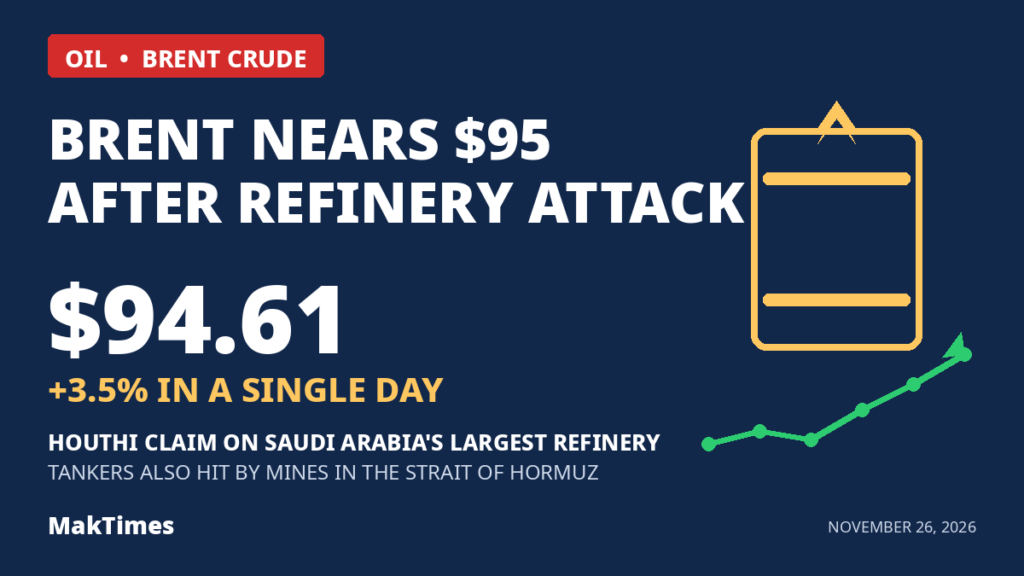
Oil Price Today: Brent Crude Nears $95 as Houthi Attack on Saudi Arabia’s Largest Refinery Rattles Markets
Oil prices jumped on Wednesday, and Brent crude is now sitting within a dollar of $95. The trigger was a claim out of Yemen: the Houthis said they had attacked Ras Tanura, Saudi Arabia’s largest oil refinery, and Riyadh’s financial district. Nobody waited for proof. Brent closed $3.21 higher, at $94.61 a barrel — a 3.5% move in a day. West Texas Intermediate, the US benchmark, rose $1.63, or 2%, to $83.68.
Thursday morning offered no calm: in early Asian trading Brent still hovered near $94.70, and nobody in the market looked ready to relax.
What Happened at Ras Tanura
Wednesday’s claim named two targets: the Ras Tanura refinery on Saudi Arabia’s Gulf coast and the King Abdullah Financial District in Riyadh. Ras Tanura matters more than most refineries: the biggest in the kingdom, its terminal loading a large share of the crude Saudi Arabia sells to the world. Put a threat next to a plant like that and the whole market feels it.
Riyadh told a different story: Saudi-led coalition spokesman Turki Al-Maliki said air defences brought down four drones above Ras Tanura Wednesday morning. Debris from the interceptions came down, he said, and the first checks found nobody hurt. The coalition did not say whether the refinery itself had taken a hit.
The Houthis told it the other way: their military spokesman, Yahya Saree, said the strike was accurate and had caused fires at the site. Neither version could be independently verified. Satellite pictures told a third story: NASA imagery reviewed by Reuters showed a thick plume of black smoke hanging over the refinery, spread across roughly 600 square kilometres. Neither Saudi Aramco nor the Saudi government answered Reuters when asked for comment.
That gap is what rattled the market. Traders price risk, not certainty, and a refinery the size of Ras Tanura does not need to be damaged for its premium to rise. It only needs to be aimed at.
Tankers Hit by Mines in the Strait of Hormuz
While the refinery claim moved prices, a second threat was unfolding in the waterway carrying a fifth of the world’s seaborne oil. A tanker ran onto a naval mine in the strait on Wednesday and caught fire, inside what the Iranians call a “restricted zone” — that account came from Fars, Iran’s semi-official news agency, quoting an Iranian Army statement. Earlier, Iranian state media had reported two tankers hitting mines and exploding in the same waterway.
Shipping through Hormuz had been recovering toward pre-war levels; that recovery is now in doubt. ANZ analyst Daniel Hynes warned the widening conflict could stop the recent recovery in oil flows dead: Gulf crude exports picked up last week, he noted, but the trend is still pointing down.
The two events landed together, and the market read them together: a refinery claim on one side of the Gulf, mines in the strait on the other.
Why Prices Jumped — and What Comes Next
Wednesday’s 3.5% jump was the sharpest single-day move in weeks, against a market that had spent the autumn expecting a surplus. One claim flipped that conversation in a day.
One number pointed the other way. American crude stockpiles grew by 1.1 million barrels in the week to November 20, reaching 418.9 million, the Energy Information Administration said — less than the 1.5 million-barrel build analysts had expected. A smaller build than forecast usually supports prices. It did on Wednesday.
Trading will be thinner than usual: no WTI settlement on Thursday, the US Thanksgiving holiday, leaves Brent to carry the signal alone until American traders return.
November 29 is the next date circled on traders’ calendars, when OPEC+ ministers sit down to set output policy for 2027. The group meets in a changed shape: the United Arab Emirates has left it, while Iraq and Kazakhstan want OPEC+ to credit them with more production capacity than it does now. Whatever comes out of that room, the ministers will be deciding with Brent near $95 and a war premium back in the price.
What It Means for Pakistan
For Pakistan, the timing could hardly be worse: petrol fell to Rs314 a litre and diesel to Rs348 from today, after the regulator cut prices by Rs4 and Rs5 — relief priced off cheaper crude. Hold Brent near $95 for another fortnight and the next pricing review starts from a very different number.
Pakistan buys almost all its oil abroad, so each dollar on Brent lands in the import bill, then the rupee, then inflation, then the pump. The last fortnight’s cuts were welcome — and fragile. Wednesday’s jump is a reminder of how quickly they can unwind.
Karachi noticed too: refinery shares were one of the few places buyers showed up at the Pakistan Stock Exchange, even as the wider KSE-100 drifted in a tight band near 178,100. The logic is simple: dearer crude means fatter margins for the companies turning it into petrol and diesel.
Not the First Strike This Autumn
None of this came out of nowhere: the Houthis have been claiming hits on Saudi energy sites all autumn. On October 27 they said a ballistic missile had struck Ras Tanura; three days later they claimed the Ras Tanura and Rabigh refineries, plus Aramco’s Abqaiq plant, had all been hit.
The pattern changes how the market treats each new claim: the first time, traders waited for damage reports. Now they move first and ask later — which is why a claim with no confirmed damage still added $3.21 to Brent in a day.
MakTimes last reported on oil on November 18, when Brent held above $92 as attacks in the Strait of Hormuz kept traders on edge. Eight days later the price is nearly $3 higher, the attacks have reached Saudi Arabia’s largest refinery, and mines are going off in the strait. From here, two things decide where oil goes: whether the next claim involves real damage, and what OPEC+ decides on November 29.
Sources: Reuters, November 26, 2026; OilPrice.com, November 25, 2026; Energy Information Administration, November 2026; MakTimes, November 18, 2026.
Educational Content Only — Not Financial Advice: MakTimes is a news and education website. This article is published for general information and awareness only and is not financial, investment, trading, or legal advice. We are not financial advisors. Cryptocurrency, gold, and other markets are volatile and can result in loss. Always do your own research (DYOR) and consult a licensed financial advisor before making any financial decision. Past performance is not a guarantee of future results.