
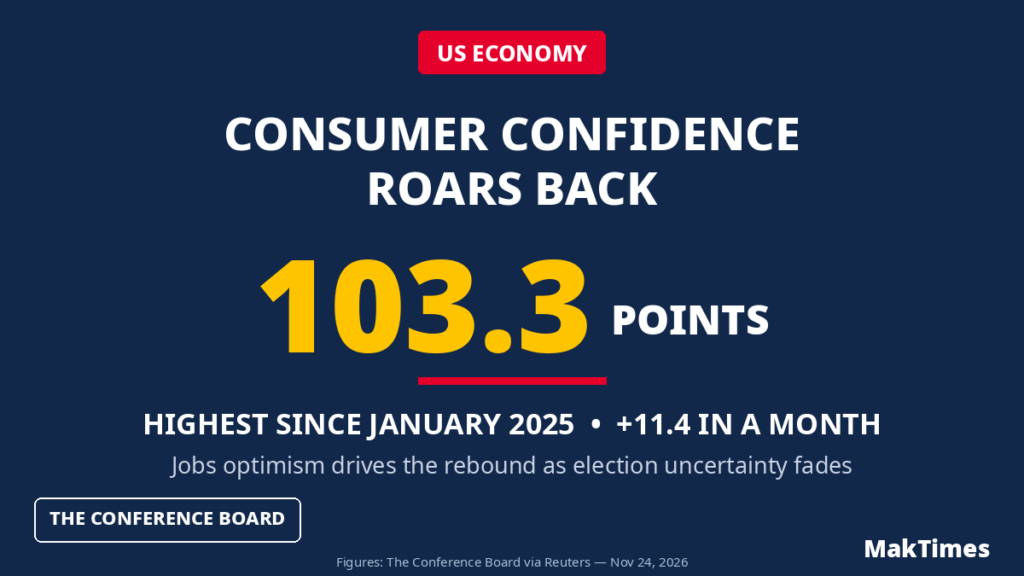
US Consumer Confidence Jumps to 103.3, Highest in Nearly Two Years as Jobs Optimism Roars Back
American consumers just delivered the biggest confidence surprise in years.
The Conference Board’s consumer confidence index jumped 11.4 points to 103.3 in November, the research group said on Tuesday, its highest reading since January 2025. The scale of the move caught forecasters flat-footed. Economists polled by The Wall Street Journal had expected a reading of 92.2. A Bloomberg survey put the consensus at 92.4. The actual number beat both by roughly eleven points.
October’s figure was revised slightly upward to 91.9. That makes November’s leap look even steeper against the month it followed.
It is the kind of number that lands differently in Thanksgiving week. Millions of Americans are about to decide how much to spend over the holidays, and the survey suggests they walked into the season feeling markedly better about their prospects than they did a month ago.
Jobs did the heavy lifting
The rebound was not spread evenly across the survey. It was driven, first and foremost, by how Americans see the jobs market — today and in the months ahead.
The present situation index, which measures how people feel about current business and labour conditions, jumped 13.7 points to 132.8. The expectations index, built on the short-term outlook for income, business and labour conditions, rose 9.9 points to 83.6.
Look closer and the labour story sharpens. The labour market differential — the share of consumers who say jobs are “plentiful” minus the share who say jobs are “hard to get” — improved by 7.6 percentage points to 12.4%. Economists watch that measure closely because it tracks, in plain language, how tight households find the jobs market.
The forward view improved too. The net balance on future employment expectations rose from minus 10.4% to minus 1.2% — still slightly negative, but barely. Net assessments of current business conditions strengthened from 3.0% to 6.5%, and expectations for future business conditions moved back into positive territory, from minus 2.8% to 2.3%.
Every age group recorded an increase in confidence. The biggest gains came from Gen Z respondents, and the largest improvements sat among higher-income households, according to the Conference Board.
The midterm effect
Why now? The Conference Board’s own explanation points to the calendar.
Fergus McCormick, an economist at the research group, said the recovery may have been driven by a drop in uncertainty after the midterm elections. The vote is over, the result is known, and households appear to have exhaled.
“Write-in responses in November were slightly less negative than previous months,” McCormick said. “While consumers continued to express frustration with high prices and rising costs, some comments cited hope for the general economy.”
That split runs through the whole release. The improvement was driven by respondents identifying as Democrats and Independents, according to Reuters, while the overall mood lifted across the board.
The timing matters for another reason. Two months ago, confidence had been sliding hard. November’s reading does not erase that slide, but it reverses its direction in a single month — and by a margin few forecasters thought possible.
What people plan to spend
A confident consumer is only useful to the economy if the confidence turns into spending. On that front, the survey offers encouragement with a caveat attached.
Planned purchases of cars, homes and big-ticket durable goods improved modestly. Vacation intentions rose from 42.7% to 44.9%. Those are small moves, but they point the same way as the headline number.
The caveat sits in the income figures. Net household income expectations actually edged down, from 7.0% to 6.3%. People feel better about the economy and the jobs market, yet slightly less sure about their own pay packets. That gap is the one soft spot in an otherwise strong release.
Inflation expectations tell a similar two-sided story. Consumers’ average expectation for price rises over the next twelve months fell for a second consecutive month, but it remained elevated at 5.7%. High prices and the cost of living still featured prominently in the survey’s written responses. The frustration has not gone away. It has simply been joined, for the first time in months, by something resembling hope.
Markets noticed
Financial and real estate stocks got a lift from the release on Tuesday, even as the broader market gave back some of Monday’s historic rally. Treasury yields eased. The confidence number arrived on a day when the Nasdaq was down more than 1.5% after Monday’s 6.5% surge, and the S&P 500 slipped around 1% — a reminder that one strong survey does not settle a jittery market.
Still, the read-through for the Federal Reserve is hard to ignore. The Fed meets on December 8–9 to decide its next move on interest rates, and a consumer this upbeat complicates the case for rushing to cut. A confident household sector spends, and spending keeps demand — and prices — under upward pressure. None of that decides the Fed’s call on its own. But it is now part of the evidence the committee will weigh, alongside the jobs data and inflation prints still to come before the meeting.
For now, the survey’s message is simpler. After months of gloom, American consumers have changed their minds — quickly, and by a lot. Whether the mood holds through the holiday season is the next question. November’s answer, at least, was emphatic.
Sources: Reuters, November 24, 2026; Morningstar / Dow Jones Newswires, November 24, 2026; Bloomberg Law, November 24, 2026; ActionForex, November 24, 2026.
Educational Content Only — Not Financial Advice: MakTimes is a news and education website. This article is published for general information and awareness only and is not financial, investment, trading, or legal advice. We are not financial advisors. Cryptocurrency, gold, and other markets are volatile and can result in loss. Always do your own research (DYOR) and consult a licensed financial advisor before making any financial decision. Past performance is not a guarantee of future results.