
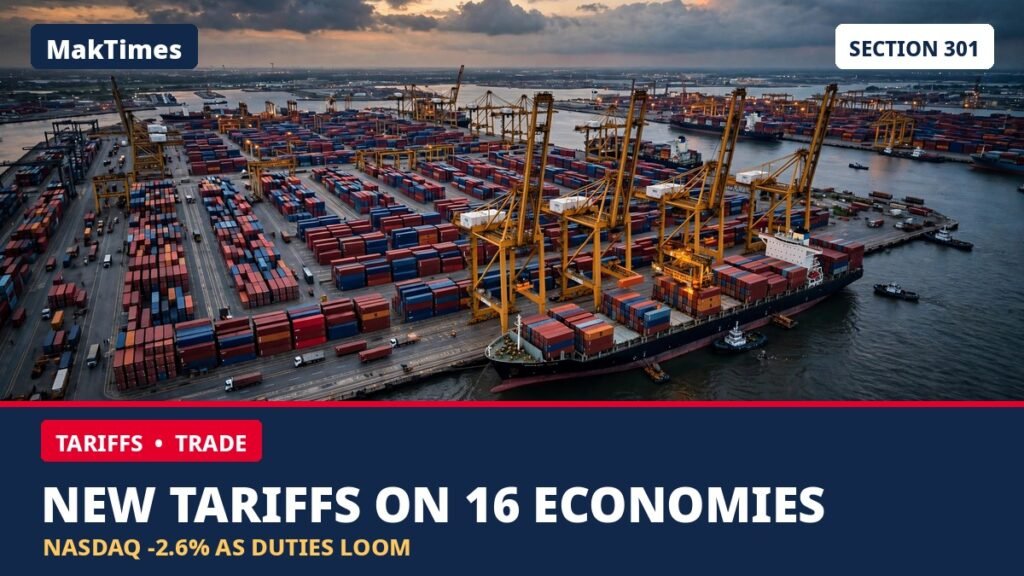
Trump Tariffs: US Set to Hit 16 Economies With New Duties as Nasdaq Slides 2.6%
The Trump tariffs are coming back — bigger, wider, and sooner than markets expected. The Trump administration is poised to unveil the findings of a months-long investigation into industrial overcapacity in 16 major trading partners, with new import duties expected as soon as Tuesday or Wednesday, according to three people familiar with the matter cited by Reuters. Wall Street got the message fast. By late morning in New York, the Nasdaq 100 was down 2.6 percent, chip stocks were sliding, and Monday’s euphoric rally was already half-forgotten.
It is a sharp turn from 24 hours earlier. On Monday, stocks posted one of their best days in years after Nvidia reinstated Jensen Huang as chief executive, with the Nasdaq jumping 6.5 percent and the S&P 500 gaining 4.7 percent. That relief lasted less than a day. The Wall Street Journal reported that the US Trade Representative is preparing to raise tariffs on China and other economies the administration says are harming American companies by subsidising their own industries. Stocks accelerated lower on the news.
What the new Trump tariffs would cover
The investigation sits under Section 301 of the Trade Act of 1974, the same legal tool Washington has used for decades to punish trading partners it accuses of unfair practices. The US Trade Representative’s office launched the probe in March, looking at what it calls evidence of excess industrial capacity in most of America’s largest trading partners.
The list is long. China, the European Union, Japan, South Korea, Mexico, Vietnam, Taiwan, Thailand, Malaysia, Indonesia, Switzerland, Norway, Singapore, Bangladesh and Cambodia are all named, along with India. Counting the EU’s 27 member states individually, the probe’s reach covers 42 countries and economies.
USTR Jamieson Greer is expected to announce the findings as early as this week, and his office is expected to propose new duties that would stack on top of tariffs already imposed during President Donald Trump’s second term. The exact rates are not yet public, and it is unclear what exemptions, if any, will be granted. The Wall Street Journal reported that the new duties could restore tariff levels negotiated during 2025 — around 20 percent for China, 15 percent for the EU, Japan and South Korea, 20 percent for Taiwan and Vietnam, and 50 percent for India.
The duties would partly replace the global import taxes the US Supreme Court struck down in February. Since that ruling, the administration has been rebuilding its tariff wall piece by piece. In July it imposed duties of 10 or 12.5 percent on 60 economies after a separate investigation into forced-labour practices. The Section 301 findings would be the next brick.
Why China sits at the centre of the probe
The administration has singled out China as the biggest source of the excess capacity it complains about, arguing that Chinese factories are flooding global markets with steel, aluminium, electric vehicles, appliances and solar products at prices American firms cannot match. Beijing rejects the accusation, saying its exports reflect competitive advantages rather than unfair subsidies.
The probe also reaches into Southeast Asia, where Chinese investment has poured into Vietnam, Indonesia and Cambodia to build goods for the American market — factories Washington says exist largely to route around existing tariffs.
For now, a fragile truce caps the pressure on China. Under the US-China trade truce, second-term tariffs on Chinese goods are capped at 20 percent, on top of roughly 25 percent in duties from Trump’s first term. That truce expires on January 10. One of the people who spoke to Reuters said the 20 percent cap would likely hold as long as the truce is extended — and if it lapses, the excess-capacity rate would snap to a higher level, giving Beijing a strong reason to keep talking.
Markets give back Monday’s rally — and then some
The market reaction was swift and concentrated where it hurts most: chips and artificial intelligence. Nvidia fell more than 8 percent, giving back part of Monday’s 31 percent surge, and the iShares Semiconductor ETF dropped more than 8 percent. Advanced Micro Devices, Micron and Marvell each fell more than 10 percent.
Anthropic, the AI company that listed on the Nasdaq last week in the largest initial public offering in history, slid more than 9 percent and fell below its 83-dollar IPO price. Crypto-linked stocks fell with Bitcoin, which slipped back below 60,000 dollars.
Not everything fell. The Dow Jones Industrial Average was nearly flat, held up by defensive and software names — Salesforce rose more than 4 percent, and Dollar Tree jumped 12 percent after beating earnings forecasts. Stocks also recovered from their worst levels of the morning after US consumer confidence rose 11.4 points to 103.3, its highest in a year and nine months.
The inflation question hanging over everything
The timing is awkward for the Federal Reserve. Annual producer inflation reached 6.5 percent in October, its highest since November 2022, and tariffs have contributed to higher prices on consumer goods in the United States. A Reuters/Ipsos poll after November’s midterm elections found 62 percent of respondents would support efforts to repeal the tariffs.
Wednesday brings the next big test: October’s personal consumption expenditures price index, the Fed’s preferred inflation gauge, is expected to rise to 3.8 percent from a year earlier, with core inflation at 3.2 percent. Markets are pricing a 100 percent chance of a quarter-point rate hike at the Fed’s December 8–9 meeting, and at least one more increase in 2027.
That is the tension at the heart of this story: tariffs are meant to protect American industry, but they also push up prices — and higher prices push the Fed toward tighter policy, the same force that rattled markets through their worst week since the Covid crash earlier this month.
What to watch next
Three dates matter now. The first is the USTR announcement itself, expected as soon as Tuesday or Wednesday. The second is Wednesday’s inflation data, which will show whether price pressures are still building. The third is January 10, when the US-China truce expires — and with it, the cap that has kept the tariff fight from escalating further. For American shoppers, the question is closer to home: whether the next round of tariffs shows up, once again, in the price of what they buy.
Sources: Reuters, November 23–24, 2026; The Wall Street Journal, November 24, 2026; Barchart, November 24, 2026; KuCoin News, November 24, 2026.
Educational Content Only — Not Financial Advice: MakTimes is a news and education website. This article is published for general information and awareness only and is not financial, investment, trading, or legal advice. We are not financial advisors. Cryptocurrency, gold, and other markets are volatile and can result in loss. Always do your own research (DYOR) and consult a licensed financial advisor before making any financial decision. Past performance is not a guarantee of future results.