
US Stock Market: Worst Week Since Covid as Dow Falls 8% and S&P 500 Enters Correction
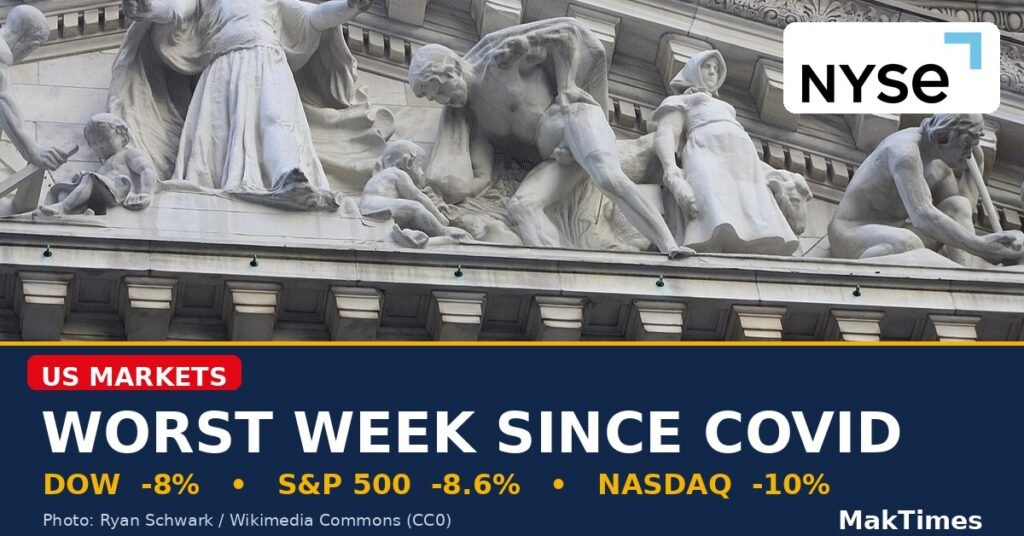
The US stock market just closed its worst week since the Covid crash — and the damage was not confined to one corner of it. The Dow Jones Industrial Average fell 8% in five sessions. The S&P 500 lost 8.6%. The Nasdaq Composite gave back 10% on the week, erasing all of its 2026 gains in five sessions. By Friday’s close, all three major indexes were in correction territory, down more than 10% from their record highs. A week earlier, the question was whether the rally could keep going. Now it is how far the fall goes — and whether the AI boom that carried stocks to record highs in October has finally run out of steam.
Friday’s rout by the numbers
Friday did most of the damage. The S&P 500 fell 265.44 points, or 3.7%, to close at 6,910.39, according to The Associated Press. The Dow dropped 949.73 points, or 1.9%, to 48,147.33. The Nasdaq plunged 1,261.47 points, or 5.3%, to 22,617.73.
Seven straight down days. That is the S&P 500’s longest losing streak since the onset of the pandemic in 2020. The index now sits 11.6% below its October 6 all-time high — its first correction since March 2025, when the Trump administration’s tariff fight rattled markets. The Nasdaq is roughly 18% below its own peak and down 2.7% for 2026.
The fear gauge told the same story. The Cboe Volatility Index, or VIX, closed at 35.89 on Friday — up 26% on the day and 86% for the week, its highest level since the “Liberation Day” tariff turmoil of April 2025.
Nothing was spared. All 11 sectors of the S&P 500 fell more than 1% on the week, the first time that has happened since the week of April 4, 2025. Smaller companies fared no better: the Russell 2000 lost 7.5% on the week. Money rushed into government bonds, pushing the 10-year Treasury yield down to near 4.91% from roughly 5.15% a week earlier. Gold fell to around $3,539 an ounce, down almost 4% on the week, while Brent crude held near $92 a barrel.
Nvidia and the AI trade unravel
At the centre of the wreckage sat Nvidia. The chipmaker’s shares plunged 14% on Friday alone and finished the week down 23% — its worst week since the financial crisis of 2008. Reuters reported that the Securities and Exchange Commission is examining the company’s accounting, and the report landed on a stock already wobbling after the sudden departure of chief executive Jensen Huang earlier this month.
Nvidia was not alone. Semiconductor stocks sank 10.6% on Friday. AMD fell 20.5% for the week, its worst since October 2018. Broadcom and Micron both suffered double-digit drops on Friday.
The irony is hard to miss. The chipmaker had delivered strong quarterly results only days before the rout. Anthropic, the AI developer, staged one of the largest public offerings in history on Thursday, pricing at $83 a share and opening at $111.50, closing its first day up 17%. On Friday it slid roughly 9%, drifting back toward the price it debuted at — and the wider market slid with it. “Sentiment is very fragile at the moment,” Angelo Kourkafas, senior global investment strategist at Edward Jones, told Reuters.
Why the selling kept coming
A week this brutal has more than one cause. Several pressures piled up at once, and each one hit the same vulnerable spot: the belief that AI spending could keep growing without limit.
The Federal Reserve supplied the first. Minutes from its October 27–28 meeting, released on Wednesday, showed nearly all policymakers expected another quarter-point rate increase in December. Higher rates for longer are poison for high-priced growth stocks — and the market’s most expensive names are exactly the AI names that had led the rally.
Then came the politics. President Donald Trump threatened a “tremendous tax” on US companies building AI data centers abroad, a direct hit on the infrastructure spending that has powered the AI trade. Doubts about data-center spending were already spreading, with investors asking whether the hundreds of billions pouring into AI facilities will ever earn their keep.
The selling fed on itself. As prices fell, funds that had ridden the AI wave were forced to sell, which pushed prices lower still. Asian markets followed on Friday, with Japan’s Nikkei down about 5% and South Korea’s Kospi falling a similar amount.
The US stock market week ahead: futures, PCE and Thanksgiving
Futures trading resumes at 6 p.m. Eastern Time on Sunday — 4 a.m. Monday in Pakistan — and that first print will matter. Exchange-traded funds tracking the Dow, the S&P 500 and the Nasdaq climbed 0.9%, 1% and 1.5% respectively in Friday night’s overnight session, a small sign that buyers may be stepping in. But overnight moves have a habit of fading by the opening bell, and nobody on Wall Street is calling a bottom yet.
The calendar gives traders plenty to chew on. Dell and Hewlett Packard Enterprise report earnings on Tuesday, and Dell’s AI-server results will be read as a fresh verdict on data-center demand. The Fed’s preferred inflation gauge, the PCE report, arrives on Wednesday. A December 9 rate hike is still expected, though traders no longer price it as a certainty after the sell-off. Thanksgiving then shortens the week: US markets close on Thursday, November 26, and trading ends early at 1 p.m. Eastern on Friday, November 27.
Two corporate stories will also hang over Monday. CrowdStrike is in talks to buy rival cybersecurity firm Zscaler, Bloomberg reported on Friday, in a combination worth about $265 billion that would rank among the largest cybersecurity deals ever. Zscaler jumped about 18% in after-hours trading on the report; CrowdStrike fell. Neither company has confirmed the talks, and no price has been disclosed. Oracle, meanwhile, posted on X after Friday’s close that its AI funding needs are “secured” — a message aimed squarely at the doubts about AI spending.
What history says about weeks like this
The comparisons reaching for this week are not flattering. The Dow’s 8% weekly fall is its worst since March 2020, when Covid shut down the global economy. The Nasdaq’s 10% drop is its worst since that same month. The S&P 500’s 8.6% slide is its worst since April 2025.
History offers both comfort and warning. After the March 2020 crash, the S&P 500 bottomed on March 23 and set a new record by August 18 of the same year. After the April 2025 tariff sell-off, markets also recovered within months. But those recoveries came after the cause of the selling was addressed. This time the causes are still in play: a Fed talking about raising rates, an AI trade under genuine questioning, and a December rate decision looming on December 8–9.
Mark Hackett, chief market strategist for Nationwide, told Reuters that the sell-off has reset valuations to more attractive levels and pushed investor sentiment to readings that have often, in the past, marked buying opportunities. Others are more cautious. With the S&P 500 down seven straight sessions and the Nasdaq’s 2026 gains gone, the market heads into Thanksgiving week with one question hanging over it: was this the washout, or just the first leg down?
Sources: TipRanks, “The Week That Was, The Week Ahead: Macro and Markets, November 22” (22 November 2026); The Wall Street Journal, stock-market live coverage (20 November 2026); MarketWatch, “Stocks suffer a brutal week” (20 November 2026); Reuters via wire reports (22 November 2026); Investor’s Business Daily, “Dow Jones Futures Due After Market’s Worst Week Since Covid” (22 November 2026); Bloomberg via CNBC, CrowdStrike–Zscaler talks (20 November 2026); New York Stock Exchange MAC Desk Weekly Recap (20 November 2026).
Educational Content Only — Not Financial Advice: MakTimes is a news and education website. This article is published for general information and awareness only and is not financial, investment, trading, or legal advice. We are not financial advisors. Cryptocurrency, gold, and other markets are volatile and can result in loss. Always do your own research (DYOR) and consult a licensed financial advisor before making any financial decision. Past performance is not a guarantee of future results.