
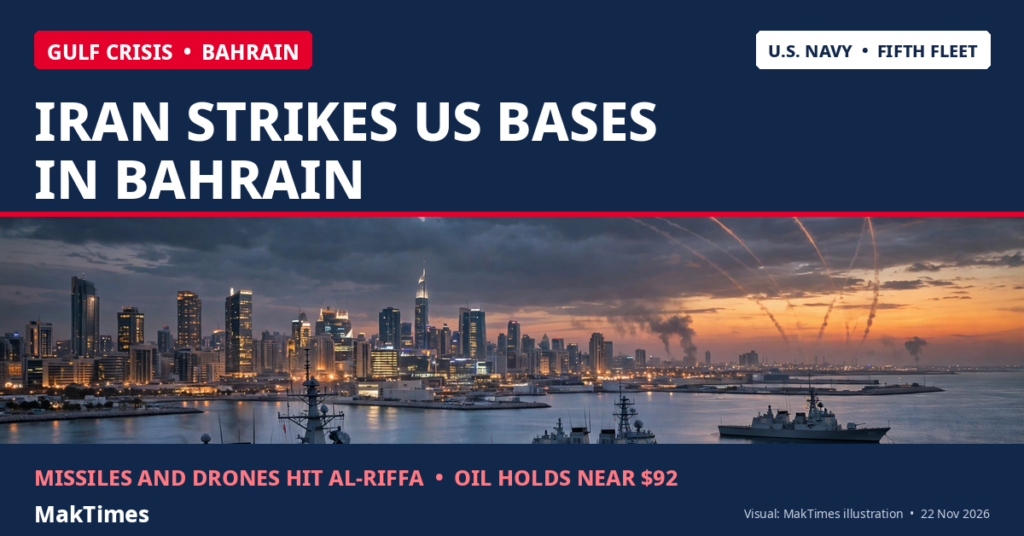
Iran Attacks US Bases in Bahrain: Missiles and Drones Hit Al-Riffa as Oil Holds Near $92
Iran says it hit American air defences in Bahrain on Saturday night. Bahrain says the only thing that burned was a civilian factory. Two versions, one night — and the sharpest escalation yet in a Gulf confrontation now nine months old. The oil market, for its part, is refusing to panic.
Iran attacks US bases in Bahrain — that is Tehran’s version of Saturday night, and it came in two waves, according to Euronews. The US Navy’s Fifth Fleet is based there. This is no distant battlefield — it is the front door of American naval power in the Gulf. A missile fired at its bases lands, one way or another, on the world’s oil supply.
Iran attacks US bases in Bahrain: Tehran’s claim
Iran’s Revolutionary Guard Corps said its Aerospace Force carried out a combined missile-and-drone attack on US positions at the Al-Riffa and Awali bases. IRNA, the state news agency, and Sepah News, the Guards’ own outlet, carried the statement. It claimed the strikes knocked out the radars of two American Patriot air defence batteries.
The Guards called it payback. Two American drones, an MQ-1 Predator and an MQ-9 Reaper, had crossed into Iranian airspace earlier on Saturday, they said, and US forces had hit a radar post on Hengam Island. Tehran drew its line in the statement: its airspace is not to be crossed.
Confusion crept in almost immediately. Iran’s semi-official Fars news agency had first named different targets — the Sheikh Isa and Al Juffair bases — before the official statement settled on Al-Riffa and Awali. Six drones went for the radar at Al-Riffa’s helicopter base, Fox News reported, citing the Guards’ account.
What Bahrain says happened
Bahrain told a very different story. Its Interior Ministry said an Iranian attack had struck a civilian industrial facility, causing a fire. Nobody was hurt, the ministry said — though it never said which facility had been hit.
Bahrain’s Defence Force said its air defences had intercepted a number of the attacks, and falling debris had caused material damage — but no casualties. The Foreign Ministry called the continuing attacks a breach of Bahrain’s sovereignty — and of the United Nations Charter.
Washington, for its part, said nothing at first about whether any American equipment had been damaged. CENTCOM had already knocked down a separate Iranian claim from Friday: that a missile damaged a US F-16 over the Gulf and forced it down for an emergency landing. The command called it false.
So by Sunday morning, nobody outside Tehran could confirm that a single American radar had been hit. What was confirmed was this: explosions over Bahrain, a factory on fire, and air-raid alerts telling residents to move to the nearest safe location — then an all-clear, followed by a second alert.
Bahrain had already been through this twice this week. Al Jazeera reported the kingdom has now been hit by three drone attacks in recent days, and it condemned Iranian attacks on November 17 and 18 as well. Five days earlier, Iran went after US sites at Kuwait’s Ali Al Salem air base — hours after American jets hit a Revolutionary Guard missile site on Iran’s Qeshm Island.
Why oil traders barely blinked
Here is the strange part. A missile attack on the home of the Fifth Fleet would once have sent oil prices vertical. On Friday, Brent settled at $92.57 a barrel, up just 59 cents, and West Texas Intermediate finished at $83.98, up 77 cents. By Sunday, Brent was trading around $92.
Traders are looking past the explosions and at the storage tanks. The International Energy Agency’s reading: the oil market is back in surplus for the first time since the Iran war began — a fourth-quarter glut of roughly 1.7 million barrels a day. November has cost Brent about 20%, even though the benchmark is still up more than 50% on the year.
The one place that decides all of this is the Strait of Hormuz — and it is taking hits almost every day. Iran’s attacks on tankers passing through the strait have run at roughly one incident a day in November, and on Thursday the Revolutionary Guards Navy said two tankers had hit naval mines and were burning. Vortexa, which tracks tanker movements, says Tehran has now designated more than half the tankers Gulf producers rely on — forcing them to shift their cargo across in the Gulf of Oman before sailing on. Gulf exports have still not climbed back to where they were before the war.
And yet the market keeps shrugging. In the earlier phases of this conflict, burning tankers in Hormuz would have lifted Brent by $5 to $10 in a session. Friday showed how little that fear now moves prices: the mine strikes plus a Houthi missile attack on Riyadh pushed Brent up 79 cents in Asian trading, and the gain was gone within hours.
Two things explain the calm. Crude is not short: OPEC+ meets on November 29 to set 2027 quotas, and about 2 million barrels a day of cuts are still in place. And traders have learned the rhythm of this war. Nine months in, the attacks keep coming and the oil keeps flowing. The market is pricing the war as background noise — until the day it is not. Gold read the night the same way. The international price sat near $3,539 an ounce on Sunday; in Pakistan, the sarafa benchmark put 24K gold at Rs381,600 a tola — down from Rs399,400 three days earlier.
What it means for Pakistan
For Pakistan, the stakes are not abstract. Almost all the crude oil and liquefied natural gas the country imports arrives by sea through Gulf waters, with the Strait of Hormuz at the mouth of that route. A serious disruption would show up in the next fortnightly petrol price review, in the rupee, and in inflation.
Bahrain matters directly, too. The island kingdom is home to a large Pakistani community, and the Gulf is one of Pakistan’s biggest sources of remittances — the foreign currency that has steadied the economy through a difficult year.
None of that means panic is warranted today. Oil near $92 is high by the standards of a year ago, but it is a long way from the $120 Brent touched in March and April at the height of the US-Iran war. The petrol price in Pakistan is set on a fortnightly cycle, and a single night of explosions in Bahrain does not rewrite it. What would rewrite it is a closure of Hormuz, or a sustained campaign against Gulf shipping — and that, for now, has not happened.
What happens next
The next dates are already on the calendar. OPEC+ meets on November 29. The US president, in an interview broadcast on Thursday, appeared to push any decision on renewed major strikes against Iran into next year. A decision, he told Fox News, would wait until after January 1.
That leaves a strange, suspended stretch: a war that is not quite a war, and markets carrying on as if the Gulf were normal. The Bahrain attack tests that assumption more directly than anything in weeks, because it struck at the US military’s own front door. Answer it the way Tehran expects, and the calm in the oil market will not survive the week.
Sources: Reuters, November 21–22, 2026; Al Jazeera, November 22, 2026; Euronews, November 21–22, 2026; IRNA / Sepah News, November 21, 2026; Bahrain Ministry of Interior and Bahrain Defence Force statements, November 21, 2026; US Central Command statement, November 21, 2026; International Energy Agency; Vortexa; PakGold.net, November 22, 2026.
Educational Content Only — Not Financial Advice: MakTimes is a news and education website. This article is published for general information and awareness only and is not financial, investment, trading, or legal advice. We are not financial advisors. Cryptocurrency, gold, and other markets are volatile and can result in loss. Always do your own research (DYOR) and consult a licensed financial advisor before making any financial decision. Past performance is not a guarantee of future results.