
Bitcoin Falls Below $73,000 as MSCI Removes Strategy (MSTR) From Global Indexes
Bitcoin fell below $73,000 on Thursday, for the first time since August, after index provider MSCI confirmed it will remove Strategy — the world’s largest corporate holder of bitcoin — from its global stock indexes.
It was the second shock to land after Wednesday’s close. Wednesday night had already delivered one jolt. Word that Nvidia’s board was weighing the removal of chief executive Jensen Huang sent the chipmaker’s shares down roughly 8% once the market closed. By Thursday afternoon, bitcoin was changing hands near $71,900, down more than 2% on the day, and the selling had spread across crypto-linked stocks.
The MSCI decision hits Strategy where its business model lives. Strategy — the firm most people still call MicroStrategy — sits on 850,364 bitcoin. At current prices that pile is worth about $62.6 billion, and the company paid an average of $75,456 for each coin. It funds those purchases by issuing shares and debt, and index inclusion has been a quiet engine of that machine: funds that track MSCI’s benchmarks are obliged to hold whatever the indexes hold.
How MSCI’s decision dragged Bitcoin below $73,000
MSCI said in its November index review, published late on Wednesday, that Strategy will leave the MSCI USA Index — and with it the broader MSCI World and ACWI indexes — after the close of trading on November 30. Metaplanet, the Tokyo-listed firm running the same bitcoin-treasury playbook, gets the same treatment in Japan — out of the MSCI Japan Small Cap Index on November 30. Uranium holder Yellow Cake is out of the MSCI United Kingdom Small Cap Index too.
The removals are the first under a new “non-operating company” screen MSCI adopted on October 15. First, the screen checks whether operating assets account for at least half of everything a company owns. Then it runs the firm through five financial ratios. Fail those, and the index provider treats you as a fund, not a business. In plain terms: if most of what you own is bitcoin or something like it, MSCI now files you under “investment fund” — and investment funds don’t belong in its stock indexes.
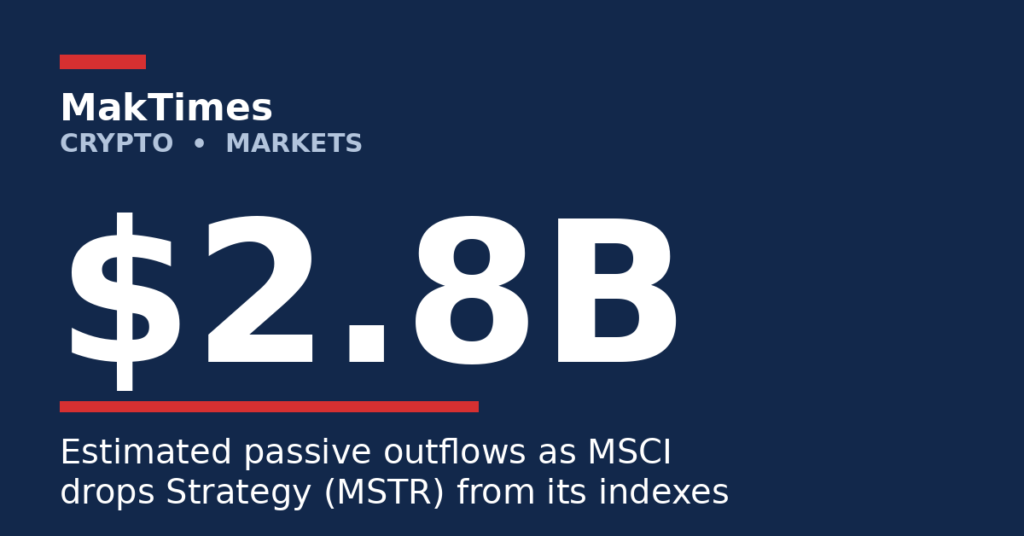
For Strategy, the arithmetic is stark. Funds tracking MSCI indexes hold roughly 13 million of its shares — about 3.1% of shares outstanding — and they will have to sell by the November 30 close. JPMorgan puts the forced selling at roughly $2.8 billion. And the bank’s own warning goes further — if other big index providers, Nasdaq included, copy the rule, the total could swell to $8.8 billion.
Wednesday’s close told only half the story. Strategy finished the session at $122.35, up 1.06% — then gave it back after hours, sliding to $120.50. Thursday’s premarket session was worse again, about 7% lower. Step back a month and the stock has lost more than a fifth of its value.
A model under pressure, but no forced bitcoin sale
The removal does not delist Strategy’s stock, and nothing in MSCI’s rules forces the company to sell any of its bitcoin. That distinction matters, and it is one the company itself has stressed. What changes is the demand for its shares — and, by extension, the cost of the equity it issues to keep buying bitcoin.
That cost has already been rising. The premium investors once paid for Strategy shares over the value of its bitcoin holdings — a ratio known as mNAV — has compressed from a peak of about 3.4 times in November 2024 to roughly 1.08 times now. At that level, issuing new shares to buy more bitcoin barely adds value for existing holders.
Not everyone is sounding the alarm. A few analysts reckon the market saw this coming months ago — the exclusion was telegraphed, they say, and the share price already carries it. Others point out that Strategy kept buying anyway: in the week to November 8, it added 1,036 bitcoin for $81.9 million, a purchase made below its average cost.
The company has fought the classification throughout. It says its bitcoin treasury is an operating segment under US accounting rules, and its chairman, Michael Saylor, has called the rule discriminatory. MSCI, for its part, gave no company-specific reasoning in its review documents, pointing only to the new eligibility screen.
Not every treasury firm was caught. SharpLink, an Ethereum treasury company that had also been flagged as an exclusion risk, survived this review and was not among the published deletions.
ETF outflows stretch to a fifth day
Bitcoin’s slide has a second engine: money is leaving the US spot bitcoin exchange-traded funds. Wednesday alone saw $299.9 million walk out the door. It was the fifth day in a row of redemptions, and the tally since November 5 now stands near $1.44 billion. Most of it came from one fund. BlackRock’s IBIT lost $269.7 million on Wednesday — the ninth straight session investors have pulled money from it.
Ether went the same way, hovering near $2,044, roughly half a percent lower. The wider CoinDesk 80 Index was down about 1%.
The backdrop has not helped. October’s inflation numbers surprised on the upside. Prices rose 0.4% for the month — economists had pencilled in 0.3% — and the bond market now gives the Federal Reserve about a 9-in-10 chance of raising rates in December. Meanwhile the 10-year Treasury — the benchmark rate that prices everything from mortgages to corporate debt — yields more than 5%. Risk assets, from chip stocks to crypto, have been paying for that repricing all week. Layer Nvidia’s boardroom drama on top — we covered it earlier today — and the risk-off mood had everything it needed.
This has been coming for over a year. MSCI floated the exclusion back in October 2025, backed off in February 2026, and spent the months since consulting the industry on a wider version of the rule. The screen adopted last month is the result — broader than the original proposal, and now, for the first time, enforced.
What to watch next
The hard date is November 30. Index trackers must have sold by the close, and the rebalanced indexes go live on December 1. Traders will also watch Thursday’s US jobless claims and Friday’s October producer price report for the next steer on interest rates — and whether any other index provider signals it will follow MSCI’s lead.
For now, the message from the market is plain enough. The world’s biggest corporate bitcoin buyer has lost its place in the indexes that millions of passive investors follow, and bitcoin’s price has slipped under a level it had held since August.
Sources: CoinDesk, November 12, 2026; Bitcoin Magazine, November 11, 2026; Investopedia, November 12, 2026; Reuters via The Block, November 11, 2026; Finnhub market data, November 12, 2026.
Educational Content Only — Not Financial Advice: MakTimes is a news and education website. This article is published for general information and awareness only and is not financial, investment, trading, or legal advice. We are not financial advisors. Cryptocurrency, gold, and other markets are volatile and can result in loss. Always do your own research (DYOR) and consult a licensed financial advisor before making any financial decision. Past performance is not a guarantee of future results.