
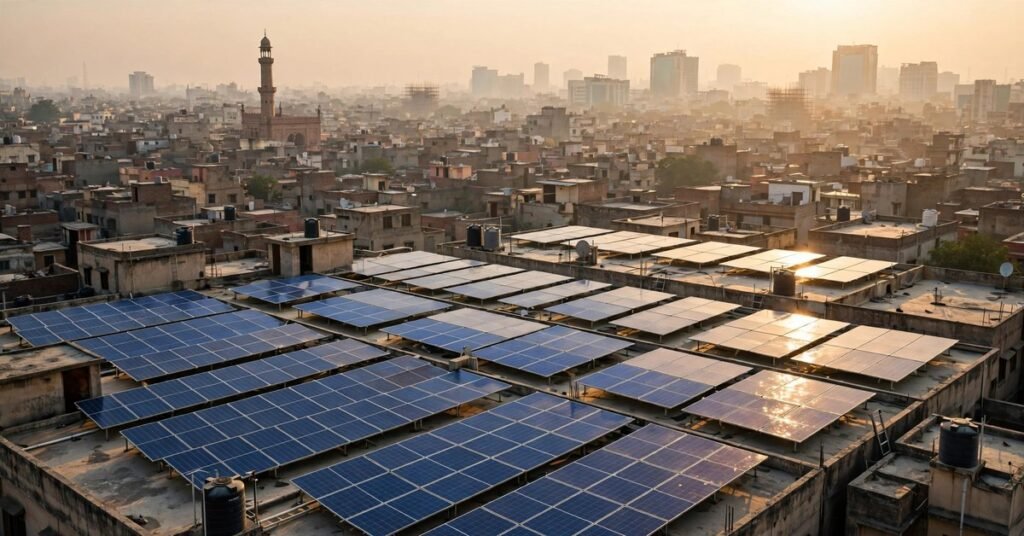
Solar Energy in Pakistan: 22GW of Rooftop Panels in Two Years as PM Seeks $188 Billion at COP31
Solar energy in Pakistan has gone from a niche purchase for the well-off to the fastest-moving change in the country’s energy story — and on Wednesday, Prime Minister Shehbaz Sharif took that story to the world stage. Speaking at the COP31 climate summit in Antalya, Türkiye, he told a room full of world leaders that Pakistani households and businesses had added nearly 22 gigawatts of rooftop solar capacity in just two years. Then he named the price of finishing the job: about $188 billion by 2035.
The number is enormous. It is also, in the prime minister’s telling, the cost of a transition that has already started without waiting for anyone’s permission.
Shehbaz was addressing a high-level dialogue titled “Clean Energy Transition by 2035: Powering the Future”, held on the sidelines of the 31st UN climate conference. His pitch was blunt. Developing countries, he said, cannot hit their climate targets without affordable money and affordable technology. The “35 by 35” global electrification pledge — raising electricity’s share of total final energy use to roughly 35 per cent by 2035 — “will be achieved only if finance flows at the speed of ambition through concessional capital and transfer of affordable technology,” he told the session.
What the $188 billion covers
The headline figure breaks into two parts. Around $138 billion would go into low-carbon power generation by 2035. Another $50 billion would pay for replacing coal-fired electricity with solar. The prime minister’s office framed the appeal as a request for concessional financing — low-cost loans and grants — rather than commercial borrowing. Nothing in the package has been committed yet. It is an ask, not a deal.
Clean sources already supply nearly 55 per cent of Pakistan’s energy mix, according to the prime minister. Before leaving for Türkiye, he inaugurated a key section of the country’s seventh nuclear power plant, a project that will add 1,200 megawatts to the national grid. COP31 itself runs in Antalya from 9 to 20 November, with climate finance for developing countries as one of its central themes.
Why solar energy in Pakistan took off so fast
Strip away the summit language and the boom has a simple engine: grid electricity got too expensive, and panels got cheap.
Household tariffs in Pakistan now run past Rs 60 per unit once fuel adjustments, cross-subsidies and duties are counted. A-grade solar panels, meanwhile, are selling at roughly Rs 41 per watt in October 2026 dealer lists — a standard 585-watt panel costs around Rs 24,000. A typical 5-kilowatt home system runs about Rs 8 to 10 lakh installed, generates roughly 7,000 units a year, and pays for itself in four to five years at current tariffs. Panels last 25 years.
That arithmetic did what no government programme managed. Rooftops filled up street by street, first in Lahore and Karachi, then in smaller cities. The prime minister called it a grassroots shift by households and businesses looking for affordable and reliable electricity. He is not wrong about the direction. Independent estimates differ on the scale — net-metered rooftop capacity alone stood at roughly 4.9 gigawatts by March 2025, with solar imports of about 16 gigawatts in 2024 — and the 22-gigawatt figure he quoted has not been independently verified. But nobody disputes that the growth has been extraordinary by any measure.
The catch nobody at the summit mentioned
There is a wrinkle in the story, and it matters more to a family thinking about panels than anything said in Antalya. In February 2026, Pakistan’s power regulator NEPRA replaced the old net metering system with net billing under its Prosumer Regulations 2026.
Under the old rules, a household that exported 100 units and imported 100 units paid nothing — a one-for-one exchange. Under net billing, exported units are credited at roughly Rs 11 per unit while imported electricity still costs Rs 40 to Rs 55. The gap means oversizing a system to sell power back to the grid no longer pays. The smart design now is to size panels to daytime use, and add a battery if the budget stretches.
Households that signed net metering agreements before 9 February 2026 keep their old one-for-one terms until their contracts expire. Everyone new falls under net billing from day one, on five-year agreements. It is a worse deal than the one early adopters got. It is still, for most homes, a better deal than buying every unit from the grid.
What the $188 billion ask means for readers
For now, the COP31 appeal changes nothing on a household bill. What it signals is where the government thinks the money should go: more low-carbon generation, and a managed exit from coal. If concessional finance arrives, it could ease the cost of the grid upgrades — transformers, storage, transmission — that a solar-heavy system needs. If it does not, the rooftop boom will keep running on its own economics anyway, because the maths on a Rs 60 unit does not need a summit to make sense.
The honest read is that Pakistan’s solar story has two halves. One is a genuine, citizen-led transformation that shows up on rooftops in every city. The other is a financing gap the size of a small country’s economy, and a regulatory shift that quietly trimmed the returns for the next wave of buyers. Both halves are true at the same time.
Anyone considering panels should check the current rules with their distribution company before spending — the buyback rate, the five-year contract terms and the transformer capacity in their area all affect the payback. Prices move with the dollar and with dealer stock, so a quote from last month is not a quote for today.
Sources: The Express Tribune and Associated Press of Pakistan via Dawn, Samaa and Profit by Pakistan Today, 11–12 November 2026; NEPRA Prosumer Regulations 2026 (SRO 251(I)/2026); Pakistan solar market price guides, October–November 2026.
Educational Content Only — Not Financial Advice: MakTimes is a news and education website. This article is published for general information and awareness only and is not financial, investment, trading, or legal advice. We are not financial advisors. Cryptocurrency, gold, and other markets are volatile and can result in loss. Always do your own research (DYOR) and consult a licensed financial advisor before making any financial decision. Past performance is not a guarantee of future results.