
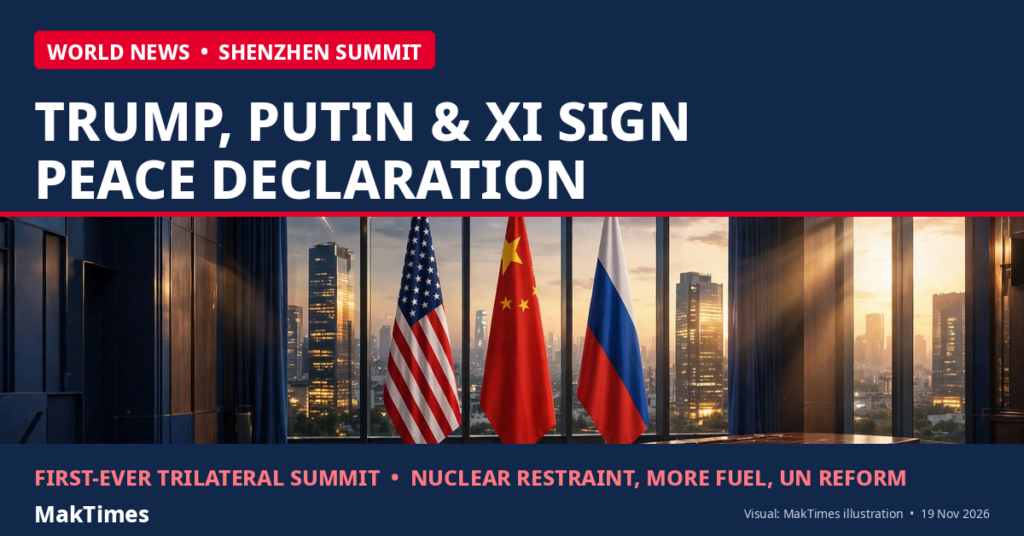
Trump Putin Xi Peace Declaration: Historic Shenzhen Summit Pledges Nuclear Restraint and More Fuel
Donald Trump, Vladimir Putin and Xi Jinping sat down together for the first time on Thursday, and the world got a piece of paper out of it. Not a treaty. Not a ceasefire. A four-point declaration, agreed in about 90 minutes in Shenzhen, that the three most powerful leaders on the planet are calling a peace declaration.
The meeting happened on the sidelines of the Asia-Pacific Economic Cooperation summit. It was the first trilateral summit between the United States, China and Russia in history. Trump flew back to Washington almost as soon as it ended. None of the three spoke to reporters afterwards.
That silence is part of the story. The document did the talking instead — and what it leaves out says as much as what it includes.
What the four points actually say
The declaration, published by the White House and by Chinese and Russian state media, runs to four short commitments.
First, the three countries, all permanent members of the United Nations Security Council, committed to reforming the UN so it can respond more effectively to global challenges. No detail on what reform means. No timetable.
Second, they plan to increase the production and supply of refined petroleum products — diesel and petrol — for the benefit of all nations, and reaffirmed the importance of stable energy flows. Again, no volumes, no targets, no dates.
Third, they recognised state consent and the immunity of state officials as paramount, and agreed that the International Criminal Court and similar bodies must not abuse their jurisdiction. The court has indicted Putin for war crimes in Ukraine. That point was not an accident.
Fourth, and the one Trump had trailed hardest before the meeting, the three leaders reaffirmed that a nuclear war cannot be won and must never be fought. They promised a dialogue on reducing nuclear risks and preventing the spread of nuclear weapons.
Read it plainly and the shape is clear. Broad promises, no deadlines, no numbers. The kind of text three governments can all sign without giving anything up.
The nuclear question is the real one
Strip away the ceremony and the nuclear pledge is the commitment that matters most — and the one with the least in it.
The last arms-control treaty between Washington and Moscow, New START, expired in February 2026. Nothing has replaced it. There is currently no binding agreement limiting the nuclear arsenals of the world’s two largest nuclear powers, and China’s stockpile has been growing fast. Estimates from the Stockholm International Peace Research Institute put the American arsenal at about 5,042 warheads and China’s at about 620 as of January 2026. Together the three states hold the overwhelming share of the world’s nuclear weapons.
Trump went in talking about a pact to cut arsenals. What came out was a promise to talk — which is what an administration official had predicted in advance, calling the discussion a preliminary step.
Putin, in his opening remarks, said the three countries held “joint responsibility for maintaining international peace.” Xi did not mention Ukraine at all in his public remarks. Trump called the three of them “uniquely positioned” to discuss cutting arsenals and lowering the risk of their use.
Whether a dialogue becomes a deal is now the open question. No date has been set for the next round, and no negotiators have been named in public.
Fuel pledge, flat market
The energy promise landed with a thud in the oil market. Brent crude rose just 0.18% on Thursday and US crude gained 0.15%, according to market reporting — barely a flicker for a pledge from the three countries that shape global energy more than any others.
Traders had reason to shrug. The declaration sets no production target and no delivery date, and gives no hint how extra fuel would reach buyers. It is not the first such promise, either. Trump had already unveiled a diesel supply deal with Putin on October 9, vowing prices would fall “FAST!” According to AAA data, American diesel still costs around $5.96 a gallon — down just 32 cents since then and roughly 58% higher than a year ago.
Brent crude has been holding above $92 a barrel, with traders watching the Strait of Hormuz and the risk of fresh strikes on Iran. The summit did nothing to move that picture. If anything, attention stayed where it was: on stubborn American inflation and the Federal Reserve’s December decision, with markets still pricing a rate hike at above 90%.
For fuel-importing countries, the pledge is still worth watching. Pakistan buys nearly all of its petrol and diesel abroad, so a genuine increase in refined-fuel supply would eventually ease pressure on import bills and pump prices. But until volumes actually rise, the declaration changes nothing at the pump.
What the declaration leaves out
Two words never appear in the text: Ukraine and Iran.
Both wars were discussed in the room, according to the leaders’ remarks before the doors closed. Neither made it into the signed document — the reason analysts call the summit an opening rather than a breakthrough.
Smaller countries have reason to be uneasy watching three great powers set the agenda between themselves. Ukraine and Europe were not in the room. The Times called the summit “short on substance or deadlines” on Ukraine and nuclear disarmament — a verdict that is hard to argue with. As for UN reform, every member state says it wants the institution to work better; none of them agree on how. The declaration offers no clue.
Why it still matters
None of this makes the meeting meaningless. The three leaders of the United States, China and Russia had never met in this format before. Getting them into one room, for 90 minutes, with a signed document at the end, is itself a signal — to markets, to allies, to adversaries — that the three capitals are talking rather than shouting.
Diplomacy at this level moves in small steps, and this was a small step. The test now is whether the nuclear dialogue produces a date, a table and negotiators, and whether the fuel pledge produces actual barrels. If both stay as words on paper, the Shenzhen declaration will be remembered as a photograph. If either turns into numbers, it will be remembered as the day the talking started.
For now, the world has a declaration. What it does not yet have is a deal.
Sources: White House, “U.S.-Russia-China Heads of State Declaration toward Peace”, November 19, 2026; BBC News, November 19, 2026; USA Today, November 19, 2026; The Times, November 19, 2026; New York Post, November 19, 2026; BeInCrypto, November 19, 2026; Bloomberg via Energy Connects, November 19, 2026.
Educational Content Only — Not Financial Advice: MakTimes is a news and education website. This article is published for general information and awareness only and is not financial, investment, trading, or legal advice. We are not financial advisors. Cryptocurrency, gold, and other markets are volatile and can result in loss. Always do your own research (DYOR) and consult a licensed financial advisor before making any financial decision. Past performance is not a guarantee of future results.