
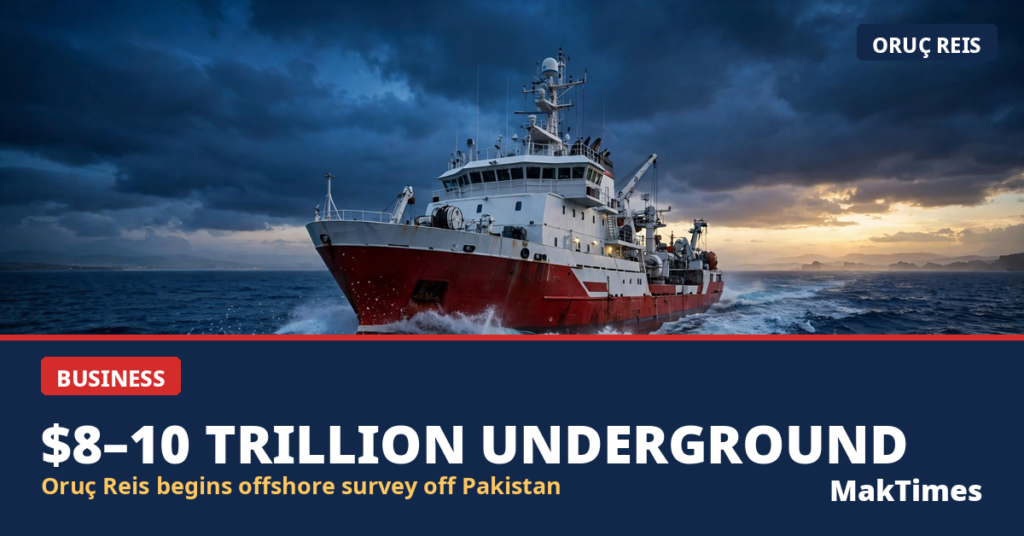
Pakistan Mineral Wealth: Dar Values Natural Resources at $8–10 Trillion as Turkish Ship Starts Offshore Survey
Pakistan’s mineral wealth is worth between $8 trillion and $10 trillion, Deputy Prime Minister Ishaq Dar said on Friday — and he called that the most conservative estimate. Dar was speaking at Karachi Port, where Pakistan had just welcomed the Turkish seismic research vessel Oruç Reis, the ship that will spend the next five to six months mapping the seabed of the Arabian Sea for oil and gas.
The number is staggering. Eight trillion dollars is roughly twenty times the size of Pakistan’s entire economy. Dar used it to push back on a label he clearly dislikes. Pakistan, he said, is not a heavily indebted or debt-trapped country: the federal government’s debt stands at about $100 billion, and around $130 billion once the foreign-exchange liabilities of private companies and public-sector enterprises are counted. Against that, he argued, sits a pile of minerals, hydrocarbons and gemstones worth eighty to a hundred times as much.
Whether the arithmetic holds is another matter. The $8–10 trillion figure is an estimate of what lies underground, not a valuation of proven, recoverable reserves. It bundles together copper and gold at Reko Diq, coal in Thar, gemstones, iron ore and chromite — and now, potentially, oil and gas beneath the sea. Turning any of it into revenue takes surveys, drilling, financing and years of work. That is exactly what the Oruç Reis has come to start.
What the Oruç Reis will actually do
The vessel docked in Karachi on Thursday and was formally welcomed on Friday in a ceremony attended by Dar, Petroleum Minister Ali Pervaiz Malik and Turkish Energy Minister Alparslan Bayraktar. Built in 2017, the 87-metre ship carries equipment for two- and three-dimensional seismic surveys — essentially, firing sound waves at the seabed and reading the echoes to build a picture of the rock below.
It will work in the Indus and Makran basins, the two offshore areas Pakistan is reopening after a gap of almost twenty years. The survey is expected to take five to six months. If the results look promising, Bayraktar said on Friday, drilling could begin in 2027. The vessel’s arrival also brought three signed energy agreements. They cover offshore exploration, and Turkish media reports say two of them involve copper and gold exploration in Pakistan, with a third aimed at antimony, a mineral that goes into batteries and electronics.
The blocks, the partners and the money
The survey sits on top of Pakistan’s Offshore Bid Round 2025, in which licences were awarded for 23 of the 40 offshore blocks offered, covering about 53,500 square kilometres. The first block in line is Eastern Offshore Indus-C, in the Arabian Sea. Turkish Petroleum’s offshore arm, TPOC, holds a 25 percent stake and operates the block. Pakistan Petroleum Limited holds 35 percent, while OGDCL and Mari Energies hold 20 percent each.
Pakistan Petroleum estimates the block could hold 1.5 trillion to 2 trillion cubic feet of gas, based on earlier seismic work. That is a geological estimate, not a reserve — no well has tested it. The initial three-year exploration programmes across the 23 awarded blocks carry about $80 million in committed investment. If the work advances to drilling, the Petroleum Division has said investment could rise to between $750 million and $1 billion.
Why this is happening now
The vessel’s arrival comes eight days after the Pakistan Minerals Investment Forum in Islamabad, where Dar pitched the same $8 trillion figure to international investors. The forum’s headline number comes from the Institute of Cost and Management Accountants of Pakistan, which estimates the country’s mineral reserves at about $8 trillion spread across 600,000 square kilometres, with 92 known minerals of which 52 are commercially exploited. Mining, though, still contributes less than 3 percent of GDP.
Reko Diq dominates the onshore story. The copper-gold deposit in Balochistan’s Chagai district is one of the world’s largest undeveloped mines. Barrick holds 50 percent, the Balochistan government 25 percent and three federal state-owned companies the rest. A feasibility study completed in February 2025 put the investment at $8.83 billion over a 37-year mine life, with first production targeted for the end of 2028. Barrick said in April this year that it would slow development and keep reviewing the project until mid-2027, citing security risks — a reminder that big numbers on paper still have to survive the ground.
There are smaller, newer signals too. OGDCL reported in July that it had found lithium in formation water from a geothermal well in Sindh. Lithium is the metal at the centre of the global battery race, and even a hint of it in Pakistan changes the conversation. The government’s own advisers have estimated that better governance and security could lift annual mineral exports from about $3 billion to $8 billion.
What to watch next
The honest test is not the ceremony in Karachi. It is the survey data, due in the middle of next year, and then the first drill bit. Offshore exploration is slow, expensive and often disappointing, and a seismic survey proves nothing on its own — only a drilled well can show whether gas or oil is actually there, and in what quantity.
For now, the ship is the story. A Turkish vessel, a five-month survey, a 2027 drilling target and a deputy prime minister willing to put a ten-trillion-dollar number on the country’s underground wealth. If the seabed cooperates, the number starts to look less like a boast and more like a balance sheet. If it doesn’t, Pakistan will still have spent five months learning exactly what it does — and does not — own.
Sources: Reuters, November 20, 2026; Dawn, November 20, 2026; The Express Tribune, November 20, 2026; The News, October 2026; Pakistan Ministry of Energy (Petroleum Division), November 2026; Barrick Mining Corporation, February and April 2026.
Educational Content Only — Not Financial Advice: MakTimes is a news and education website. This article is published for general information and awareness only and is not financial, investment, trading, or legal advice. We are not financial advisors. Cryptocurrency, gold, and other markets are volatile and can result in loss. Always do your own research (DYOR) and consult a licensed financial advisor before making any financial decision. Past performance is not a guarantee of future results.