
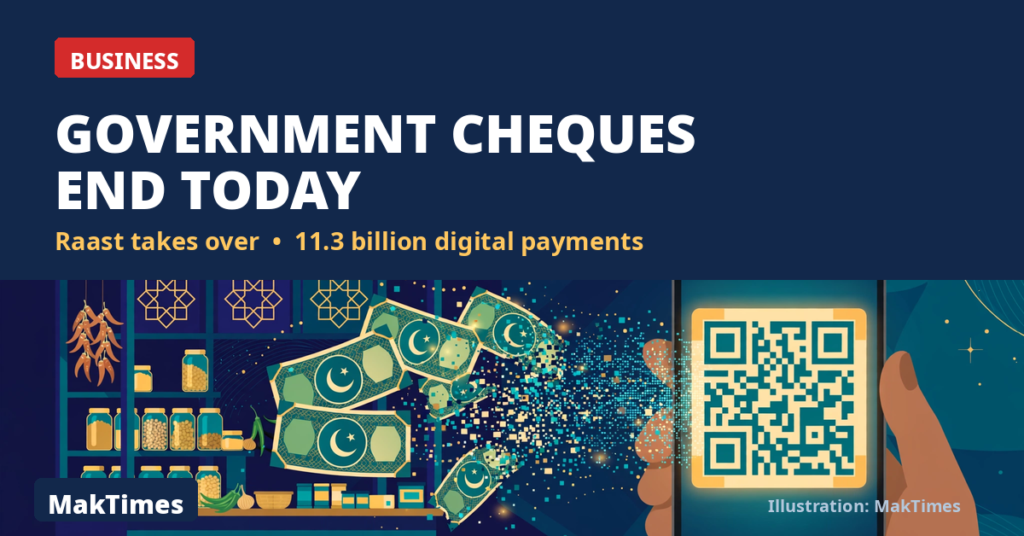
Cashless Pakistan: Government Cheques End Today as Raast Takes Over, Digital Payments Hit 11.3 Billion
From today, the government stops writing one kind of cheque. Payments through Asaan Assignment Accounts — the channel departments use to pay suppliers, contractors and service providers — move entirely to Raast, the State Bank of Pakistan’s instant payment system. The change takes effect on Monday, November 16, a day after cheque payments through those accounts were discontinued.
It is the most concrete deadline yet in the Cashless Pakistan drive. And it arrives with a warning worth repeating, because the headlines have been louder than the facts: ordinary bank cheques are not banned. Nobody’s personal cheque book stops working today.
What changes is narrower, and more deliberate. The state is moving its own money first.
What actually ends today
An Asaan Assignment Account is a special government banking arrangement. Departments and public projects use it to pay from approved public funds, under official financial controls. The officers who authorise and release that money — Drawing and Disbursing Officers — have already been trained in the new system, the government confirmed on November 12.
Business Recorder first reported the switch on November 7. The decision followed a meeting on the cashless economy chaired by Prime Minister Shehbaz Sharif on November 6, where he directed officials to produce a clear roadmap, with timelines and targets, for a fully digital payments system. A follow-up session at the Finance Division, chaired by Minister of State for Finance Bilal Azhar Kayani, turned those orders into dated actions.
The cheques ending today belong to that one channel. A private business paying a supplier by cheque, or a citizen writing a cheque for rent, is untouched. The Negotiable Instruments Act of 1881 still governs those instruments, and no law has changed that.
The numbers behind the push
The switch lands on top of growth that is hard to argue with. Annual digital transactions have risen from 6.9 billion to 11.3 billion in a single year, according to figures presented at the Finance Division meeting. Active digital payment merchants have grown from 500,000 to more than two million under the Raast QR initiative — 2.03 million active digital commerce payment points by June 2026, of which 1.73 million merchants actively use Raast QR.
Raast itself is doing the heavy lifting. The State Bank’s Payment Systems Quarterly Review counted 742 million Raast transactions worth Rs23.27 trillion — roughly $83 billion — in January to March 2026 alone, up from 295.7 million transactions in October to December 2024. Ahson Saeed, chief executive of Raast Payments Pakistan, told a Mobile Commerce conference in June that the system now handles 10 million to 11 million transactions a day and will process more than $500 billion in 2026.
Government money is moving fastest of all. Disbursements to people through Raast and other digital channels rose from Rs472 billion in July 2025 to Rs4.402 trillion by June 2026 — about 76 percent of total government disbursements. Mobile, internet and digital banking users climbed from 95 million to 137 million over the same period, and the share of remittances credited directly to accounts and wallets reached 92 percent, up from 80 percent.
Islamabad goes first, the country follows
The capital is the test case. Islamabad is set to become Pakistan’s first fully cashless city by December 31, 2026, with cash payments at government counters stopping even sooner — after November 30. The decision was announced on November 13 at a meeting chaired by Minister of State for Interior Talal Chaudhry. Around 26,000 merchants in the capital have already been connected to digital payment systems, and the target is every merchant in the city, from roadside vendors to large commercial centres.
Interior Minister Mohsin Naqvi had pledged to Prime Minister Shehbaz Sharif that Islamabad would be made Pakistan’s first cashless city.
Nationally, 25 high-impact federal and provincial entities have been identified for complete digitisation through Raast by December this year, and most government institutions are expected to finish the transition by then. The original roadmap aimed for two million active digital merchants, 120 million digital banking users, 15 billion annual digital transactions and 70 percent financial inclusion by December 2026. Raast QR codes have already been placed on more than 45 million electricity and gas bills.
The shopkeeper problem
The rails work. The harder question is whether the small shopkeeper at the end of them wants to use them — and that is where the next decision sits.
Kayani has directed the State Bank to prepare a working paper for approval of the Raast QR Merchant Discount Rate scheme. The MDR is the small fee charged when a customer pays digitally, shared between the bank, the payment network and the merchant’s service provider. Get it wrong and merchants quietly go back to cash; get it right and the QR code stays on the counter.
Raast person-to-person and person-to-merchant payments are free to consumers by design. The state bridged merchant costs with a Rs3.5 billion subsidy for Raast QR transactions that ran from September 2025 to June 2026. What replaces it is now the open question.
There are other gaps the government itself has acknowledged. The November 6 meeting noted that a payment mechanism for areas without internet connectivity is still being developed. And nobody has yet said what happens to traders who miss the December 31 merchant deadline in Islamabad.
Meanwhile the State Bank is modernising the cheque itself rather than abolishing it. On October 5 it announced the Pakistan Express Clearing System, or PECS, which uses cheque truncation to clear ordinary cheques faster. The pilot began on October 15, with nationwide coverage planned by April 30, 2027.
What it means for you
For most readers, today changes nothing at the bank counter. Your cheque book works. Your bank account works. The change bites only if you deal with the government as a supplier, contractor or service provider — in which case payments that used to arrive by cheque will now arrive through Raast, instantly, and only to a bank account or wallet linked to a Raast ID.
The wider direction is now unmistakable. Cashless Pakistan was launched in June 2025 under the prime minister’s direct supervision, built on three stated pillars — public convenience, transparency, and bringing more of the economy into the formal, documented system. It comes as the government’s own books stay under pressure — Pakistan’s fiscal surplus shrank 40% in the first quarter — even as 13 mining and minerals deals were signed in Islamabad this week. Today’s deadline is the first time a whole payment channel has actually been switched off. December brings the next test: most government institutions fully digitised, and a capital city that takes no cash at its own counters.
Whether the shopkeeper follows the state onto Raast will decide whether this becomes a genuine change in how Pakistan pays — or just a faster way for the government to pay itself.
Frequently asked questions
Are bank cheques banned in Pakistan from November 16? No. Only cheque payments through government Asaan Assignment Accounts end. Ordinary cheques for citizens and private businesses remain legal and are still cleared — and the State Bank is modernising cheque clearing through its new PECS system.
What is Raast? Raast is the State Bank of Pakistan’s instant payment system, launched in 2021. It lets people, businesses and the government transfer money instantly between banks, wallets and microfinance institutions, including by scanning a Raast QR code at a shop.
What is an Asaan Assignment Account? It is a special government banking arrangement that lets authorised departments and projects pay suppliers, contractors and service providers from approved public funds. From November 16, those payments go through Raast instead of by cheque.
Do I need to do anything? Only if you receive payments from the government. Make sure the receiving account is linked to a Raast ID and the IBAN on record is up to date. For everyone else, no action is needed — but beware of fraud: never share Raast OTP codes with anyone claiming to help with the switch.
Sources: Business Recorder, November 7, 2026; Press Information Department / Finance Division, November 12–13, 2026; State Bank of Pakistan Payment Systems Quarterly Review, January–March 2026; State Bank of Pakistan Annual Payment Systems Review FY26, October 6, 2026; MEA Tech Watch, November 15, 2026; TechX, November 13, 2026.
Educational Content Only — Not Financial Advice: MakTimes is a news and education website. This article is published for general information and awareness only and is not financial, investment, trading, or legal advice. We are not financial advisors. Cryptocurrency, gold, and other markets are volatile and can result in loss. Always do your own research (DYOR) and consult a licensed financial advisor before making any financial decision. Past performance is not a guarantee of future results.