
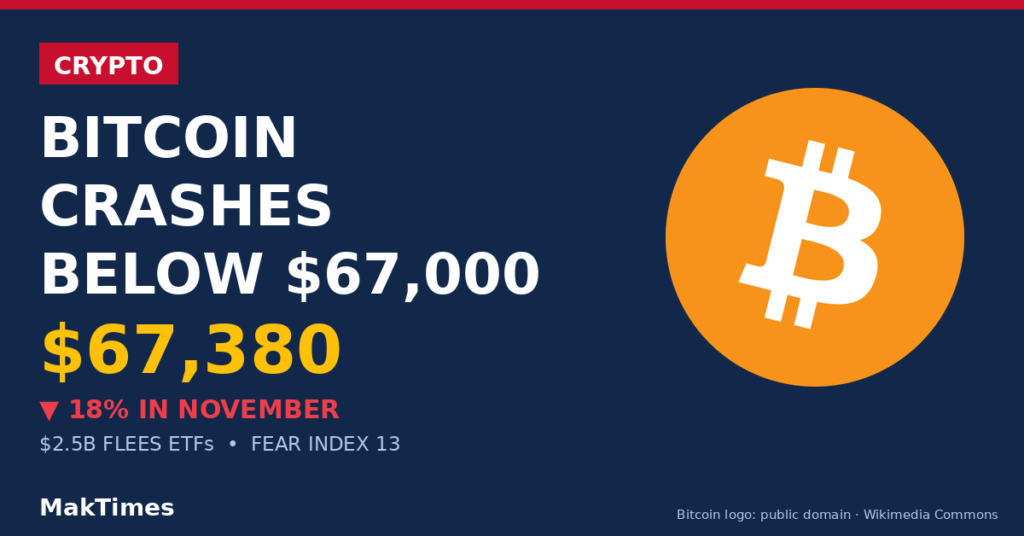
Bitcoin Price Today: Bitcoin Crashes Below $67,000 to a Three-Month Low as $2.5 Billion Flees ETFs
Bitcoin price today tells a story that has been building all month, and on Saturday morning it reached a new low point. Bitcoin fell below $67,000, its weakest level in about three months, as another wave of forced selling swept through the crypto market and big investors kept pulling money out of US spot Bitcoin funds.
As of 03:17 UTC on November 14, Bitcoin was trading at about $67,380, according to CoinGecko data reported by The Crypto Times. That is down roughly 3.3% over the previous 24 hours. The day’s range ran from a high of $70,045 to a low of $67,032. On Binance’s USDT market, the price dipped even further, to $66,915 — the lowest print since August 19.
Just a day before that, the coin had slipped through $70,000 — a line it had held since August. It did not stop there. The fall has now stretched past 18% in November alone, and the coin is down close to 10% this week — on course for its worst weekly performance since June, according to CoinDesk data cited by Morningstar. Measured against its all-time high of $126,080, set on October 6, 2025, Bitcoin now sits about 46.6% lower.
Bitcoin price today: the key figures at a glance
Bitcoin price (03:17 UTC, Nov 14): about $67,380. 24-hour range: $67,032 – $70,045. Intraday low (Binance): $66,915 — lowest since Aug 19. 24-hour change: down about 3.3–3.8%. Fall in November so far: more than 18%. Distance from all-time high: about 46.6% below $126,080. 24-hour liquidations: $1.26 billion. US spot ETF outflows since Oct 30: more than $2.5 billion. Crypto Fear & Greed Index: 13 — Extreme Fear.
Bitcoin’s market value stood near $1.358 trillion, on $41.44 billion of trading over 24 hours. The wider crypto market was down too: total market value slipped to about $2.31 trillion, a fall of roughly 5.5% in a day, and the Crypto Fear & Greed Index sank to 13, its “Extreme Fear” zone.
Why bitcoin is falling: hot inflation and a December rate hike
No single headline explains the slide. The pressure has been building from the US economy, where two inflation reports in one week both came in hotter than expected.
October’s Consumer Price Index came in at 0.4%, the Bureau of Labor Statistics said on November 10. Core CPI, which strips out food and energy, rose 0.3%. Economists had expected 0.3% and 0.2%. Then, on November 13, producer prices rose 0.3% on the month and 6.5% year on year — the biggest annual increase since November 2022.
That changed the conversation about interest rates. Before the CPI release, Federal Reserve Governor Christopher Waller said in a November 10 speech in London that he was leaning toward a 25 basis point rate hike in December, adding that a 50 basis point move should be considered if core CPI rose about 0.3% or more. “Hiking only 25 basis points would put our credibility at risk,” he said.
After the PPI data, the CME FedWatch Tool — which reads rate probabilities from fed funds futures — showed an 89.7% chance of a quarter-point hike in December and a 10.3% chance of a half-point move. Put together, traders now fully expect some kind of hike. The Fed held its benchmark rate at 3.75% to 4.00% in October, and its rate-setting committee meets next on December 8 and 9.
On Friday, the 10-year US Treasury yield climbed to 5.17% as rate expectations rose. Higher yields raise the return investors give up by holding assets that pay no interest — Bitcoin among them. The dollar has strengthened at the same time, hitting a 19-month high, and that combination has weighed on crypto and on technology shares alike.
Analysts at Bitfinex Alpha, quoted by MarketWatch, put it plainly: the evidence points to a retreat from risk rather than a loss of conviction in Bitcoin itself, with crypto-specific leverage and ETF outflows amplifying the move.
ETF outflows: $2.5 billion gone since October 30
The other half of the story is institutional money walking out the door. November 12 marked the sixth straight session of withdrawals from US spot Bitcoin ETFs, with $284 million leaving the funds, SoSoValue data shows. BlackRock’s iShares Bitcoin Trust (IBIT) led with $204 million in outflows that day.
The five sessions through November 11 had already cost the funds about $1.44 billion. Add November 12, and six-session outflows reach roughly $1.72 billion. Since October 30, more than $2.5 billion has flowed out of the funds, according to data reported across the week. November outflows alone total about $1.88 billion, per Farside Investors data cited by Decrypt, after $520 million left in October. Total net assets in the funds have fallen to about $93.7 billion, roughly 45% below their October 2025 peak of $169.5 billion.
Bloomberg ETF analyst Eric Balchunas offered a calmer reading: the scale of outflows is relatively small against the size of the funds, and he assessed that most investors are holding their existing positions despite the price drop. Cumulative net outflows for the year to date stand at about $1.4 billion — small next to the tens of billions that flowed in during the funds’ first year.
Strategy, the largest corporate holder of Bitcoin, is also set to leave the MSCI global equity indexes after the November 30 close, removing a source of passive demand. Its shares fell 13.6% this week.
Liquidations: $1.26 billion wiped out in a day
Leveraged traders took the hardest hit. Over the past 24 hours, exchanges forcibly closed $1.26 billion in crypto positions, wiping out 173,014 traders, CoinGlass data shows. Bets on rising prices took almost all of the damage — $1.08 billion, or 86.4% of the total — while shorts lost $170.34 million.
Roughly half of the wipeout — $635.81 million — came from Bitcoin positions, and 90.5% of those were longs. Ether traders lost $289.71 million. One trade stood out: a $17.81 million ETHUSDT position on Binance, the biggest single wipeout of the day, on the exchange that handled 39.8% of all liquidations.
The flush was concentrated: in one hour alone, $236.54 million of positions were closed out — $229.03 million of them longs — which is over 60% of everything liquidated in the previous 12 hours. In plain terms, the latest dip dragged a whole group of leveraged longs below the prices at which their exchanges close them out.
Ethereum and the wider market slide too
Bitcoin was not alone. Ether, the second-biggest crypto asset, sank under $2,000, trading around $1,900–$1,932, its lowest since mid-August and down nearly 15% this week. Solana fell about 3.8% to $78.37, and XRP slipped 2.2% to about $1.01. The CoinDesk 20 Index, which tracks the largest cryptocurrencies, fell 2%.
There are more tests ahead. Nvidia reports earnings on November 17, and the chipmaker’s shares have been tied to the same risk-off mood that is hitting crypto. Morningstar also noted that Anthropic’s initial public offering next week could draw cash away from existing holdings, as investors sell assets to make room for what is expected to be one of the most sought-after stock offerings in recent years.
For now, analysts are watching two lines. Bitfinex Alpha sees $67,800 — Bitcoin’s 200-week moving average — as a key support level, with a weekly close above roughly $68,000 needed to keep the long-term trend intact, according to MarketWatch. On the upside, $70,000 is the level to reclaim: it sits at the top of the 24-hour range and was the support Bitcoin lost on Friday. What happens next depends on whether institutional demand returns through the ETFs, and on how far December rate expectations move before the Fed meets.
Frequently asked questions
Why is Bitcoin falling today? Two forces are combining: US inflation came in hotter than expected in October, lifting the odds of a Federal Reserve rate hike in December, and leveraged traders are being forced out of their positions. More than $1.26 billion in positions were liquidated in 24 hours, most of them bets that prices would rise.
How far has Bitcoin fallen from its peak? Bitcoin’s all-time high was $126,080 on October 6, 2025. At about $67,380, it is roughly 46.6% below that peak, and down more than 18% in November alone.
Are Bitcoin ETFs losing money? The funds have now seen money leave for six sessions in a row, adding up to more than $2.5 billion since October 30. Analysts note the outflows are small relative to the funds’ size, and most holders appear to be staying put rather than selling everything.
Sources: The Crypto Times (November 14, 2026); CoinDesk via Morningstar and AlphaMaven (November 13, 2026); CoinGabbar (November 14, 2026); US Bureau of Labor Statistics CPI and PPI releases (November 10 and 13, 2026); CME FedWatch Tool (November 13, 2026); CoinGlass liquidation data (November 14, 2026); SoSoValue and Farside Investors ETF flow data (November 2026).
Educational Content Only — Not Financial Advice: MakTimes is a news and education website. This article is published for general information and awareness only and is not financial, investment, trading, or legal advice. We are not financial advisors. Cryptocurrency, gold, and other markets are volatile and can result in loss. Always do your own research (DYOR) and consult a licensed financial advisor before making any financial decision. Past performance is not a guarantee of future results.