
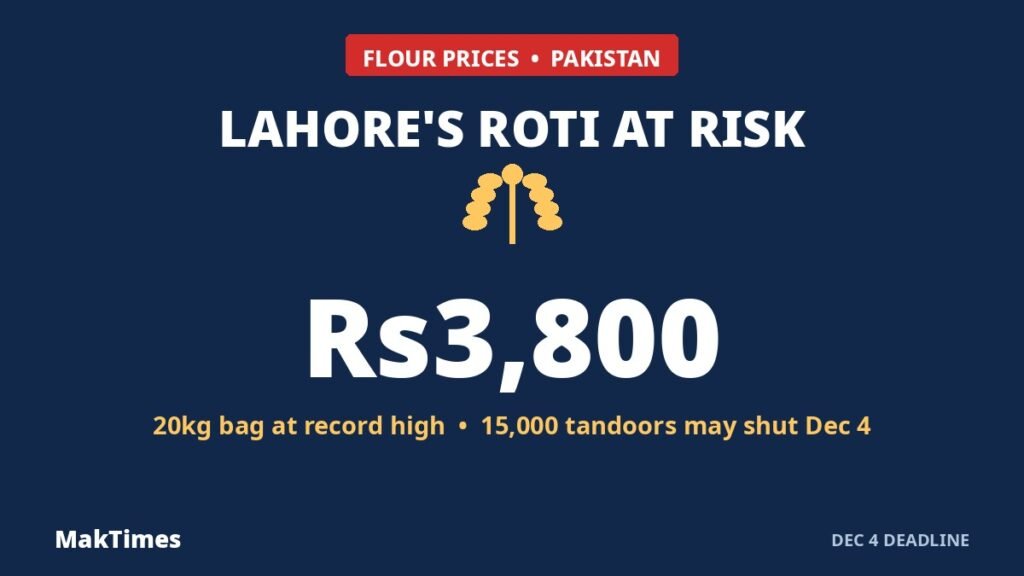
Flour Price in Pakistan Hits Rs3,800 as Lahore’s 15,000 Tandoors Threaten December 4 Shutdown
A 20-kilogram bag of flour now costs as much as Rs3,800 in Pakistan — the highest price in the country’s official data — and in Lahore, the people who bake the nation’s cheapest meal say they are about to stop. The Mutahidda Nan Roti Association, which speaks for around 15,000 tandoors across the city, has warned it will halt roti sales from December 4 unless the Punjab government fixes a pricing squeeze that leaves vendors losing money on almost every flatbread they sell.
It is the kind of threat that lands differently from most price stories. Roti is not a luxury. For millions of low-income families it is the meal itself, bought hot from a neighbourhood tandoor. When the people who make it say they cannot afford to keep the ovens lit, it stops being about statistics.
Why Lahore’s tandoors say they cannot go on
The numbers behind the standoff are brutally simple. Until recently, Lahore’s tandoor owners were buying a 10-kilogram bag of subsidised flour for Rs1,100 and selling plain rotis for Rs17. Then the government raised the bag to Rs1,275. The roti price stayed where it was.
Association president Aftab Gill laid out the maths to Dawn: at the new flour price, with liquefied petroleum gas (LPG) getting dearer and gas load shedding cutting into working hours, the notified selling price no longer covers the cost of making a roti. The association has asked the Lahore deputy commissioner to raise the official roti price to Rs30 — nearly double the current Rs17 — and has given the government until December 4 to answer.
The dispute turned sharper when the Punjab Enforcement and Regulatory Authority, known as PERA, began sealing tandoors accused of storing or using subsidised flour without authorisation. Eight outlets have been sealed so far, according to Dawn. Vendors protested outside the deputy commissioner’s office, demanding access to subsidised flour and an end to the sealing drive. Their argument is blunt: commercial tandoors were never given a workable supply of the cheap flour they are now punished for using.
Lahore’s tandoors burn through flour on a scale that is hard to picture. The association says the city’s outlets need roughly 15,000 bags of 80 kilograms every single day. That is the daily bread of a city of millions, and the whole chain now hangs on a negotiation with five days left.
Flour Price in Pakistan: what the official numbers show
The Lahore standoff is the sharp end of a national climb. Figures from the Pakistan Bureau of Statistics, published on November 28, show a 20-kilogram flour bag selling for up to Rs3,800 in Hyderabad — the most expensive city in the country. Only a week earlier, the highest price recorded anywhere was Rs3,600.
Hyderabad is not an outlier. Peshawar follows at Rs3,750 for the same 20-kilogram bag. Rawalpindi and Islamabad are at Rs3,733. Karachi, Bannu and Quetta sit at Rs3,600. In Punjab’s big cities the bag costs Rs3,533 in Lahore, Gujranwala and Sialkot. The cheapest city in the survey, Khuzdar, still charges Rs3,200 — a price that would have sounded steep a year ago and now reads as a bargain.
Hyderabad’s mills shut down in a separate row
While Lahore’s vendors threaten to close, Hyderabad’s flour mills have already shut. Mill owners there stopped work after talks with district authorities broke down over Sindh’s fixed flour price of Rs145 per kilogram at retail, with an ex-mill rate of Rs138.
The gap between the notified price and the market price tells its own story. Roller mills in Hyderabad were reportedly selling flour at Rs175 per kilogram despite the Rs145 notification, while traditional chakki flour — the stone-ground flour most households prefer — was going for Rs190 to Rs200 per kilogram. The Sindh Food Department’s rates apply until January 31, 2027, but on the ground, no mill had even displayed a banner advertising flour at the official price, according to The Express Tribune.
Millers say their costs have risen too. The government recently raised the estimated processing cost for roller-mill flour from Rs16 to Rs26 per kilogram after demands from the mills’ association. Chakki operators, meanwhile, want a bigger subsidised wheat allocation, now restricted to 60 kilograms per grinding stone a day.
In Rawalpindi, the roti is already Rs25
Lahore is not the first city where the roti price has broken away from the official line. In Rawalpindi, a 20-kilogram flour bag has reached Rs3,600, and a 15-kilogram bag has jumped from Rs2,200 to Rs2,600 within days. Roti there now sells for Rs25 at many tandoors. Naan costs Rs35.
That is a long way from the promise Punjab Chief Minister Maryam Nawaz made when she announced roti would be available for Rs7. The government later indicated verbally that tandoor owners could sell roti for Rs17, but no formal notification followed, and the subsidised 10-kilogram flour bag fixed at Rs1,100 is now being quoted at Rs1,270. In Rawalpindi, a significant number of the city’s more than 5,000 registered tandoors have already closed because the sums no longer work, according to The News.
What happens between now and December 4
Five days is not much time. The association’s written application sits with the Lahore deputy commissioner, and the government has two options that cost it something either way: release subsidised flour to commercial tandoors at the old rate, or let the notified roti price rise toward Rs30 and take the political hit.
Neither option fixes the deeper problem. Wheat imports were supposed to cool the market and have not, and every fix so far — imports, fixed prices, enforcement raids — has been outrun by the market. December electricity bills may carry Rs4.22 per unit in adjustments as well, which means the same households facing dearer roti are about to be charged more to keep the lights on.
For now, the ovens are still lit. The question is whether they stay lit past December 4 — and what a roti costs the morning after.
Sources: Dawn (via ANI), November 28, 2026; Pakistan Bureau of Statistics flour price data, November 28, 2026; The Express Tribune, November 28, 2026; The News, November 2026.