
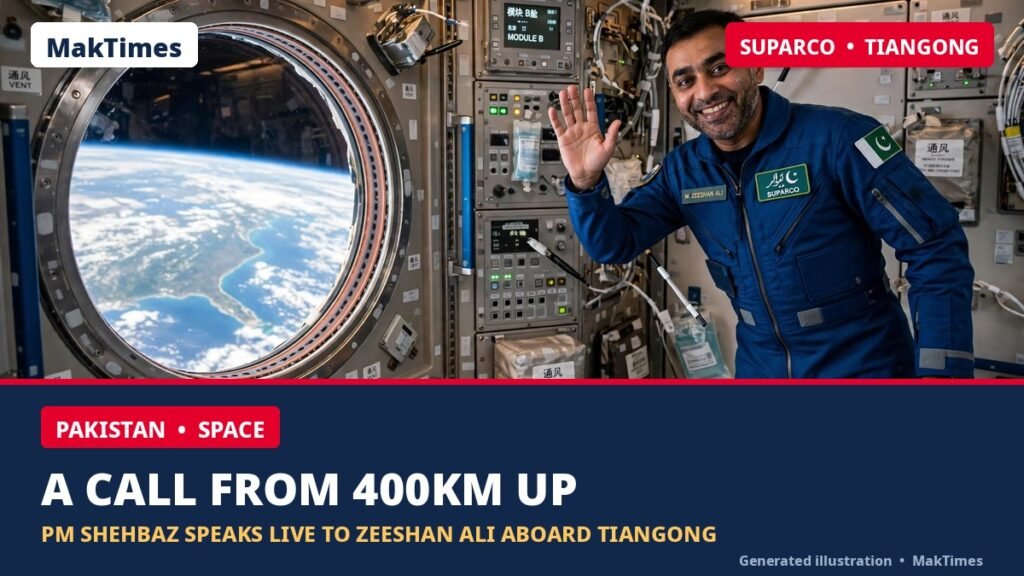
Pakistani Astronaut Zeeshan Ali: PM Shehbaz and Field Marshal Munir Speak Live as He Orbits 400km Above Earth
Pakistan’s first astronaut took a call from home on Saturday — from 400 kilometres above Earth. Prime Minister Shehbaz Sharif and Chief of Defence Forces Field Marshal Syed Asim Munir spoke live by video link with Wing Commander Muhammad Zeeshan Ali aboard China’s Tiangong space station, three days after he became the first Pakistani to fly to orbit.
The call went out from the headquarters of the Space and Upper Atmosphere Research Commission — SUPARCO — in Islamabad, and Pakistan Television carried it live. On a big screen in the control room, Ali appeared in his blue flight suit, the Pakistani flag stitched on the shoulder, floating inside a module decorated with the flags of Pakistan and China. Around the table sat Deputy Prime Minister Ishaq Dar, Information Minister Atta Tarar and Chinese Ambassador Jiang Zaidong, watching a Pakistani speak from orbit for the first time in the country’s history.
A call from SUPARCO, 400 kilometres up
The prime minister did not waste the moment on ceremony. He called it a day of pride for Pakistan’s 240 million people, congratulated Ali’s family and the colleagues who trained him, and paid tribute to the experts behind the mission.
“We are proud of young people whose ambitions soar beyond the stars,” Shehbaz Sharif told the astronaut. “The entire Pakistani nation is looking forward to the success of your remarkable space mission and your safe return home.”
Field Marshal Munir spoke next, and his words were simpler. “Pakistan’s son has reached space and achieved this great feat,” he said, adding that the whole nation — and the armed forces with it — took pride in the milestone.
Then he turned to the partnership that put Ali up there. The friendship between Pakistan and China, he said, is “higher than the Himalayas, deeper than the oceans and sweeter than honey” — and it has now reached, in his words, “the vastness of the universe”.
What Zeeshan Ali told the leaders
Ali answered from a place most Pakistanis will never see. He told the leaders he was speaking from 400 kilometres above Earth, travelling at 7.9 kilometres every second, and that the mission was progressing according to plan. Representing Pakistan in space, he said, was a great honour and a source of pride — and he was carrying out his assigned duties and research work aboard the station with full dedication.
According to Arab News, he used the exchange to urge young Pakistanis to pursue science. It was the one piece of advice in a call otherwise given over to congratulations: the first Pakistani in orbit telling the next generation to follow him up.
Three days into a first for two countries
The call came three days after the launch that made it possible. Ali lifted off on Wednesday, November 25, at 5:18 a.m. Pakistan time, riding a Long March-2F rocket out of the Jiuquan Satellite Launch Centre in China’s north-western Gobi Desert. His spacecraft, Shenzhou-24, docked with Tiangong at 8:56 a.m. the same morning — about three and a half hours after liftoff — and the crew was welcomed aboard by the Shenzhou-23 astronauts already on the station.
Ali flies as a payload specialist alongside commander Tang Hongbo, who is visiting Tiangong for a third time, and flight engineer Wu Yi, on his first spaceflight. He is the first Pakistani to travel beyond Earth, and the first foreign astronaut ever to board China’s station — a double first that put Pakistan among the countries taking part in human spaceflight.
His stay is short but it is not a sightseeing trip. Reports put it at five to ten days, during which he will work on four research payloads chosen from more than 300 proposals submitted by universities and research institutions across Pakistan — experiments in biotechnology and related fields, designed to use the microgravity aboard the station. He will come home aboard Shenzhou-23, the vehicle that has been docked at Tiangong since May, travelling back with two of its crew while Tang and Wu stay on for a six-month tour.
The road to Tiangong
Ali’s seat traces back to a deal struck in Islamabad on February 28, 2025, when SUPARCO and China’s manned space agency agreed that China would select and train Pakistani astronauts for flights to Tiangong. Ali and fellow pilot Khurram Daud were chosen in April 2026 after a selection process that began with around 20 finalists; Daud trained alongside him in Beijing and serves as his backup.
Both men spent months at the Astronaut Centre of China — centrifuge runs, low-pressure chamber assessments, weightlessness adaptation and orbital systems coursework, along with mandatory Mandarin. The mission’s emblem carries the partnership too: the Shenzhou-24 insignia features jasmine, Pakistan’s national flower.
President Asif Ali Zardari and Chinese President Xi Jinping exchanged messages after Wednesday’s flight, and on Thursday the prime minister received Chinese Ambassador Jiang Zaidong in Islamabad to congratulate China’s leadership and people on the mission.
Why the call mattered beyond the moment
A phone call to orbit is, on its own, a piece of theatre. What made this one land was the timing: three days into a mission that is still unfolding, with the astronaut’s return still to come, the country’s civilian and military leadership spoke to him together, in public, from the headquarters of the agency that sent him.
Allama Iqbal’s name came up more than once around the call. The prime minister invoked the poet’s vision for Pakistan’s youth, and Al Jazeera noted how Iqbal’s verses were being shared across borders as the mission unfolded — a reminder that a first in space is also a story a country tells about itself.
For SUPARCO, the flight is the first time a Pakistani national has travelled to space under the country’s own human spaceflight programme. For the rest of the week, the question is a simple one: the experiments run, the station keeps circling, and in a few days a Pakistani comes home from orbit.
Sources: The News, November 28, 2026; Islamabad Post, November 28, 2026; The Diplomatic Insight, November 28, 2026; Dawn, November 28, 2026; Sial News, November 28, 2026; Arab News, November 28, 2026; MakTimes, November 24, 2026.