
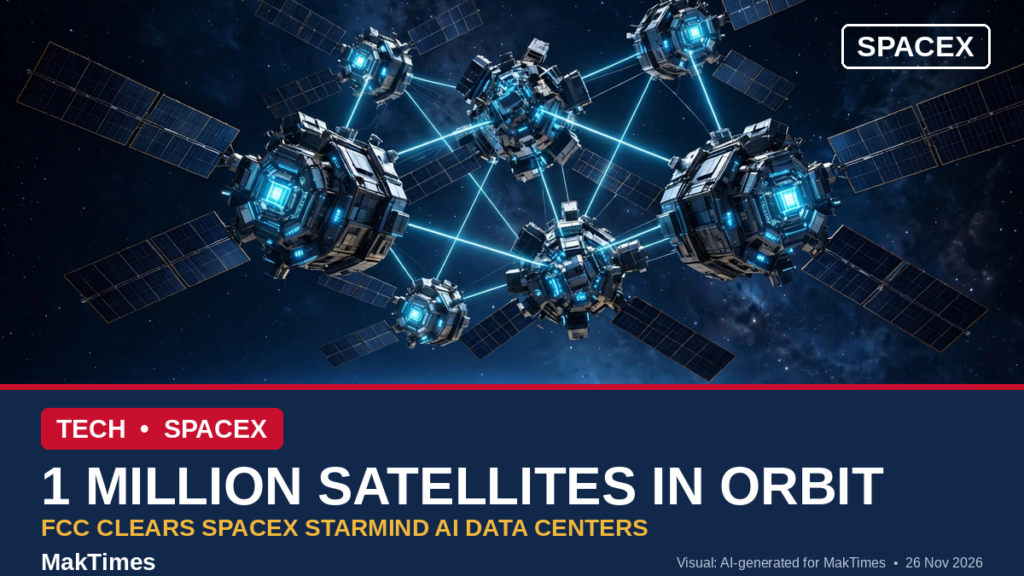
SpaceX 1 Million Satellites: FCC Approves Orbital AI Data Centers in Space
The SpaceX 1 million satellites plan cleared its biggest hurdle on Wednesday, when the Federal Communications Commission gave the company permission to put a data centre in orbit. Not one data centre — a constellation of up to one million of them, a network called Starmind that would process the data behind artificial intelligence above the Earth instead of on it. The FCC called it the first authorisation in American history for a constellation of data centres in space.
SpaceX filed its petition on January 30, 2026, asking to deploy up to one million “orbital compute modules” — satellites that do the heavy processing for AI workloads and beam the results back to Earth. The FCC said yes the day before Thanksgiving, saying the network would help meet “rapidly growing demand” for AI computing.
A million satellites against 17,000
The scale is what stops people. Jonathan McDowell’s catalogue — the tally astronomers actually use — puts the working total at about 17,000 satellites circling the planet right now. SpaceX’s own Starlink network — already the biggest thing humans have ever put in the sky — accounts for roughly 11,200 of them. Starmind, at full size, would be nearly 60 times that: sixty times every working satellite in orbit today, from every country, company and space agency combined.
Each Starmind satellite is itself enormous by satellite standards. Each one, SpaceX says, stretches 75 metres across — close to 246 feet — and stands 30 metres tall once its panels and antennas unfold. One satellite carries roughly 250 kilowatts of computing power. The trick, according to Michael Nicholls, SpaceX’s senior vice president for Starlink and AI, is that they will not work alone. They will fly in tight clusters of about ten, linked by ten terabits of bandwidth between them, “such that we can run these AI models efficiently”, as he put it at the International Astronautical Congress in October.
The satellites will sit in orbital shells between 500 and 1,002 kilometres up — higher than the International Space Station — and talk to each other over optical links. Radio frequencies are kept as a backup only, for telemetry and control if the lasers fail.
The timetable: first launch in 2027, a million by 2040
Musk’s own timetable puts the first Starmind spacecraft in the air in the third quarter of 2027. He promised a slow start first — then, in his words, “significant volume probably in ’28 and then very large volume in ’29”. SpaceX chief financial officer Bret Johnsen told investors last week that the company plans to put its first data centres in space in 2027 and expand through 2029.
The FCC’s deadlines are looser than Musk’s. One satellite has to be flying by November 25, 2033. A tenth of the constellation — 100,000 of them — by November 2035, half by November 2038, and the whole million by November 25, 2040.
Nvidia is the manufacturing partner. The satellites will be built at SpaceX’s plant in Bastrop, Texas — some 350 miles north of Starbase, where the rockets launch. The satellites will go up on Starship, the company’s giant Super Heavy rocket.
To Carr, the FCC chairman, this is a race. “Compute campuses or data centers are essential to sustaining America’s leadership in [artificial intelligence],” he said in a statement. “By moving compute capacity beyond Earth, SpaceX and the many competitors working on their own orbital data centers are meeting the moment.” Musk replied on X: “Much appreciated. This will be a great asset to America and the world.”
Why space at all?
A data centre on Earth is, at heart, a building full of computers that gets hot. Cooling them eats enormous amounts of water and electricity, and the biggest AI data centres now draw as much power as a small city. That is why Washington has spent the month arguing about taxes on data centres built abroad.
Space answers two of those problems at once. Up there, the Sun never sets on a solar panel in the right orbit, and the cold of space is free. The pitch SpaceX made in its application is that orbit removes the land, water and grid constraints that now limit how fast AI infrastructure can grow on the ground. It is a pitch others are making too — Carr’s statement noted “the many competitors working on their own orbital data centers”, and the FCC’s order is written as a first, not a last.
Astronomers are not celebrating
Not everyone sees a triumph. The American Astronomical Society, which represents professional astronomers in the United States, said it was “disheartened and dismayed” by the decision and called the constellation “at odds with a spirit of cooperation and goodwill”. A million bright satellites, the society warned, would put “the future of federally funded astronomical research under such a fundamentally altered night sky” in danger — and leave the taxpayer money already poured into observatories around the world wasted.
Viasat, the satellite operator, and Amazon’s Kuiper Systems — Starlink’s rival — filed their own objections, warning about radio interference and the debris a million new satellites would add. The FCC rejected all of the petitions to deny. On debris, the FCC was more careful. SpaceX will test its satellites at lower altitudes first, and their propulsion systems allow them to manoeuvre out of the way of other objects and dispose of themselves at the end of their lives. One idea — parking dead satellites in orbits around the Sun instead of bringing them back to burn up — was deferred, pending more detail.
Scepticism is not limited to astronomers. A million satellites is a number no one has ever built, launched or operated, and SpaceX’s own application took ten months to clear the FCC. The first satellite is still, on Musk’s own timetable, the better part of a year away.
But the authorisation itself changes the argument. Until Wednesday, a data centre in space was a founder’s daydream. Now it is a licensed network with deadlines, a manufacturing partner in Nvidia, a rocket to carry it, and a regulator’s signature. Look up in a decade and the sky may not be the one you remember. For the first time, that is not a warning from astronomers. It is the plan.
Sources: Reuters, November 25, 2026; Spaceflight Now, November 26, 2026; CNN, November 26, 2026; The Wall Street Journal, November 25, 2026; Associated Press / NPR, November 26, 2026; Engadget, November 26, 2026.