
US Stock Market Hours This Week: Thanksgiving Closure, Black Friday Early Close and the Rest of 2026
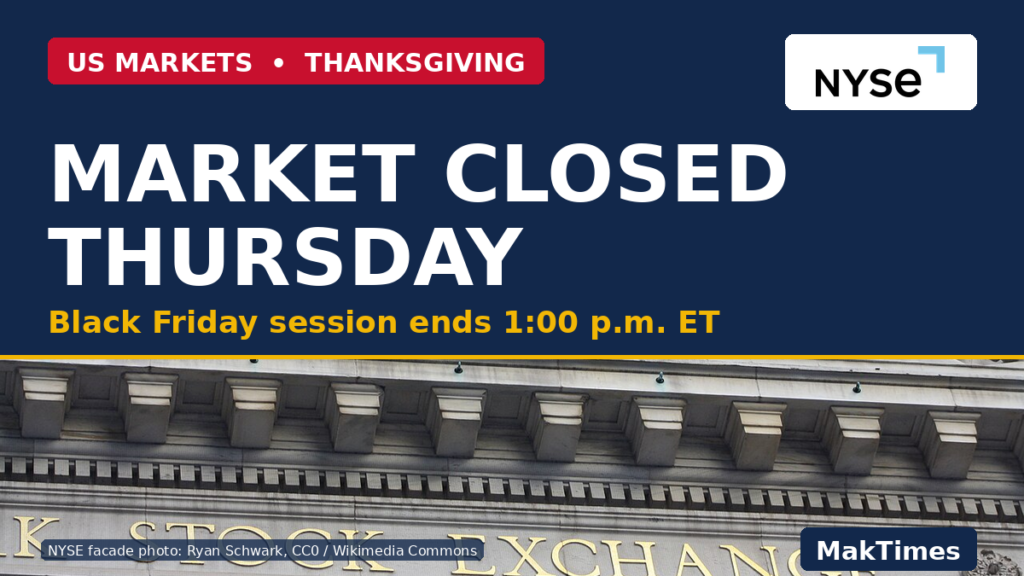
Thanksgiving week is the shortest trading week of the year on Wall Street, and it starts with a question every investor asks at least once: is the market open on Thanksgiving? The answer this year is no. The New York Stock Exchange and the Nasdaq both close on Thursday, November 26, 2026, and they reopen on Friday for a shortened session that ends at 1:00 p.m. Eastern.
That is the short version. The longer version matters more, because the week still has real market-moving data in it, the bond market keeps different hours from stocks, and one of the dates most people get wrong is still ahead — New Year’s Eve, which is a full trading day for stocks even though the bond market closes early.
This week’s trading hours at a glance
| Day | Date | Stocks (NYSE & Nasdaq) | Bonds |
|---|---|---|---|
| Monday | Nov 23 | 9:30 a.m.–4:00 p.m. ET, normal session | Normal hours |
| Tuesday | Nov 24 | 9:30 a.m.–4:00 p.m. ET, normal session | Normal hours |
| Wednesday | Nov 25 | 9:30 a.m.–4:00 p.m. ET, normal session | Normal hours |
| Thursday | Nov 26 | Closed — Thanksgiving | Closed |
| Friday | Nov 27 | 9:30 a.m.–1:00 p.m. ET, early close | Close 2:00 p.m. ET |
After the holiday break, full-length trading resumes on Monday, November 30.
Thursday: everything stops
Thanksgiving is one of the ten full holidays on the NYSE calendar, and the closure is total for cash equities. The NYSE and the Nasdaq do not trade at all on Thursday, November 26. The bond market is closed too, on the recommendation of the Securities Industry and Financial Markets Association (SIFMA).
Futures keep a different rhythm. CME equity-index futures halt at 1:00 p.m. ET on Thursday and reopen at 6:00 p.m. ET that evening, ahead of Friday’s session. Bitcoin, which trades around the clock and is not tied to exchange hours, is unaffected — though the thin liquidity of a holiday week can still show up in crypto prices.
Friday: a three-hour session
Black Friday is not a holiday for the exchanges. The market opens at the usual 9:30 a.m. ET and closes at 1:00 p.m. ET — three hours early. Eligible stock options trade until 1:15 p.m. ET, and the NYSE’s late trading sessions end at 5:00 p.m. instead of the usual 8:00 p.m.
The bond market gets one extra hour: SIFMA recommends a 2:00 p.m. ET close for US Treasuries and other fixed income on Friday.
Orders placed after Wednesday evening’s pre-open are generally treated as Friday trade-date orders, so anyone leaving a limit order in place over the holiday should check when it actually becomes live. A limit order left sitting through a three-hour session can easily go unfilled while liquidity drains away — that is the practical risk of the short day, and it catches people every year.
The data still lands before the holiday
The holiday does not pause the economic calendar. Wednesday, November 25, is the week’s busiest day for data, and it arrives before the market closes:
- 8:30 a.m. ET, Wednesday: the second estimate of third-quarter GDP and the October personal income and outlays report, which includes the PCE price index — the Federal Reserve’s preferred inflation gauge.
- 2:00 p.m. ET, Wednesday: the Fed’s Beige Book, its anecdotal survey of economic conditions across the twelve districts.
Both land on a full trading day, so the market gets a full session to react. After that, traders are on their own until Monday: no major data is scheduled for Friday’s shortened session. The data lands two weeks before the Fed’s next rate decision on December 9.
The rest of 2026: two more early closes, one common mistake
Thanksgiving is not the last disruption of the year. The remaining 2026 calendar looks like this:
| Date | Holiday | Stocks | Bonds |
|---|---|---|---|
| Thu, Dec 24 | Christmas Eve | Early close, 1:00 p.m. ET | Early close, 2:00 p.m. ET |
| Fri, Dec 25 | Christmas Day | Closed | Closed |
| Thu, Dec 31 | New Year’s Eve | Full session, 9:30 a.m.–4:00 p.m. ET | Early close, 2:00 p.m. ET |
| Fri, Jan 1, 2027 | New Year’s Day | Closed | Closed |
The date that trips people up is December 31. New Year’s Eve is a full, normal session for stocks — the NYSE keeps the market open at year-end even when New Year’s Day is the adjacent holiday, and the 4:00 p.m. closing auction sets the official year-end prices used for annual performance figures and index rebalances. Only the bond market closes early, at 2:00 p.m. ET. Several holiday-calendar pages list December 31 as an early close for stocks; the NYSE’s own calendar says otherwise.
In total, the NYSE and Nasdaq close for ten full holidays in 2026. The remaining early closes this year are just two: Friday, November 27, and Thursday, December 24.
Regular hours, pre-market and after-hours
Outside holidays, the regular session runs 9:30 a.m. to 4:00 p.m. Eastern, Monday to Friday, with weekends off. Around it, the extended sessions run on broker platforms: pre-market from 4:00 a.m. to 9:30 a.m. ET, and after-hours from 4:00 p.m. to 8:00 p.m. ET.
On early-close days those extended hours shrink too. After-hours trading ends at 5:00 p.m. ET on Friday, November 27, and on Christmas Eve. Which pre-market and after-hours sessions are available depends on the broker — not every platform offers the full window.
Why a short week still moves markets
A holiday week is quiet, but quiet is not the same as safe. Volume drops sharply when much of Wall Street is away, and thin volume means prices can move further on less news. Spreads widen, and a single large order can push a stock further than it would on a normal day. That is why the week’s real event — Wednesday’s GDP and PCE data — matters more than usual: it lands into a market that will then sit idle for a day and trade a three-hour session the day after, coming right after the market’s worst week since Covid.
None of that is a reason to trade or not to trade. It is simply how the calendar works, and knowing the hours before the week starts is the difference between planning around them and discovering them by accident.
Frequently asked questions
Is the stock market open on Thanksgiving 2026?
No. The NYSE and Nasdaq are closed all day on Thursday, November 26, 2026. The bond market is closed too.
Is the stock market open on Black Friday?
Yes, but only for a shortened session. Stocks trade from 9:30 a.m. to 1:00 p.m. ET on Friday, November 27, 2026. Bonds close at 2:00 p.m. ET.
Is the stock market open the day before Thanksgiving?
Yes. Wednesday, November 25, 2026, is a normal full trading day for stocks and bonds, 9:30 a.m. to 4:00 p.m. ET.
Does the stock market close early on New Year’s Eve?
No — not for stocks. December 31, 2026, is a full session, 9:30 a.m. to 4:00 p.m. ET. Only the bond market closes early, at 2:00 p.m. ET.
What time does the stock market open and close normally?
The regular session is 9:30 a.m. to 4:00 p.m. Eastern, Monday to Friday, excluding market holidays. Pre-market trading starts at 4:00 a.m. ET and after-hours runs to 8:00 p.m. ET on most brokers.
When is the next stock market holiday after Thanksgiving?
Christmas Day, Friday, December 25, 2026, when the market is closed all day. Christmas Eve, Thursday, December 24, is an early close at 1:00 p.m. ET.
Sources
- NYSE Group 2025–2027 Holiday & Early Closings Calendar, via Morningstar and Kiplinger (2026 holiday schedule; early closes November 27 and December 24; December 31 a full session for stocks)
- USA Today, “Is the stock market open on Thanksgiving, Black Friday?” (November 23, 2026 — Thanksgiving closure, Friday 1:00 p.m. close, bond market 2:00 p.m.)
- AARP, “Stock Market Holidays 2026” (Thanksgiving closure; early closes November 27 and December 24)
- SIFMA bond-market recommendations, via USA Today and Morningstar (bond early closes November 27, December 24 and December 31)
- CME Group holiday schedule, via Stopline Investor and QuantVPS (equity-index futures halt 1:00 p.m. ET Thursday, reopen 6:00 p.m. ET; early close Friday)
- Exent, “Stock Market Calendar November 2026” (PCE and GDP Wednesday, November 25, 8:30 a.m. ET; Fed Beige Book 2:00 p.m.)
Educational Content Only — Not Financial Advice: MakTimes is a news and education website. This article is published for general information and awareness only and is not financial, investment, trading, or legal advice. We are not financial advisors. Cryptocurrency, gold, and other markets are volatile and can result in loss. Always do your own research (DYOR) and consult a licensed financial advisor before making any financial decision. Past performance is not a guarantee of future results.