
Gas Prices in California: Why Drivers Pay America’s Highest Prices
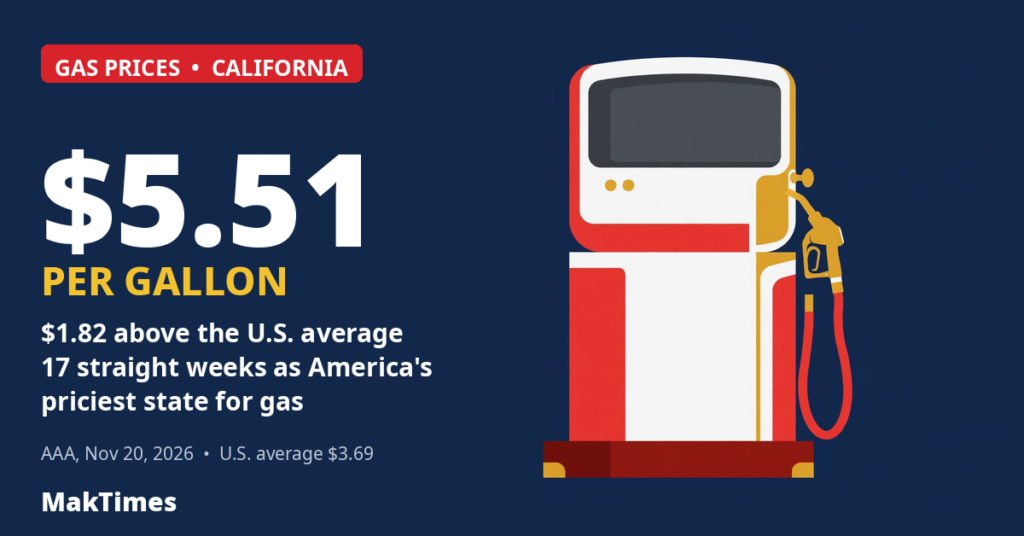
Fill up in California this week and the pump will show you a number that looks like a mistake. Regular gasoline averaged $5.51 a gallon in California on November 20, 2026, according to AAA. The national average that same day was $3.69. A California driver pays $1.82 more per gallon than the average American — for the same fuel, from the same crude oil, refined to nearly the same specification.
It is not a one-week blip. California held the most-expensive spot in the country for 17 straight weeks into mid-November, and in early October its average peaked at $6.23 a gallon — less than five cents below the all-time record of $6.27 set in June 2022. The gap is not an accident and it is not one thing. It is nine layers, stacked on top of each other, and two of the layers got dramatically worse in 2026.
The number, layer by layer
The California Energy Commission breaks the state’s monthly average pump price into nine parts. Three are market prices — what refiners pay for crude, the margin between crude and wholesale gasoline, and the margin between wholesale and the pump. Two are the costs of California’s carbon programmes. The last four are taxes and a fee.
Here is what a gallon bought in Los Angeles in October 2026 actually contained, using the CEC’s breakdown and the Tax Foundation’s 2026 figures:
- State excise tax: 63.4 cents. The highest in the nation. It rose from 61.2 cents on July 1, 2026, under a 2017 law that indexes it to inflation every July.
- Federal excise tax: 18.4 cents. The same in every state, unchanged since 1997.
- State and local sales tax: about 30 cents at $6 gas — California is one of the few states that charges sales tax on top of the excise tax.
- Underground storage tank fee: 2 cents.
- Cap-and-trade: about 23 cents at the allowance prices of early 2025, according to the Legislative Analyst’s Office — and potentially 74 cents if allowances ever hit the price ceiling.
- Low Carbon Fuel Standard: roughly 26 cents, the second carbon programme, which pushes refiners toward lower-carbon fuels and passes the cost through.
- The crude oil itself and the refining and retail margins: the rest.
Add the taxes and fees together and a Los Angeles driver pays roughly $1.55 a gallon before a single drop of fuel is counted. The Tax Foundation’s total for California’s state fuel taxes and fees is 73.6 cents a gallon, against a 33.6-cent average across the 50 states. California’s figure is the highest in the country — and it is more than double the national mean.
The refineries that closed
Taxes explain a permanent gap. They do not explain 2026. For that, look at the refineries.
California requires its own cleaner-burning blend of gasoline, set by the state Air Resources Board. Most refineries outside the state do not make it. There are no pipelines carrying gasoline from the big refining centres of Texas and the Gulf Coast. When California runs short, extra fuel has to arrive by tanker — often from Asia — and that takes weeks.
That supply has been shrinking fast. Phillips 66 stopped making fuel at its Los Angeles refinery in the fourth quarter of 2025. Then Valero shut its Benicia refinery in the Bay Area, with the cessation completed in April 2026. Together, those two plants made up about 17% of the state’s crude oil refining capacity, according to a May 2026 state report — some analysts put the figure at a fifth.
The timing could hardly have been worse. A conflict in the Middle East that began in late February 2026 cut oil flows through the Strait of Hormuz and the Bab al-Mandeb Strait, pushing crude prices up worldwide. The Energy Information Administration expects Brent crude to average about $105 a barrel in the last three months of 2026. Every American driver felt that. But California started from a much higher base — and with two fewer refineries to absorb the shock — which is why its prices broke $6 in October while the national average stayed near $4.30.
The California Energy Commission’s own price stack shows which layers moved when crude rose by nearly half in 2026, and which stayed put. The tax rows barely moved. The crude row and the refining margins did almost all of the work. In other words: the shock was global, but California’s market had the least slack to absorb it.
The “mystery surcharge”
There is one more layer, and it is the most argued-over number in California energy politics. In its October 2025 report, the state’s Division of Petroleum Market Oversight found that between 2015 and 2024, California drivers paid an average “mystery gasoline surcharge” of 41 cents per gallon above what the known costs explain — costing Californians $59 billion over the decade. The figure moved with the market, ranging from 27 to 62 cents a gallon in different years.
Nobody has a settled explanation for it. The division’s own report treats it as an unexplained premium. Refiners say it reflects the real costs of operating in an isolated market with no spare capacity. Critics say it reflects pricing power in a market with too few sellers. Either way, it is real money: roughly 41 cents on every gallon, every year, for a decade.
What it costs a family
The gap is easiest to feel in annual terms. On November 5, 2026, California averaged $5.83 a gallon and North Carolina $3.34 — a $2.49 spread. A driver covering 15,000 miles a year in a car that returns 25 miles per gallon burns 600 gallons. That spread is worth $1,494 a year on that mileage alone.
Thanksgiving week makes the timing sharp. AAA reported the national average at $3.81 on November 16, with California at $5.56 and Hawaii — the one state that edged ahead of California on the November 20 table, at $5.60 — just above it. Millions of Californians are driving to family this week, and every one of them is paying the premium at the pump.
There is a longer trend underneath the weekly numbers. The California Energy Commission expects the supply gap to grow over the foreseeable future, even as it projects gasoline demand will keep declining — electric vehicles took about 23% of all newly registered cars in the state in 2025. Fewer gasoline buyers, but also fewer refineries to serve them. Governor Gavin Newsom has urged the commission to coordinate with the remaining refineries and to build import infrastructure to fill the gap. The commission itself has warned lawmakers that the transition “is not going to be a smooth transition.”
Will it get better?
The honest answer is: not quickly. The two refineries are not coming back. The tax structure is set by law and rises every July. The carbon programmes are designed to get more expensive over time, not less. And the state has no pipeline to the Gulf Coast, so every supply crunch will keep arriving by tanker, weeks late.
What could change the picture is new import capacity — terminals that let California bring in finished gasoline faster when its own refineries falter — and, over the longer term, the steady shift to electric vehicles shrinking demand itself. But for the millions of Californians still driving petrol cars, the $1.80 premium over the rest of America is not a spike. It is the price of the market California built: the cleanest gasoline in the country, taxed the hardest, refined in the fewest plants, in the most isolated fuel market in the United States.
Frequently asked questions
How much is gas in California right now?
Regular gasoline averaged $5.51 a gallon in California on November 20, 2026 (AAA), against a $3.69 national average. Hawaii was marginally higher that day at $5.60.
Why is gas so expensive in California?
Three main reasons: the highest state fuel taxes in the country (73.6 cents a gallon in taxes and fees), two state carbon programmes (cap-and-trade and the Low Carbon Fuel Standard), and an isolated refining market that lost two refineries — Phillips 66 Los Angeles in late 2025 and Valero Benicia in April 2026 — about 17% of state capacity.
How much tax is on a gallon of gas in California?
About $1.55 a gallon in combined taxes and fees in Los Angeles: 63.4 cents state excise, 18.4 cents federal excise, about 30 cents in sales tax, plus carbon-programme costs passed through by refiners and a 2-cent storage fee.
What is the most expensive state for gas?
California held the top spot for 17 straight weeks into mid-November 2026. Hawaii edged ahead on the November 20 AAA table. The two states trade the top spot; the rest of the country is roughly $1.50–$2.00 behind both.
Did refinery closures cause the 2026 price spike?
They made it worse. The 2026 spike started with a global oil shock — the Middle East conflict and the Strait of Hormuz disruption — but California’s prices rose furthest because it had the least spare refining capacity after the Phillips 66 and Valero closures.
Will California gas prices come down?
Prices have eased from the October peak of $6.23, but the structural premium — taxes, carbon costs and tight refining capacity — is set by law and by plant closures, and the state expects the supply gap to grow. Short-term moves follow crude oil; the gap itself is likely to stay.
Fuel prices change daily. Figures in this article are AAA and EIA readings for the dates stated and will have moved since.
Educational Content Only — Not Financial Advice: MakTimes is a news and education website. This article is published for general information and awareness only and is not financial, investment, trading, or legal advice. We are not financial advisors. Markets are volatile and can result in loss. Always do your own research (DYOR) and consult a licensed financial advisor before making any financial decision. Past performance is not a guarantee of future results.
Sources
- AAA Fuel Prices — State Gas Price Averages (gasprices.aaa.com), November 19–21, 2026
- AAA Oregon — “National Average Price for Regular Gas Falls below $4 for First Time since July” (November 10, 2026)
- LendingTree — “Gas Prices Jump 28% in a Year; Diesel Soars 64%” (November 11, 2026, source: EIA and AAA)
- Energy Factbook — “Why Is Gas So Expensive in California?” and “How Much Is Gas in California?” (November 20, 2026; EIA weekly survey, Tax Foundation 2026)
- PetroEyes — “Why Is California Gas So Expensive? 2026 Layers” (November 2026; CEC price breakdown, EIA weekly series)
- Daily Telescope — “Los Angeles Gas Prices: Why They Are So High in 2026” (October 2026)
- Tax Foundation — state fuel taxes and fees, 2026 edition
- California Legislative Analyst’s Office — cap-and-trade cost estimate (May 2025)
- California Division of Petroleum Market Oversight — October 2025 report (“mystery gasoline surcharge”)
- Press-Telegram / Pacific Research Institute — refinery closures and capacity (2026)
- USA Today — “Gas prices are falling. Why Thanksgiving travel may still dip” (November 16, 2026)