
FOMC Meeting Schedule 2026: Every Fed Rate Decision Date, Plus the 2027 Calendar
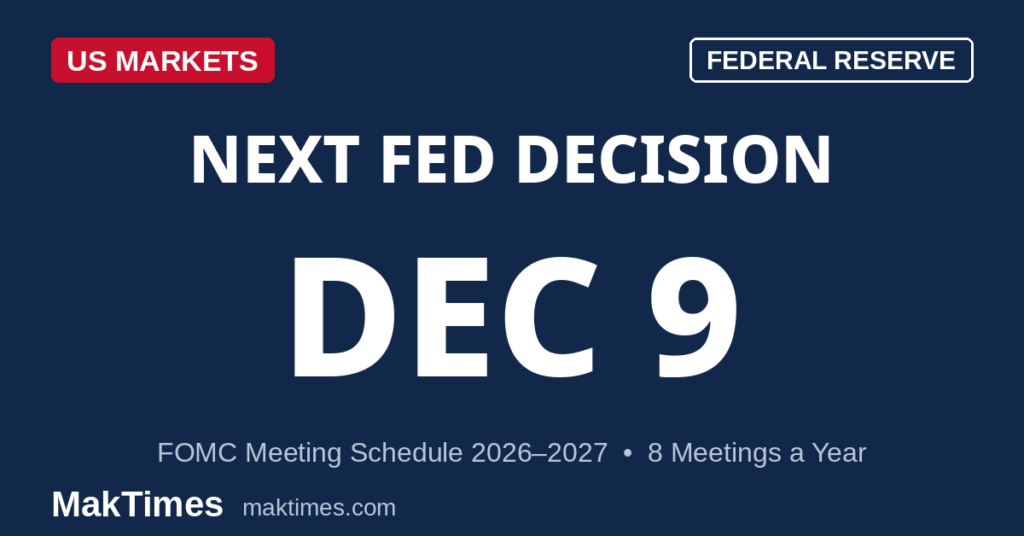
The FOMC meeting schedule for 2026 is nearly complete, with one date left on the calendar — and it is the one markets are watching most closely. The Federal Open Market Committee, the Fed’s rate-setting body, meets next on December 8–9, 2026, with its decision announced on Wednesday, December 9. Eight meetings a year, two days each, and a single announcement that can move stocks, gold, the dollar and mortgage rates within minutes: that rhythm is why the schedule itself is one of the most searched phrases in finance.
This guide lists every FOMC meeting date for 2026 and 2027, explains what the committee actually decides, and shows how to follow a decision day. The dates come from the Federal Reserve’s own meeting calendar, last updated in late October 2026. One caution up front: the Fed lists every future date as tentative until the committee confirms it at the meeting before.
FOMC Meeting Schedule 2026
The committee held eight scheduled meetings in 2026. Seven are done; the December meeting is the last of the year. Meetings marked with an asterisk include a Summary of Economic Projections — the officials’ forecasts and the famous “dot plot” of where each member expects rates to go.
| Meeting | Decision announced | Outcome | Federal funds rate after |
|---|---|---|---|
| January 27–28 | Wed, Jan 28 | Held | 3.50% – 3.75% |
| March 17–18* | Wed, Mar 18 | Held | 3.50% – 3.75% |
| April 28–29 | Wed, Apr 29 | Held | 3.50% – 3.75% |
| June 16–17* | Wed, Jun 17 | Held | 3.50% – 3.75% |
| July 28–29 | Wed, Jul 29 | Held | 3.50% – 3.75% |
| September 15–16* | Wed, Sep 16 | Raised 0.25 points | 3.75% – 4.00% |
| October 27–28 | Wed, Oct 28 | Held | 3.75% – 4.00% |
| December 8–9* | Wed, Dec 9 | Next meeting | — |
The story of 2026, in one line, is patience followed by a single move. For five straight meetings the committee held rates at 3.50% to 3.75%, with dissenters on both sides — some members wanted cuts, others wanted hikes, and the votes showed it. The September meeting finally produced a quarter-point increase, taking the target range to 3.75% to 4.00%, where it has stayed since. October’s vote to hold was 10–2, with two members still arguing for another rise.
That September hike is worth understanding because it ran against the script many investors expected. Through most of 2025 the market’s base case was cuts; instead, sticky inflation kept the committee cautious, and when it moved, it moved up. It is a useful reminder that the Fed’s calendar tells you when decisions happen, never what they will be.
FOMC Meeting Schedule 2027
The 2027 calendar follows the same pattern: eight two-day meetings, with economic projections at four of them. The Fed has also pencilled in a first meeting of 2028, on January 25–26.
| Meeting | Decision announced | Projections (SEP) |
|---|---|---|
| January 26–27 | Wed, Jan 27 | No |
| March 16–17 | Wed, Mar 17 | Yes |
| April 27–28 | Wed, Apr 28 | No |
| June 8–9 | Wed, Jun 9 | Yes |
| July 27–28 | Wed, Jul 28 | No |
| September 14–15 | Wed, Sep 15 | Yes |
| October 26–27 | Wed, Oct 27 | No |
| December 7–8 | Wed, Dec 8 | Yes |
Two details in the 2027 list are easy to miss. First, the June meeting falls unusually early — June 8–9, rather than the mid-June slot 2026 used. Second, there is no November meeting; the committee goes from late October straight to early December, the same gap it kept in 2026. If you are planning around Fed dates a year ahead — a mortgage decision, a business loan, a big investment — these are the dates to put in the calendar now, and to re-check against the Fed’s own page as each one approaches.
When Is the Next Fed Rate Decision?
The next Fed rate decision is on Wednesday, December 9, 2026, the second day of the December 8–9 meeting. The statement is released at 2:00 p.m. Eastern Time (midnight in Pakistan, 00:00 PKT on December 10), and the Fed Chair’s press conference follows at 2:30 p.m. Eastern. Because this is a projections meeting, the statement arrives alongside the Summary of Economic Projections and the dot plot — the two documents markets actually trade on, often more than the rate decision itself.
The question behind the question — “will they raise, cut, or hold?” — has no reliable answer in advance, and anyone selling one is selling a guess. What can be said: the rate stands at 3.75% to 4.00% after the September hike, October’s hold came with two dissenters wanting a rise, and inflation data between now and December 9 will matter more than any speech. Watch the data, not the predictions.
After December, the next decision falls on January 27, 2027. Between decisions, the record of what happened is published too: minutes of each meeting appear about three weeks later — the minutes of the October 27–28 meeting were released on November 18, 2026, and December’s minutes are due on December 30.
What the FOMC Actually Decides
The Federal Open Market Committee is the Fed’s monetary-policy arm: twelve people — the seven governors of the Federal Reserve Board, the president of the New York Fed, and four of the other eleven regional Fed presidents, rotating yearly — who set the target range for the federal funds rate. That rate is what banks charge each other for overnight loans, and it is the lever the Fed pulls to steer the whole economy.
The committee operates under a dual mandate from Congress: maximum employment and stable prices. In practice that means a constant balancing act. Cut rates too fast and inflation takes off; hold them too high for too long and jobs suffer. Every statement, every dot plot, every press-conference answer is the committee explaining which side of that balance worries it more right now.
The rate decision on its own is only one part of what happens that day. The statement is a few hundred words, and traders parse it like a legal text — a single changed adjective can move markets. Four times a year, the projections add the committee’s forecasts for growth, unemployment and inflation, plus the dot plot showing where each official thinks rates should be in the years ahead.
How a Fed Decision Moves Markets
A Fed decision is one of the few scheduled events that can move almost everything at once. The mechanics are straightforward, even if the outcomes never are.
Stocks: higher rates make borrowing costlier for companies and make future earnings worth less in today’s money, which tends to pressure share prices. Lower rates do the opposite. The September 2026 hike was followed by sharp falls in US indices — part of a broader sell-off, but the rate path was at the centre of it.
Gold: gold pays no interest, so when rates rise, holding gold costs more in forgone interest — that usually weighs on the price. When rates fall, or are expected to, gold tends to find buyers. The link is not iron-clad, but it is one of the most consistent relationships in markets, and it is why gold traders mark FOMC dates in red.
Bitcoin and crypto: crypto trades like a high-risk asset, and rate expectations drive risk appetite across the board. As hike expectations built through 2026, Bitcoin slid from its highs, falling below $56,000 by late November. Rate decisions do not determine crypto prices, but they set the weather crypto prices move in.
The dollar and mortgages: rate decisions feed into the dollar’s value against other currencies and, through bond yields, into mortgage rates. A single Fed meeting can shift the cost of a 30-year home loan by a visible amount within a day.
The honest caveat: markets move on the surprise relative to expectations, not on the decision itself. If everyone expects a hold and the Fed holds, very little happens. The violent moves come when the statement, the dots or the press conference say something nobody had priced in.
How to Follow a Fed Decision Day
You do not need a trading terminal. The routine that works:
- Morning of decision day: check what markets expect — the CME FedWatch tool is the standard reference.
- 2:00 p.m. Eastern (midnight PKT): the statement lands on federalreserve.gov. Read it yourself before reading anyone’s reaction; it is short, and the first paragraph tells you the decision.
- 2:00 p.m. Eastern, projections meetings: the Summary of Economic Projections and dot plot are published with the statement. Look at the median dot for next year first — that is the number markets will trade on.
For readers in Pakistan, the timing is awkward but manageable: the decision lands at midnight PKT, so the morning papers and market coverage will carry the full picture by the time the PSX opens.
Frequently Asked Questions
How many times does the FOMC meet each year?
Eight scheduled meetings, each lasting two days, with the decision announced on the second day. The committee can also meet unscheduled in an emergency — it did so during the 2008 crisis and the 2020 pandemic — but that is rare.
What is the dot plot?
A chart in the Summary of Economic Projections showing where each FOMC member expects the federal funds rate to be at the end of this year, next year, the year after, and in the longer run. Each dot is one official’s view, published anonymously. Markets treat the median dot as the committee’s best signal of the rate path.
Where can I check the official schedule?
The Federal Reserve publishes its meeting calendars at federalreserve.gov. Dates are listed as tentative until confirmed at the preceding meeting — check there before making any decision around a specific date.
What is the current federal funds rate?
3.75% to 4.00%, set at the September 15–16, 2026 meeting. The next decision is December 9, 2026.
Sources: Federal Reserve, FOMC meeting calendars and monetary policy statements (calendar last updated October 2026); CME FedWatch; Federal Reserve Beige Book schedule. Facts checked November 21, 2026.
Educational Content Only — Not Financial Advice: MakTimes is a news and education website. This article is published for general information and awareness only and is not financial, investment, trading, or legal advice. We are not financial advisors. Cryptocurrency, gold, and other markets are volatile and can result in loss. Always do your own research (DYOR) and consult a licensed financial advisor before making any financial decision. Past performance is not a guarantee of future results.