
S&P 500 Today: Index Heads for Seventh Straight Loss as Nasdaq Sinks 2% and Anthropic Slides 9%
The bleeding on Wall Street has not stopped. The S&P 500 fell again on Friday morning, putting the benchmark on course for a seventh straight daily loss — a run of declines Wall Street has not seen since the pandemic.
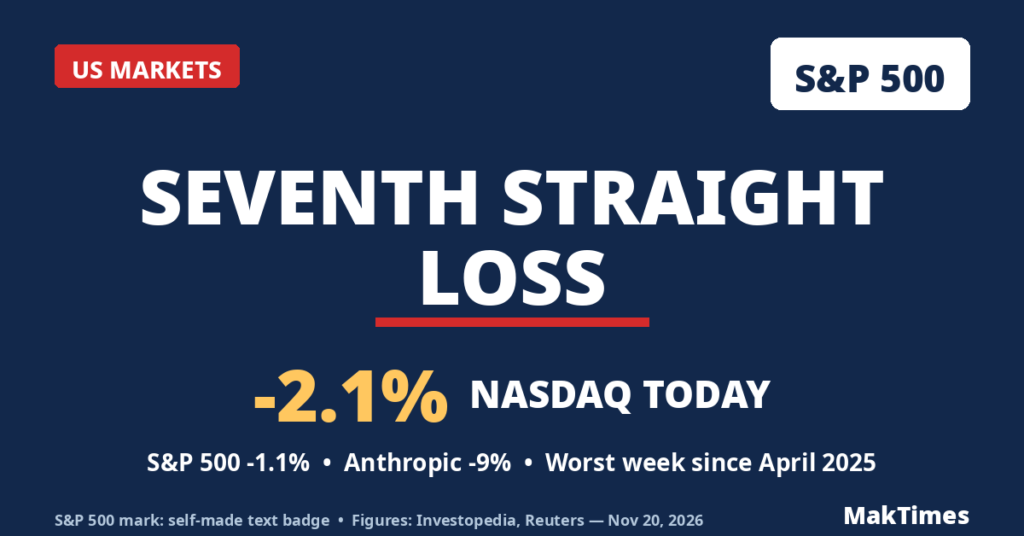
By late morning in New York, the S&P 500 was down about 1.1%. The Nasdaq Composite, heavy with the technology stocks that carried this year’s rally, was down roughly 2.1%. Only the Dow Jones Industrial Average held its ground, up about 0.1%.
Thursday had already been brutal. The S&P 500 dropped 2.02% to 7,175.83, its sixth consecutive loss and its longest losing run since 2024. The Dow crashed 1,101 points to 49,097, falling below 50,000 for the first time since June. The Nasdaq slid 2.25% to 23,879. And the fear gauge, the VIX, jumped nearly 16% in a single day to 28.44.
Friday’s selling has now pushed the indexes toward their worst week since April 2025, when President Donald Trump’s tariff announcement sent markets into a tailspin. Coming into the session, the S&P 500 and the Dow were each down about 5% for the week. The Nasdaq had given up more than 6%. At one point on Friday morning, the Nasdaq briefly slipped into negative territory for 2026.
Anthropic Gives Back Its Debut Gains
Not even the biggest public listing in history could steady the market. Anthropic, the maker of the Claude AI assistant, made its Nasdaq debut on Thursday in a record $81.3 billion offering. The shares opened at $111.50, well above the $83 offer price, touched $115, and closed at $97.17 — still up 17% on the day.
By Friday morning, the celebration was over. Anthropic shares were down about 9%, trading below $89. They had fallen as much as 13.5% before the market opened.
The pattern repeated all week: Nvidia’s blowout earnings and Anthropic’s historic debut both became chances to sell, not reasons to buy.
“When neither a blockbuster Nvidia beat nor the largest IPO in history can lift the tape, market psychology has fundamentally flipped from dip-buying to structural de-risking,” Tickmill strategist Patrick Munnelly wrote in a note on Friday.
The AI Trade Is Unwinding
The damage is concentrated where the gains were biggest. Chip stocks, the engine of the artificial intelligence rally, are leading the retreat.
Advanced Micro Devices fell 7.72% on Thursday to $489.19 after short-selling firm Hunterbrook Media published a report questioning the chipmaker’s business in China. Hunterbrook, which disclosed a short position in AMD, alleged that a blacklisted Chinese server maker, IEIT Systems, kept receiving newer versions of AMD firmware after the United States placed it on an export blacklist in March 2025. AMD rejected the claims, saying they misrepresented its business and that it complies with US export control laws. Reuters said it could not independently verify the report. AMD fell further in after-hours trading.
Nvidia extended its losses on Thursday, ending the session 3.3% lower. The chip giant’s shares have been under pressure all week since Jensen Huang resigned as chief executive. California’s attorney general has also opened a probe into whether the company misled investors, Dow Jones reported on Friday.
The selling crossed oceans overnight. Japan’s Nikkei 225 fell about 4.5%. South Korea’s Kospi lost about 5%. Taiwan and Hong Kong shares sank more than 5%. The MSCI Asia-Pacific index outside Japan is heading for its worst week since 2020, down roughly 8% over five sessions. In Europe, the continent’s most valuable company, Dutch chip equipment maker ASML, slid more than 5%. The Nasdaq’s correction from its October record high has now stretched past 15%.
Why the Selling Keeps Going
The trigger is not one headline. It is a pile of them.
Investors have spent weeks asking whether the enormous sums pouring into AI data centres, chips and electricity will turn into profits fast enough to justify the valuations. Nvidia’s earnings and Anthropic’s debut were supposed to answer that question. Both came and went. The market’s verdict was to keep selling.
Interest rates are adding to the pressure. Traders now price a near-certain rate rise from the Federal Reserve at its December meeting — rate futures put the chance of a 25-basis-point hike at 99.1%, according to Barchart. Federal Reserve Governor Christopher Waller had already made the case for a bigger, 50-basis-point move earlier in the week.
The economic data is not helping either. The Labor Department reported 203,000 Americans filed new jobless claims last week, slightly more than expected. The Philadelphia Federal Reserve’s manufacturing index fell to 6.3 in November, a six-month low and far below forecasts of 20.6.
Behind the headlines, market mechanics are making the fall steeper. Dealers hold options positions that force them to sell as prices drop — Tickmill put the figure at roughly $100 billion of mechanical selling for every 1% move in the S&P 500 below the 7,400–7,500 zone.
Gold Falls With Stocks
Even the usual shelters are not working. Gold, which investors normally buy when stocks fall, dropped to its lowest level in 14 months on Friday. Spot gold traded near $3,552 an ounce, down almost 9% for the week — its worst weekly performance in eight months.
A stronger dollar is part of the story. So is the prospect of higher US rates, which makes holding gold, which pays no interest, less attractive. But part of Friday’s selling was forced: investors facing losses in shares sold gold to raise cash and cover positions elsewhere.
The 10-year US Treasury yield, a benchmark for borrowing costs across the economy, fell to 4.99% as investors moved money into government bonds. Brent crude slipped 1.5% to $90.62 a barrel, despite the continued tension around the Strait of Hormuz.
What Comes Next
The market still has hours of trading left on Friday, and the session’s final numbers could look different from the morning’s. Investors will watch the University of Michigan’s final consumer sentiment reading, due later in the day, and remarks from two Federal Reserve governors.
Next week brings the US personal consumption expenditures inflation report — the Fed’s preferred measure of price rises — which will feed directly into the December rate decision. Thursday’s close also left the S&P 500 below its 200-day moving average, near 7,348, and about 8% below its October high.
For now, the pattern is clear. Six days of losses. A seventh in sight. And a market that, for the first time in months, is not buying the dip.
Sources: Investopedia, “Stock Market Today” (November 20, 2026); Reuters via Kitco, “Stocks slide as AI selloff deepens” (November 20, 2026); Zacks, “Stock Market News for Nov 20, 2026”; Barchart, “Nasdaq Futures Plunge as AI Selloff Rolls On” (November 20, 2026); Associated Press, “US stocks waver as tech sell-off continues” (November 20, 2026); Tickmill, “Daily Market Outlook, November 20, 2026.” Figures are intraday as of late Friday morning, US Eastern time, unless stated as Thursday’s close.
Educational Content Only — Not Financial Advice: MakTimes is a news and education website. This article is published for general information and awareness only and is not financial, investment, trading, or legal advice. We are not financial advisors. Cryptocurrency, gold, and other markets are volatile and can result in loss. Always do your own research (DYOR) and consult a licensed financial advisor before making any financial decision. Past performance is not a guarantee of future results.