
Anthropic Stock: ANT Opens at $111.50, Tops $2 Trillion, Then Closes at $97.17 on Record Debut
Anthropic stock did not ease into public life. It arrived.
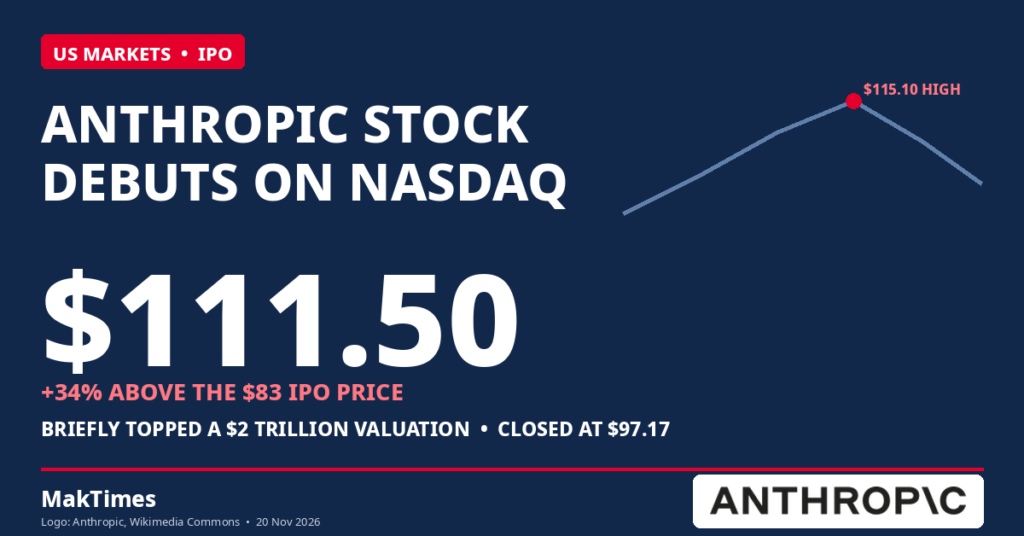
The first trade in ANT stock printed at $111.50 on the Nasdaq on Thursday, 34 percent above the $83 price set the night before. For a few dizzying minutes the company behind the Claude chatbot was worth $2 trillion. Then the air came out. By the closing bell the shares stood at $97.17 — still 17 percent above the offer price, still the biggest stock market debut anyone has ever seen, but a long way from the morning’s peak.
That swing, from euphoria to a cooler close, tells you most of what you need to know about this listing. Investors wanted in badly. They just were not sure what the right price was.
The biggest IPO in history, by a distance
Start with the scale, because it is genuinely hard to overstate. Anthropic sold 980 million shares at $83 each and raised about $81.3 billion — the largest headline IPO total on record, ahead of SpaceX’s $75 billion June listing before that deal’s over-allotment option took it higher.
The pricing itself had already told the story. Anthropic first talked about a range of $70 to $78 a share. Demand was so strong — orders ran to roughly seven times the shares on offer, as we reported ahead of the debut — that the final price came in above the top of that range. At $83, the fully diluted valuation sat near $1.5 trillion. At the $111.50 open, it crossed $2 trillion.
One hundred and eight million shares changed hands in the opening burst alone. Dario Amodei, the chief executive, rang the Nasdaq opening bell in Times Square alongside his sister Daniela Amodei, the company’s president, and the rest of the founding team. The ceremony was the easy part. What followed was a market trying to price a company that barely resembles anything listed before it.
How the first day actually played out
Trading began just before noon Eastern time, at 11:48 a.m., and the stock shot straight up. Within the first hour it touched $115.10, its high for the day. At that point ANT was up nearly 39 percent on its offer price, and the $2 trillion valuation was real, if only briefly.
Then the tape turned. The shares drifted through the afternoon, slipped below $100, and never really recovered their morning energy. They closed at $97.17.
Context matters here. Thursday was a rough day for the wider market. The Nasdaq Composite fell 2.25 percent to 23,879.20, and the S&P 500 and the Dow each lost about 2 percent. Thursday’s sell-off also dragged the Dow below 50,000. Anthropic was swimming against that current from the moment it opened. Chip stocks, including Nvidia and AMD, fell the same day. A debut that still closed 17 percent higher on a day like that is not a failure. It is a debut that ran into a bad market at exactly the wrong hour.
Why investors paid up — and why some held back
The case for paying up is written in Anthropic’s own filing. The company took in $33.2 billion of revenue in the first nine months of 2026, up 1,206 percent on the year before. That is not a typo. Demand for Claude, its AI assistant, has grown at a speed that makes even the boom years of the cloud era look sedate.
The case for caution is written in the same filing. Anthropic is still loss-making. Building and running the giant computing systems behind frontier AI costs staggering sums, and the company spends heavily to stay in the race with OpenAI and Google. Two of those rivals are also, awkwardly, its biggest backers: Amazon and Google together hold roughly 28 percent of the company, a web of interests that analysts will be picking apart for months.
That tension — explosive revenue growth on one side, heavy losses and enormous spending on the other — is what the first day’s trading actually priced. The morning said: this is the most important AI company to reach the public market. The afternoon said: at $2 trillion, the arithmetic gets hard.
Some of the market’s professional watchers said much the same thing in plainer terms. Analysts quoted in Thursday’s coverage urged investors not to rush into the shares on day one, arguing that the price would settle once the first-day excitement faded and the company’s next set of results gave the market something solid to work with.
What happens next for ANT stock
The mechanics are not finished yet. The offering itself is expected to close on Friday, November 20, with a separate $26 billion private placement closing immediately afterwards. That will put still more shares into circulation and give the company a war chest that few listed firms can match.
Then comes the index question. If ANT qualifies for early inclusion, it could join the Russell 1000 after the market closes on December 11 and the Nasdaq 100 before trading opens on December 21. Index membership matters because it forces the giant funds that track those benchmarks to buy the stock, whatever they think of the price.
Beyond that, the questions are the ones that will decide whether Thursday’s close was a bargain or a warning. Can Anthropic keep revenue growing anywhere near its current pace? Can it narrow its losses while still spending what it takes to compete? And can it do all of that while the biggest names in technology — some of them its own shareholders — are trying to build the same thing?
None of those questions has an answer yet. On a debut day, that is hardly surprising. What Thursday did settle is simpler: the biggest IPO in history found buyers, it found them at a price far above the offer, and it finished its first session worth about $1.77 trillion. The market’s argument about what Anthropic is really worth has only just begun.
Sources: The Wall Street Journal, Barron’s, MarketWatch, Fox Business, New York Post, AsiaToday, Finnhub market data — November 19–20, 2026.
Educational Content Only — Not Financial Advice: MakTimes is a news and education website. This article is published for general information and awareness only and is not financial, investment, trading, or legal advice. We are not financial advisors. Cryptocurrency, gold, and other markets are volatile and can result in loss. Always do your own research (DYOR) and consult a licensed financial advisor before making any financial decision. Past performance is not a guarantee of future results.