
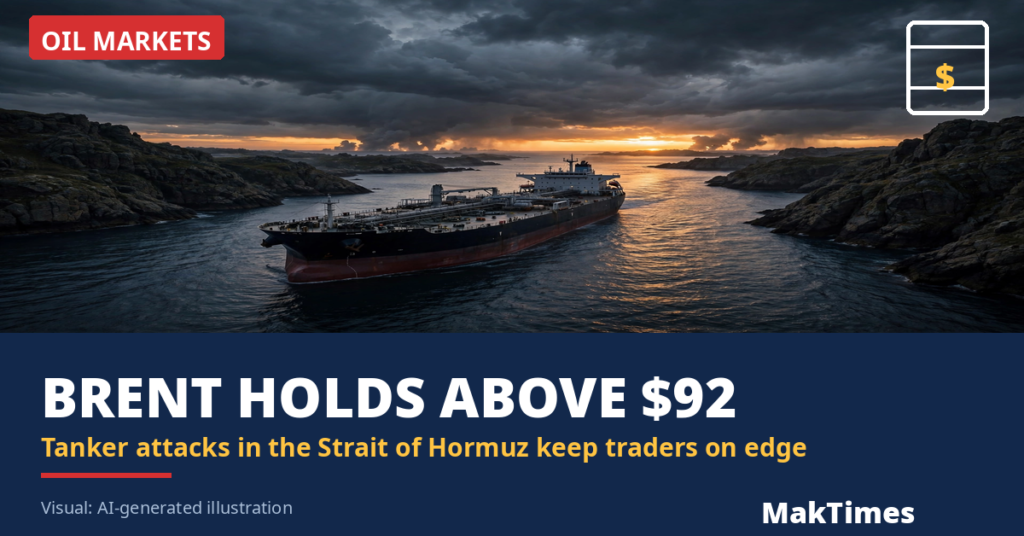
Oil Price Today: Brent Crude Holds Above $92 as Strait of Hormuz Attacks Keep Traders on Edge
Oil prices refused to fall on Wednesday, even as the market’s own numbers argued they should. Brent crude held above $92 a barrel through the Asian session, caught between two forces pulling in opposite directions: tankers burning in the Strait of Hormuz on one side, and swelling American stockpiles on the other.
The benchmark settled Tuesday at $93.14 a barrel, up 70 cents, after swinging through a range of about $3 in a single session. By Wednesday morning it had eased to around $92.53 — down roughly 0.7% — but the slide stopped there. US West Texas Intermediate, the American benchmark, closed Tuesday at $86.01 and traded near $84.77 in Asia, down about 1.4%.
That is a strange place for oil to sit. A month ago Brent was flirting with far lower levels. In November alone it is down about 20%. Yet it is still up more than 50% on the year. The market cannot decide whether the war premium or the glut matters more — and on Wednesday, neither side would give ground.
What happened in the Strait
Tuesday was the worst day yet for shipping in the world’s most important oil chokepoint. Iran’s Revolutionary Guard said its drones struck a US radar system at Sheikh Isa Air Base in Bahrain. Bahrain has now come under fire three times in under a week. American forces answered with strikes on a missile-launch site on Qeshm Island, the largest island in the strait.
Out at sea, the picture was worse. A tanker transiting the strait near Khasab, Oman, was hit twice. The second strike set it alight. One member of its 25-strong crew is unaccounted for, according to India’s foreign ministry. British maritime authorities, who track attacks in the region, have now logged seven incidents in or near the strait since November 10.
Yemen’s Houthi rebels added their own claim on Tuesday: five drones sent at two pumping stations along Saudi Arabia’s East-West pipeline, the artery that moves Saudi crude from the Gulf coast to the Red Sea.
The strait itself is the reason all of this moves markets. About one barrel in five of all the oil traded worldwide squeezes through a channel barely 21 miles across at its tightest point. When ships stop moving there — and ship-tracking data suggests traffic has yet to return to normal — every barrel in the world gets a little more expensive to insure, to ship, and to buy.
Why the price did not spike
Here is the part that surprises people who only follow the headlines. Seven attacks, a burning tanker, a third strike on Bahrain — and Brent still fell on Wednesday morning. The reason sits in a warehouse in America.
The American Petroleum Institute reported that US crude inventories rose by 5.28 million barrels in the week to November 13. Petrol stocks jumped 5.12 million barrels. Distillates rose too. Traders had expected a drawdown, or at least a small build. They got a flood.
That is not a one-week quirk. The Paris-based energy watchdog’s latest monthly report, published last week, has supply running ahead of demand in the last three months of 2026 — the first such gap since the conflict with Iran began. Goldman Sachs has gone further, forecasting a significant glut next year. The world, in other words, is producing more oil than it burns. Fighting can lift the price for a day. A glut caps it for a quarter.
So the market is stuck in a tug of war. Every headline from the Gulf pulls the price up; every inventory report drags it back down. Tuesday’s $3 swing was the rope snapping back and forth in real time.
What Pakistan should watch
For Pakistan, the arithmetic is direct. The country imports almost all the oil it burns, so Brent above $90 feeds straight into the import bill — and, with a lag, into pump prices. Petrol was cut by Rs3 a litre in the latest fortnightly review, with diesel unchanged, according to Dawn. That relief came from the November slide, not from anything that happened this week.
If Brent stays near current levels, the next review gets harder. If the strait worsens and the price jumps, it gets harder still. None of that is a forecast — it is how the pricing formula works. Pakistan buys oil in dollars, sells petrol in rupees, and every dollar on Brent shows up in the bill eventually.
The same tension runs through the wider economy. High oil prices push up transport costs, food prices and the current-account deficit, all at once. Low oil prices do the opposite. That is why a waterway 1,500 kilometres away matters to a commuter in Lahore.
What comes next
Two numbers land later today that could break the deadlock. The US Energy Information Administration releases its official weekly inventory report at 10:30 a.m. Eastern time. If it confirms the big stock build the industry figures showed, the glut argument gets stronger. The written record of the Fed’s late-October meeting is due at 2 p.m. Eastern. With bets on a December rate rise running high, anything in it that shifts the dollar shifts oil as well, because crude trades in dollars.
The shipping picture matters just as much. Seven attacks in eight days is a pattern, not a coincidence. Insurers and tanker owners watch the strait the way traders watch the price screen. If vessels keep getting hit, freight rates rise, fewer ships take the route, and the war premium grows — whatever the stockpiles say.
For now, oil sits in the middle of the argument. Above $92, but not running away. Falling, but not collapsing. The market has heard both stories, and it is waiting for one of them to win.
Sources: Reuters, November 18, 2026; Bloomberg, November 17, 2026; Business Post, November 18, 2026; Morningstar/Dow Jones, November 18, 2026; Dawn, November 18, 2026.
Educational Content Only — Not Financial Advice: MakTimes is a news and education website. This article is published for general information and awareness only and is not financial, investment, trading, or legal advice. We are not financial advisors. Cryptocurrency, gold, and other markets are volatile and can result in loss. Always do your own research (DYOR) and consult a licensed financial advisor before making any financial decision. Past performance is not a guarantee of future results.