
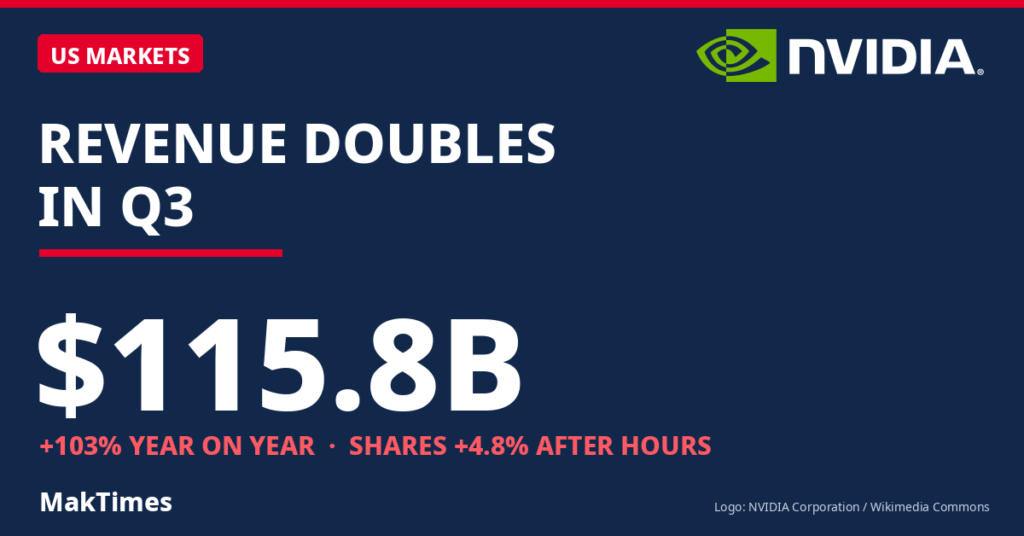
Nvidia Q3 Earnings Results: Revenue Doubles to $115.8 Billion as Shares Jump 5% After Hours
Nvidia Q3 earnings landed after the closing bell on Tuesday, and they were the kind of numbers that stop a sell-off in its tracks. Revenue more than doubled from a year ago, profit did the same, and shares climbed almost 5% in after-hours trading.
The headline number: $115.8 billion of revenue in the three months to October 25. A year ago the same quarter produced barely half that — revenue is up 103% year on year, 20% on the quarter before. Wall Street had pencilled in about $109.1 billion; Nvidia’s own August forecast was $108 billion. It beat both, and not by a little.
It was not a one-line beat — just about every number in the release came in ahead of what analysts had pencilled in, and the outlook did too.
Nvidia Q3 earnings in detail: the numbers that beat Wall Street
The data centre division carried the quarter on its own. Revenue there hit $107.6 billion — up 110% on a year ago, 21% on the quarter before, and well clear of the roughly $101.9 billion analysts expected. One division now brings in about 93 cents of every dollar Nvidia earns.
Earnings told the same story. Adjusted profit was $2.68 a share — analysts had pencilled in about $2.47 — and more than double the $1.30 of a year earlier. On the standard accounting measure, earnings were $2.70 a share. Net income hit $65.3 billion, up 105% from the same quarter last year.
Then came the guidance, and that is the part the market actually trades on. Nvidia put fourth-quarter revenue at about $130 billion, give or take 3%, where analysts had been looking for roughly $125 billion. The quarter has an extra week — 14 instead of 13 — but even allowing for that, the forecast sits ahead of consensus. Margins will give some of it back: 71% to 72% next quarter, against 74.8% in the one just reported.
Interim chief executive Colette Kress struck a steady note in the release. “Our momentum is real,” she said. “NVIDIA is an exceptional technology leader, powered by the relentless innovation of our people.” She also raised the company’s outlook for fiscal 2028 on the earnings call.
First report without Jensen Huang
Tuesday’s numbers were the first Nvidia has published since Jensen Huang resigned as chief executive on November 12. The quarter itself ended on October 25, so the figures cover a period when Huang was still in charge — only the report, and the forecast, came after his exit.
The finance chief for years, Kress now carries both roles — she stays on as CFO while serving as interim chief executive. Harvey Jones, a director for years, became the board’s first chair. On the call he was blunt: the board has no plans to bring Huang back. Huang, for his part, wrote to the board on Tuesday offering to return, according to reports.
What the numbers showed, though, was a business that kept selling at full speed while the boardroom changed around it. Nvidia also said its next-generation Vera Rubin NVL72 systems began shipping.
The $130 billion guide — and the China hole in it
Buried in the outlook is one line worth pausing on: the $130 billion forecast assumes zero data centre compute revenue from China. None.
Kress was plain about it on the call: Nvidia took $2.4 billion from licensed chip sales into China during the quarter, and those shipments — the H200 chip included — have now stopped as Washington tightens the export rules. The company is, in effect, writing its second-biggest market out of its own forecast — and still guiding above what Wall Street expected.
A gamble, in other words. Demand everywhere else has to fill the hole, and this quarter suggests it can — data centre sales outgrew the company as a whole. The price shows up in margins: 71% to 72% next quarter, three to four points below the 74.9% adjusted figure just reported.
Why a record quarter only lifted the stock 5%
Here is the puzzle: Nvidia beat on revenue, earnings, margins and guidance, and the stock still only rose about 5% after hours.
The shares had been in freefall. Six straight weekly falls before Tuesday — the worst run since 2012 — and a regular-session close of $155.46, down 0.44% on the day. They are still roughly 35% below the October peak near $240. The rest of the market offered no cover: the Dow lost 1.64% on Tuesday, the S&P 500 1.03%, the Nasdaq 0.74%.
Minutes after the release, the stock jumped to $161.70, up 4%. It handed back more than half of that before the 5 p.m. call, then climbed again late in the call to finish after-hours trading near $162.95 — up 4.8% on the close. After-hours trading is thin, so every move looks bigger than it is. Even so, the first verdict was relief, not euphoria.
Part of the caution is the leadership question, which no set of numbers can answer. A company synonymous with one founder for three decades is now run by an interim chief executive while the board hunts for a permanent one. Investors bought the quarter; whether they buy the next chapter depends on who runs it.
What comes next
The cleaner verdict comes on Wednesday, when the full market — not just the after-hours crowd — gets its say. Nvidia’s own trajectory also feeds straight into the week’s other big market event: Anthropic, the AI company behind the Claude models, is expected to price its initial public offering on Wednesday ahead of a Nasdaq debut on Thursday, with orders reported at around seven times the shares on offer.
For now, the quarter says one thing plainly: demand for AI computing kept growing through the most turbulent fortnight in Nvidia’s recent history. A founder’s exit. A board investigation. Export curbs tightening. A stock in freefall. The demand kept growing anyway.
Sources: Nvidia Q3 fiscal 2027 earnings release, November 17, 2026; Reuters; CNBC; Zacks; Motley Fool; Yahoo Finance.
Educational Content Only — Not Financial Advice: MakTimes is a news and education website. This article is published for general information and awareness only and is not financial, investment, trading, or legal advice. We are not financial advisors. Cryptocurrency, gold, and other markets are volatile and can result in loss. Always do your own research (DYOR) and consult a licensed financial advisor before making any financial decision. Past performance is not a guarantee of future results.