
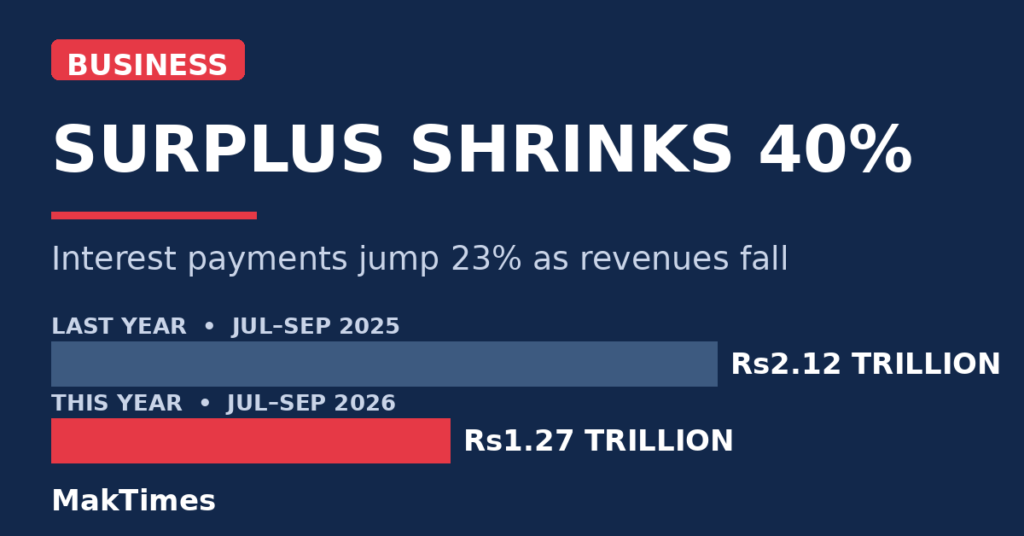
Pakistan Fiscal Surplus Shrinks 40% to Rs1.27 Trillion as Interest Payments Jump 23%
Pakistan’s fiscal surplus shrank by 40% in the first three months of the current financial year, falling to Rs1.27 trillion as a sharply higher interest bill and weaker revenues squeezed the government’s books, Finance Ministry data published on November 14 shows.
The surplus for July to September — the first quarter of fiscal year 2026-27 — came in at 0.9% of gross domestic product, down from 1.7% in the same quarter last year, when it stood at Rs2.12 trillion. Roughly Rs850 billion of surplus has disappeared in twelve months.
It is still a surplus. But the direction is what will concern Islamabad — and the International Monetary Fund, whose board is expected to decide Pakistan’s next loan payment in December.
The interest bill did the damage
Interest payments were the single biggest weight on the quarter. They rose by more than 23% to Rs1.7 trillion, swallowing a far larger share of everything the government collected than they did a year ago.
The State Bank raised its policy rate by 100 basis points in May 2026, and dearer money feeds straight into what the government pays to service its large stock of domestic debt.
Total revenue, meanwhile, slipped to Rs6.004 trillion from Rs6.2 trillion a year earlier even though tax collection grew. The gap narrowed from both sides at once, and the surplus took the hit.
Strip out interest payments and the picture looks steadier. The primary surplus — revenue minus spending before debt servicing — stood at Rs2.97 trillion, or 2.1% of GDP, down from 2.8% last year but slightly above the 2.0% full-year target agreed with the IMF.
Revenue fell even as tax collection rose
The tax side of the story is a study in contrasts. The Federal Board of Revenue finished the quarter marginally ahead of its target, collecting about Rs30.5 billion more than planned, and quarterly tax collection grew about 7% to Rs3.09 trillion.
Then October arrived, and the cushion vanished. The FBR collected Rs1.003 trillion in October against a monthly target of Rs1.131 trillion — a shortfall of Rs127.4 billion in a single month.
That October miss is the number that will linger: if the shortfall becomes a pattern, the full-year IMF targets start to look fragile.
The finance minister, Muhammad Aurangzeb, says Pakistan has satisfied three of the four fiscal benchmarks attached to the IMF programme. The December board meeting now hangs on whether revenue can recover before the Fund sits down to decide on about $1.2 billion in loan tranches.
The central bank profit that flattered the numbers
One figure did a lot of quiet work in the quarter’s accounts: the State Bank of Pakistan’s annual profit. The government books the central bank’s profit in full during the first quarter, and this year it came to just over Rs1.9 trillion.
Even that prop was smaller than last year’s — roughly 20% lower than the amount booked a year earlier. So the surplus had less help from the central bank this time, and still came in 40% lower.
The July-to-September quarter usually looks better than the rest of the year because the central bank profit lands in it. A surplus that shrinks 40% in the flattered quarter is a warning about the three quarters that follow, when no such windfall arrives.
December brings the IMF test
The timing could hardly be tighter. The IMF Executive Board is tentatively expected to meet in December to consider about $1.2 billion in tranches, and the first-quarter numbers land on the Fund’s desk just weeks before that meeting.
Pakistan closed the last financial year, FY26, with its budget deficit contained at 2.6% of GDP — the lowest in 22 years. Brokerage forecasts put the FY27 deficit at 3.6% of GDP, with the primary surplus at 2.0%, in line with the IMF target.
Hitting those full-year numbers now depends on interest costs easing as the rate cycle turns and tax collection recovering from its October stumble. Neither is guaranteed.
The government is also courting foreign capital on other fronts — 13 mining and minerals deals were signed at the Pakistan Minerals Investment Forum 2026 in Islamabad this week.
One bright spot: a $3 billion Eurobond issue in September helped deliver an overall balance-of-payments surplus of $3.1 billion against a deficit of $274 million a year earlier. The current account gap, though, grew to $874 million, up from $755 million a year earlier.
What it means for households and businesses
For ordinary Pakistanis, a shrinking fiscal surplus is not abstract. It shapes what the government can afford — and what it may have to raise.
Equity investors have been watching the fiscal picture too — the KSE-100’s record rally past 179,000 earlier in November showed the market still backing Pakistan’s recovery story.
A government paying Rs1.7 trillion in interest in one quarter has less room for relief on energy bills or development spending, and more reason to lean on taxation. When the FBR misses a monthly target by Rs127 billion, the usual response is tighter enforcement and fresh revenue measures — which land on businesses and salaried households.
The December IMF decision matters for the same reason: a smooth board meeting keeps the programme and external financing on track, while a delay or tougher review would tighten the screws on the rupee, borrowing costs and spending room.
None of that is decided yet: the primary surplus is still above the IMF’s target and the Eurobond showed investors are willing to lend. But the message is plain — the cushion is thinning, and the next two months will decide whether this was a wobble or the start of a slide.
Frequently asked questions
What is a fiscal surplus? It is the amount by which a government’s total revenue exceeds its total spending. Pakistan’s surplus of Rs1.27 trillion means the state took in that much more than it spent between July and September 2026.
What is the primary surplus, and why does the IMF watch it? It strips out interest payments on past borrowing, showing whether day-to-day finances balance before debt costs. Pakistan’s 2.1% of GDP sits slightly above the Fund’s 2.0% target for FY27.
Why did the surplus fall if tax collection grew? Because the two biggest forces moved against the government at once: total revenue fell as the central bank’s profit shrank by about 20%, while interest payments jumped more than 23% after the May rate hike. Tax growth of about 7% could not offset both.
Sources: Dawn, November 14, 2026; Focus Pakistan, November 13, 2026; Pakistan Business News, November 13, 2026; Ministry of Finance consolidated fiscal summary, November 14, 2026.
Educational Content Only — Not Financial Advice: MakTimes is a news and education website. This article is published for general information and awareness only and is not financial, investment, trading, or legal advice. We are not financial advisors. Cryptocurrency, gold, and other markets are volatile and can result in loss. Always do your own research (DYOR) and consult a licensed financial advisor before making any financial decision. Past performance is not a guarantee of future results.
Pingback: Cashless Pakistan: Government Cheques End Today as Raast Takes Over, Digital Payments Hit 11.3 Billion - MakTimes