
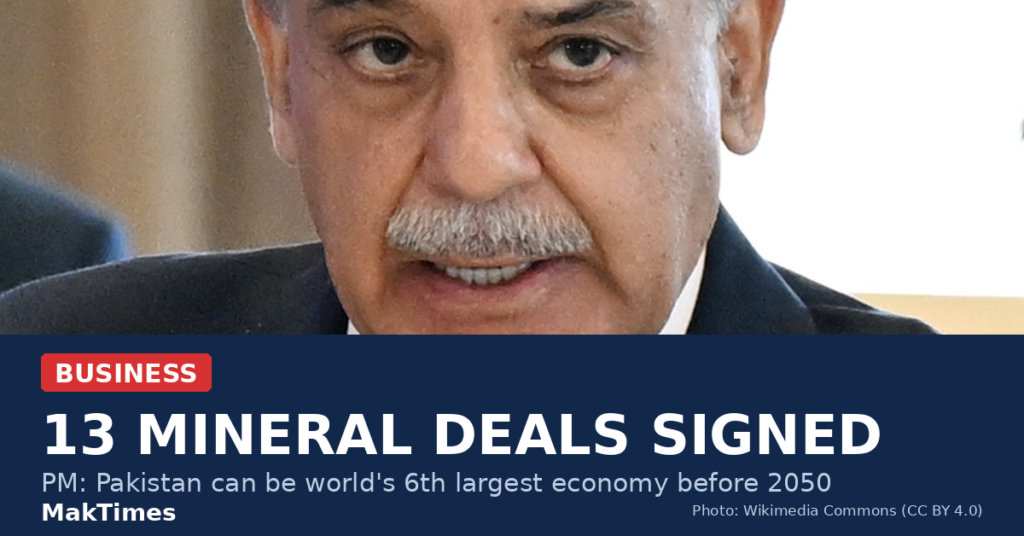
Pakistan Minerals Investment Forum 2026: 13 Deals Signed as PM Targets 6th Largest Economy Before 2050
Pakistan signed 13 mineral deals with international companies this week, closing a two-day investment forum in Islamabad that drew more than 10,000 participants from over 60 countries. Prime Minister Shehbaz Sharif used the closing session to make the boldest economic claim of his government so far: Pakistan, he said, could become one of the world’s major economies before 2050.
The claim rests on a Goldman Sachs projection. The bank’s long-range assessment puts Pakistan as the world’s sixth-largest economy by 2075. Sharif told the forum he wanted to amend that date. “Instead of 2075, it will be earlier than 2050,” he said, according to reports from the event. It was a confident line, delivered to a hall full of mining executives, diplomats and investors. Whether the timeline holds is another matter. What the forum did produce, in concrete terms, was paper: 13 agreements and memorandums of understanding, a string of investment announcements, and a government promise to stop shipping raw minerals abroad and start processing them at home.
What was actually signed
The 13 deals cover mineral exploration, investment, geological surveys and work linked to existing mining licences, according to Ahmed Hayat Lak, managing director of the Oil and Gas Development Company and president of the forum. He confirmed the number to Arab News on the sidelines of the event. Their combined financial value was not disclosed, which is worth noting: a memorandum of understanding is a statement of intent, not a cheque.
The most eye-catching single agreement came from the United States. Ivanhoe Atlantic, the strategic metals company run by billionaire Robert Friedland, signed a memorandum of understanding with Mari Minerals, a subsidiary of the listed Pakistani energy firm Mari Energies, to explore for copper and gold in Balochistan. Friedland announced the deal on Thursday, on the sidelines of the forum, and said the company was opening a local office and expected to sign a second agreement the following day. The memorandum is non-binding, and the two sides still have to negotiate final agreements, win regulatory approvals and transfer exploration licences.
Two domestic announcements carried hard numbers. National Resources Limited said it would invest $100 million in Pakistan’s mineral sector. And the Frontier Works Organization announced an estimated 350 million tonnes of copper in the Dasht-e-Kain area of Chagai, based on roughly half of its drilling data analysed so far. Mari Minerals separately announced what it called its first-ever gold and copper discovery in Chagai, citing potential resources of around one billion tonnes of copper and gold. Punjab’s chief minister, Maryam Nawaz, told the forum that significant placer gold had been found in the province’s rivers, while Punjab also cited 261.5 million tonnes of iron ore at Chiniot.
Reko Diq is the centrepiece
Everything at the forum circled back to one project. Reko Diq, in Balochistan’s Chagai district, is one of the largest undeveloped copper and gold deposits in the world, and it has been stalled for the better part of two decades. Sharif told the forum it was now moving towards practical completion and the operational phase.
The numbers behind it are large. The deposit’s indicated resources hold roughly 17 million tonnes of copper and 29 million ounces of gold, according to Ivanhoe Atlantic’s own release. Canada’s Barrick Mining holds a 50 per cent stake and leads the development alongside the federal government and Balochistan. With multilateral financing secured and major equipment contracts signed, first production is expected by late 2028, at around 200,000 tonnes of copper a year plus significant gold output. A $1.25 billion US-backed financing package has been approved for the project, and the Asian Development Bank has approved a $410 million support package.
Barrick’s global chairman, John Thornton, attended the forum, met Pakistani officials and delivered a keynote address, reaffirming the company’s commitment to the project. The company also told the government it was interested in investing in mineral processing industries in Karachi and Gwadar, extending its involvement beyond the mine itself.
The pitch: process it at home
The government’s message at the forum was consistent, and it came from both the prime minister and the army chief. Pakistan will not keep exporting raw ore. It will refine and process minerals at home, turning them into finished and semi-finished products before they leave the country.
Sharif framed it as a question of value. Domestic processing, he said, would create jobs, build technical expertise, bring in technology and increase the economic return from the country’s mineral wealth. Field Marshal Syed Asim Munir, the chief of defence forces and army chief, made the same point in blunter terms: Pakistan should build the complete mineral value chain domestically, including refining and manufacturing, and the communities in mineral-rich regions must directly benefit. His message was that the country had to move beyond potential and promises — turning its minerals into finished goods at home instead of shipping raw rock abroad.
The prime minister also gave investors a personal assurance on security, telling them: “Your safety is our safety.” Balochistan has pledged a new Frontier Constabulary division to protect investors, and the forum heard that formal security guarantees would be extended to foreign operators.
Infrastructure sits underneath all of it. Petroleum Minister Ali Pervaiz Malik told the forum that finding a deposit was only the first step, and that a commercially viable mine needed electricity, water, roads, railways and access to international markets. He pointed to the planned upgrade of the Rohri–Nokundi railway corridor and connectivity to Port Qasim as the links that would connect mineral-producing areas with global markets. The prime minister and the army chief also inaugurated the National Minerals Data Centre and the Geological Survey of Pakistan’s GeoPortal, digital platforms meant to give investors open access to geological data and cut the uncertainty that has long put them off.
Why sceptics will wait for proof
There are good reasons to treat the forum’s announcements as a beginning rather than a result. Barrick said earlier this year that it would slow development of Reko Diq and extend its review of the project until mid-2027, citing escalating security concerns in Pakistan and the wider region. That review is still running. The 13 agreements are memorandums and early-stage deals, not completed investments, and their combined value has not been published. And the forum’s own sessions acknowledged the constraints: security, provincial consent, and transport links such as the Nokundi–Gwadar corridor all have to be resolved before any of this turns into revenue.
None of that makes the forum unimportant. It was the third edition of the event, it drew participants from more than 60 countries, and the next one is already scheduled for November 2027. The direction of travel is clear enough: the government wants minerals to become a pillar of the economy, alongside the export and energy stories that have dominated recent headlines, from the PSX rally that pushed the KSE-100 past 179,000 to the country’s push for clean-energy investment at COP31.
What it could mean for ordinary Pakistanis
For most people, the value of a mineral deal is not measured in tonnes of copper. It is measured in jobs in Balochistan and Gilgit-Baltistan, in export earnings that ease pressure on the rupee, and in whether the wealth stays in the country instead of leaving as raw rock. That is the test Sharif and Munir both set for the sector: local processing, local jobs, and communities in mining areas seeing the benefit first.
The forum has given Pakistan’s minerals story a global audience. The hard part, as ever, is the execution — turning 13 signed documents into mines, plants, railways and pay cheques. The next twelve months, and the next edition of the forum in November 2027, will show whether this week’s promises hold.
Sources: The News, The Standard, Pak Observer, Arab News, Mining.com, The Northern Miner, Pakistan TV, Business Recorder, 13–14 November 2026.
Educational Content Only — Not Financial Advice: MakTimes is a news and education website. This article is published for general information and awareness only and is not financial, investment, trading, or legal advice. We are not financial advisors. Cryptocurrency, gold, and other markets are volatile and can result in loss. Always do your own research (DYOR) and consult a licensed financial advisor before making any financial decision. Past performance is not a guarantee of future results.