
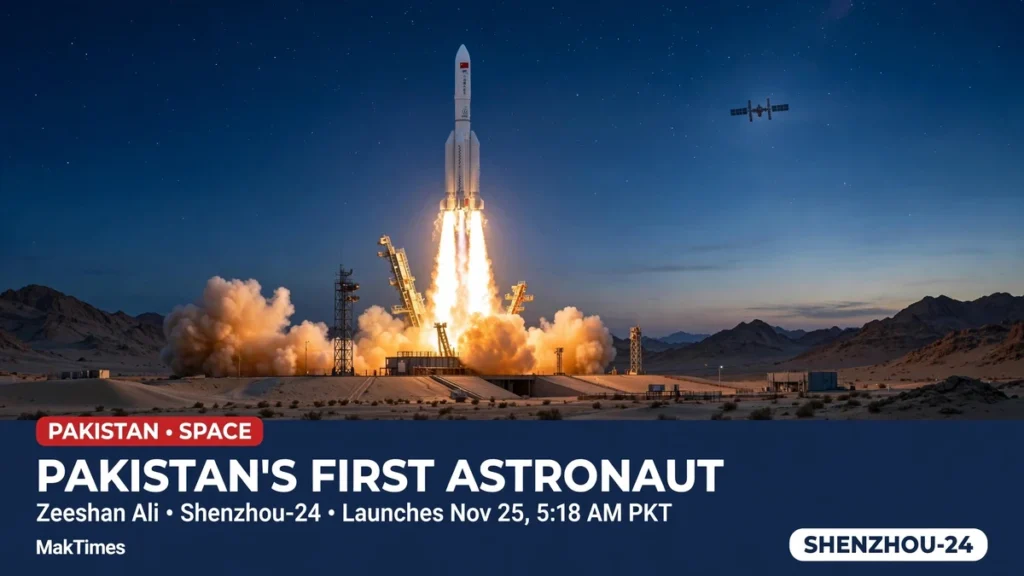
Pakistan’s First Astronaut: Zeeshan Ali to Fly to China’s Tiangong Space Station on November 25
Pakistan’s first astronaut has a name, a seat and a launch time. Wing Commander Muhammad Zeeshan Ali, 40, will ride China’s Shenzhou-24 spacecraft to the Tiangong space station on Wednesday morning, November 25 — a double first: no Pakistani has ever flown to orbit, and no guest from another country has ever boarded the Chinese station.
China’s space agency named the crew on Tuesday, a day before liftoff, following the tradition of its crewed programme. According to the China Manned Space Agency, liftoff is set for 8:18 a.m. Beijing time — 5:18 a.m. in Pakistan — from the Jiuquan Satellite Launch Center in the country’s north-west. Ali will fly as a payload specialist alongside commander Tang Hongbo, 51, and flight engineer Wu Yi, 39, aboard a Long March 2F rocket.
For Pakistan, the moment has been nearly two years in the making. It is also a first for China: in more than three decades of crewed flight, no foreign astronaut has ever boarded one of its stations. That changes on Wednesday, with a Pakistani in the third seat.
The crew named a day before launch
Tang Hongbo is the veteran of the trio. The major general has flown to Tiangong twice before, on Shenzhou-12 and Shenzhou-17, and this mission will make him the first Chinese astronaut to visit the station three times. Wu Yi, a colonel, is making his first spaceflight as the mission’s flight engineer.
Ali is the newcomer in every sense. A Pakistan Air Force wing commander, he was one of two Pakistani pilots chosen in April 2026 after a selection process that ran through three stages and began with around 20 finalists. The other candidate, Pakistan Navy pilot Khurram Daud, trained alongside him in Beijing and will serve as his backup.
Both men spent months at the Astronaut Centre of China, where their preparation included centrifuge runs, low-pressure chamber assessments, weightlessness adaptation exercises and orbital systems coursework — along with mandatory Mandarin language instruction. Prime Minister Shehbaz Sharif met the pair in April, days after they were publicly named as the two finalists.
The timing was no surprise to Islamabad. Planning Minister Ahsan Iqbal had said in October that the mission would fly on November 25, and he has travelled to Beijing for the departure ceremony. The spacecraft and its rocket were moved to the launch pad on November 17, and the crew completed a joint launch rehearsal at Jiuquan on November 22.
A week in orbit — and a different ride home
Ali’s stay will be short, but it is not a sightseeing trip. He will spend about a week aboard Tiangong working as a payload specialist — the crew member responsible for scientific experiments rather than flying the spacecraft.
Pakistan’s space agency, SUPARCO, says he will work on four research payloads chosen from more than 300 proposals submitted by universities and research institutions across Pakistan. The experiments are in biotechnology and related fields, designed to take advantage of the microgravity environment aboard the station — the kind of work that is difficult or impossible to run under normal gravity on Earth.
The return journey is where the plan gets unusual. Ali will not come home on the spacecraft that carries him up. After his week aboard the station, he will return to Earth aboard Shenzhou-23, the vehicle that has been docked at Tiangong since May, travelling back with two of its crew members, Zhang Zhiyuan and Li Jiaying. The swap is part of a crew rotation: Tang and Wu will stay on for a six-month tour, while Ali’s short visit overlaps with the outgoing crew’s departure.
Tiangong itself orbits roughly 400 kilometres above Earth. The station has three modules — Tianhe, Wentian and Mengtian — weighs about 77 metric tons and has been operating since 2021. Shenzhou-24 is China’s 18th crewed spaceflight and the 24th flight of the Shenzhou programme.
Two years in the making
Ali’s seat traces back to a deal struck in Islamabad on February 28, 2025: SUPARCO and the China Manned Space Engineering Office agreed that China would pick and train Pakistani astronauts for flights to Tiangong. The China Manned Space Agency confirmed on November 7 that a Pakistani payload specialist would fly on Shenzhou-24, and China’s foreign ministry confirmed the arrangement two days later.
Even the mission’s emblem carries the partnership. The Shenzhou-24 insignia features jasmine, Pakistan’s national flower, alongside the mission’s designation — a small detail, but one that was not lost on the crowds following the announcement in Pakistan on Tuesday.
For SUPARCO, the flight is the first time a Pakistani national travels to space under the country’s own human spaceflight programme. It opens a new chapter for an agency that has spent decades launching satellites and now, for the first time, has one of its own in orbit.
A first, with one footnote
The headlines will call Ali Pakistan’s first astronaut, and in the sense that matters most, he is: the first Pakistani to fly to orbit, the first to live and work aboard a space station, and the first to do it as a professional astronaut under his country’s own programme.
There is one footnote worth keeping straight. A Pakistani has been to space before, in a different sense of the word. Namira Salim, a Pakistan-born explorer, flew to the edge of space on a Virgin Galactic suborbital flight in 2023 — a trip of a few minutes above the atmosphere, with no orbit and no station. Ali’s flight is different in kind: a launch to orbit, a week of scientific work 400 kilometres up, and a return aboard a second spacecraft.
That distinction is exactly why the mission matters beyond the symbolism. Pakistan is not buying a seat for a photograph. It is sending a trained pilot to run its own experiments on someone else’s station, and bringing the experience home. For a country whose space programme has long worked in the shadow of its satellites, Wednesday morning is the day it finally puts a person up there.
Sources: Associated Press, November 24, 2026; Reuters, November 24, 2026; Xinhua / China Manned Space Agency, November 24, 2026; Dawn, November 24, 2026; China Daily Asia, November 24, 2026; Space.com via The Daily CPEC, November 2026.